
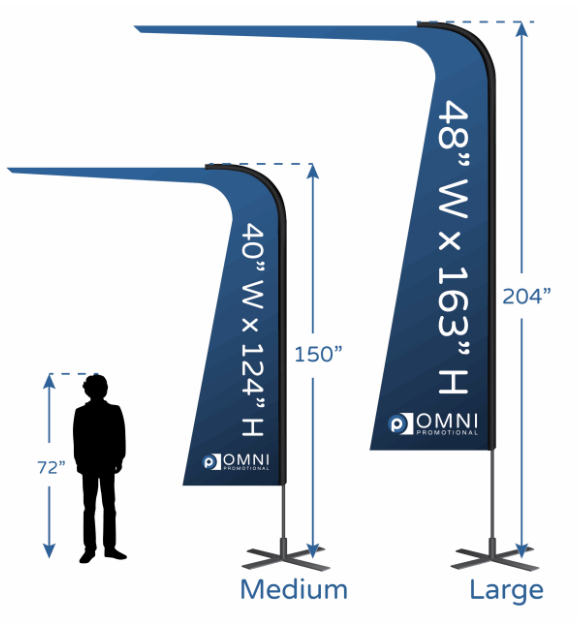

Wind banners are portable fabric displays designed to attract attention through movement while presenting a business name, logo, message, or promotional graphic. Their lightweight construction and vertical design make them useful for businesses, sporting events, festivals, trade shows, grand openings, and outdoor promotional campaigns.
Unlike conventional rigid signs, wind banners move naturally with air currents. This movement can make them noticeable from a distance while allowing businesses to display branding without requiring a large permanent sign.
Choosing the right wind banner involves more than selecting a graphic. Size, shape, fabric, pole system, base, placement, and expected weather conditions all influence how effectively the display performs.
What Are Wind Banners?
Understanding Wind Banner Displays
A wind banner typically consists of a printed fabric panel attached to a flexible or semi-flexible pole system.
The pole gives the banner its shape while allowing the fabric to move with the wind. Different designs create different visual profiles.
Common styles include:
- Feather banners
- Teardrop banners
- Sail banners
- Bow banners
- Vertical flag banners
- Custom-shaped promotional banners
These displays can be installed on grass, pavement, concrete, or other surfaces using different base systems.
The combination of movement, height, and large printed graphics makes wind banners particularly effective for attracting attention in busy outdoor environments.
Benefits of Wind Banners
High Visibility
Wind banners are designed to stand above many conventional signs and displays.
Their vertical orientation makes logos and messages visible to pedestrians and approaching traffic.
Movement can further draw attention to the banner, especially when several displays are installed together.
Portable Advertising
Many wind banner systems can be disassembled and transported between locations.
This makes them useful for businesses that participate in recurring events or operate temporary promotional locations.
They can be transported to:
- Festivals
- Sporting events
- Trade shows
- Outdoor markets
- Grand openings
- Sales events
- Community gatherings
Reusable Branding
A quality wind banner can be used repeatedly.
Businesses can maintain the same branding across multiple events rather than creating a new temporary sign for every occasion.
Reusable promotional displays can provide greater long-term value when they are properly maintained and stored.
Types of Wind Banners
Feather Banners
Feather banners have a curved shape that resembles a feather.
The design provides a tall advertising surface while allowing the fabric to move with the wind.
They are commonly used outside storefronts, at sporting events, and alongside roads or entrances.
Teardrop Banners
Teardrop banners have a rounded upper section and tapered lower profile.
Their shape helps keep the graphic relatively consistent even as the banner moves.
They are suitable for retail promotions, events, exhibitions, and outdoor advertising.
Sail Banners
Sail banners use a broader fabric profile and can provide substantial space for branding.
They may be suitable for businesses that want a prominent display without using a rigid sign.
Custom-Shaped Banners
Businesses can also request custom shapes that match specific logos, campaigns, mascots, or event themes.
A custom shape can make a display more distinctive, but the design should still preserve readability from the expected viewing distance.
Wind Banner Materials
Polyester Fabric
Polyester is commonly used for promotional flags and banners because it is lightweight and suitable for detailed printing.
The selected fabric affects:
- Appearance
- Durability
- Weight
- Print quality
- Outdoor performance
- Maintenance requirements
Businesses should ask manufacturers about fabric specifications before ordering large quantities.
Printing Quality
A wind banner is only effective if its graphics remain readable.
High-quality printing can help logos, lettering, and images appear sharp and professional.
Designers should prioritize large, simple visual elements when the banner will be viewed from a distance.
A complicated design may look impressive up close but become difficult to read when the banner is positioned beside a road or across a large event area.
Custom Branding Options
Logos and Business Names
The most common branding approach is to place a company logo and name prominently on the fabric.
This allows the banner to function as an outdoor identification sign.
Promotional Messages
Businesses can also use short promotional messages.
Examples include:
- Grand Opening
- Special Offer
- Now Open
- Sale
- Welcome
- Event Entrance
- Registration
- Sponsor
Short messages generally work better than lengthy paragraphs.
Brand Colors
Wind banners can be produced using company colors to maintain consistency with other marketing materials.
Matching colors across banners, tents, table covers, signs, and other displays can create a more professional event presentation.
Sponsor Branding
Event organizers can use wind banners to recognize sponsors.
Multiple banners can display different sponsors or group several sponsor logos within one coordinated design.
Sponsor banners work best when logos remain large enough to be recognized quickly by participants and spectators.
Choosing the Right Wind Banner Size
Small Wind Banners
Smaller banners can work well in limited spaces.
They may be suitable for:
- Store entrances
- Sidewalk promotions
- Indoor exhibitions
- Small events
- Reception areas
Medium Wind Banners
Medium-sized displays provide a balance between portability and visibility.
They can be useful for retail locations, outdoor markets, sporting events, and promotional campaigns.
Large Wind Banners
Large banners can create stronger visibility across large event spaces.
They may be appropriate for festivals, races, dealerships, outdoor exhibitions, and areas where the display needs to be visible from farther away.
The correct size should be determined by viewing distance, available space, wind conditions, and the intended advertising message.
Choosing a Wind Banner Base
Ground Stakes
Ground stakes can be useful for grass and soil.
They allow the pole system to be anchored directly into the ground.
The suitability of a stake depends on the surface and expected weather conditions.
Cross Bases
Cross-style bases can be useful on hard surfaces where ground stakes are not practical.
Additional weight may be required depending on the banner size and environmental conditions.
Water or Weighted Bases
Weighted bases can provide additional stability for outdoor displays.
Some systems use water-filled bases that can be transported empty and filled at the installation site.
The base should be selected according to the banner size, surface, and expected wind—not simply based on convenience.
Wind Banners for Outdoor Events
Sporting Events
Wind banners are widely suited to sports environments.
They can identify:
- Starting areas
- Finish areas
- Registration zones
- Spectator entrances
- Sponsor areas
- Team locations
- Hospitality areas
Their vertical shape makes them easy to position around event facilities.
Festivals and Fairs
At crowded outdoor events, banners can help identify entrances and specific activity zones.
A coordinated group of banners can also establish a visual pathway for attendees.
Grand Openings
Retailers and service businesses can use branded wind banners to announce a grand opening.
Multiple banners positioned around a storefront can increase visibility from nearby roads and sidewalks.
Wind Banners for Businesses
Retail Stores
Retail businesses can use banners to announce sales, seasonal promotions, or new locations.
They can be positioned near entrances or in nearby outdoor areas where permitted.
Restaurants
Restaurants can use promotional banners to highlight:
- New locations
- Daily specials
- Grand openings
- Outdoor dining
- Seasonal promotions
Real Estate
Real estate professionals can use wind banners around open houses, developments, and property marketing events.
The displays can help visitors identify the correct entrance or property.
Automotive Businesses
Automotive dealerships often require highly visible outdoor marketing.
Wind banners can supplement other signage and help draw attention to promotional areas.
Because they can be moved and reused, wind banners can support changing campaigns without requiring permanent signage.
Wind Banners and Weather Conditions
Understanding Wind Exposure
Wind is central to the operation of these displays.
The banner should move naturally, but excessive wind can place additional stress on the fabric, pole, and base.
Manufacturers may provide operating recommendations for specific products.
Proper Anchoring
Outdoor displays should be properly secured.
The appropriate anchoring system depends on:
- Banner height
- Banner shape
- Base type
- Ground surface
- Wind conditions
- Local environment
Severe Weather
A wind banner should not be left outside simply because it is marketed for outdoor use.
Strong winds, storms, and severe weather can create conditions beyond the intended operating range.
Event organizers should monitor weather conditions and follow manufacturer recommendations for when displays should be removed or stored.
How to Set Up Wind Banners
Prepare the Location
Choose a clear area away from sharp objects, vehicles, overhead obstacles, and heavy pedestrian traffic.
Make sure the base can be positioned securely.
Assemble the Pole
Connect the pole sections according to the manufacturer’s instructions.
Avoid forcing components together because incorrect assembly can damage the system.
Attach the Fabric
The fabric should be secured to the pole as directed.
A properly installed banner should maintain its intended shape without excessive tension.
Secure the Base
Install the ground stake or position the weighted base correctly.
Before leaving the display unattended, check that it is stable.
Proper installation is essential for both the appearance and safety of an outdoor wind banner.
Maintaining Wind Banners
Cleaning the Fabric
Outdoor banners can accumulate dust, dirt, pollen, and other debris.
Cleaning should follow the manufacturer’s fabric recommendations.
Harsh chemicals or aggressive scrubbing can damage printed graphics or fabric.
Inspecting Hardware
Before repeated use, inspect:
- Poles
- Connectors
- Fabric edges
- Stitching
- Base components
- Ground stakes
- Carrying cases
Damaged components should be repaired or replaced before the next event.
Proper Storage
The banner should be clean and completely dry before storage.
It should be folded or rolled according to the manufacturer’s instructions and stored in a dry environment.
Proper storage can help preserve both the fabric and printed graphics between events.
Wind Banners vs. Traditional Banners
Traditional vinyl banners are generally rigid when installed with fixed attachment points.
Wind banners are designed to move and are typically mounted on poles.
| Feature | Wind Banners | Traditional Banners |
|---|---|---|
| Movement | Designed to move | Usually fixed |
| Portability | High | Moderate |
| Installation | Pole and base | Grommets, frames, or hardware |
| Shape | Feather, teardrop, sail, custom | Usually rectangular |
| Branding | Custom graphics | Custom graphics |
| Outdoor use | Common | Common |
| Best use | Mobile visibility | Fixed messaging |
Wind banners are particularly useful when mobility and attention-grabbing movement are important.
Wind Banners vs. Feather Flags
The terms “wind banner” and “feather flag” are sometimes used interchangeably.
However, feather flags represent a specific style of wind banner with a characteristic curved, feather-like shape.
Wind banners can be a broader category that includes feather, teardrop, sail, and other designs.
When purchasing, businesses should compare the actual shape, dimensions, base system, and fabric rather than relying only on product terminology.
How to Choose the Best Wind Banners
Consider the Purpose
First determine what the banner needs to accomplish.
Is it intended to:
- Advertise a business?
- Direct visitors?
- Promote a sale?
- Mark an event entrance?
- Display sponsorship?
- Identify a race location?
The purpose will influence the appropriate design.
Evaluate Visibility
Consider the distance from which people will see the banner.
Large lettering and recognizable graphics are particularly important for displays positioned near roads or large event spaces.
Select the Correct Base
The base should match the installation surface and environmental conditions.
A grass installation may require a different system from a concrete sidewalk.
Consider Reusability
Businesses that attend multiple events should consider a durable system that can be assembled and transported repeatedly.
Portability, durability, and storage requirements should be evaluated together when selecting a reusable display.
Frequently Asked Questions
What are wind banners used for?
Wind banners are used for outdoor advertising, sporting events, festivals, trade shows, grand openings, retail promotions, directional signage, and sponsor displays.
Are wind banners waterproof?
Many outdoor wind banners are manufactured from materials designed to withstand normal outdoor exposure, but resistance to water and severe weather varies by product.
Can wind banners be customized?
Yes. Custom wind banners can typically include logos, colors, business names, promotional messages, sponsor graphics, and other artwork.
What is the difference between a feather flag and a wind banner?
A feather flag is a particular style of wind banner. The broader term can include feather, teardrop, sail, and other flag-shaped displays.
What base is best for a wind banner?
The best base depends on the surface and environmental conditions. Ground stakes work for suitable soil, while weighted or water-filled bases can be used for many hard-surface applications.
Can wind banners be used indoors?
Yes. Smaller displays with suitable bases can be used indoors at trade shows, exhibitions, retail spaces, and corporate events.
How long do wind banners last?
Lifespan varies according to material quality, printing, frequency of use, weather exposure, maintenance, and storage.
Can wind banners be used in strong winds?
Wind banners should only be operated within the conditions specified by the manufacturer. Strong winds and severe weather may require the display to be removed.
How should wind banners be stored?
They should generally be cleaned, dried completely, disassembled, and stored in a dry location according to manufacturer instructions.
Final Thoughts
Wind banners provide businesses and event organizers with a flexible way to combine advertising, branding, and directional signage in a portable display.
Their movement can attract attention, while custom printing allows organizations to communicate logos, messages, event information, and sponsor branding.
The best wind banner depends on the intended application, available space, viewing distance, fabric, shape, pole system, and base.
For outdoor use, proper anchoring and weather awareness are essential to maintaining a safe and effective display.
Businesses should also consider how frequently the banner will be transported and reused. A durable system with an appropriate carrying and storage solution can make recurring promotions easier to manage.
When the right size, design, branding, base, and installation method are combined, wind banners can become an effective and reusable advertising tool for businesses, events, and promotional campaigns.



