Physical Address
304 North Cardinal St.
Dorchester Center, MA 02124
Physical Address
304 North Cardinal St.
Dorchester Center, MA 02124

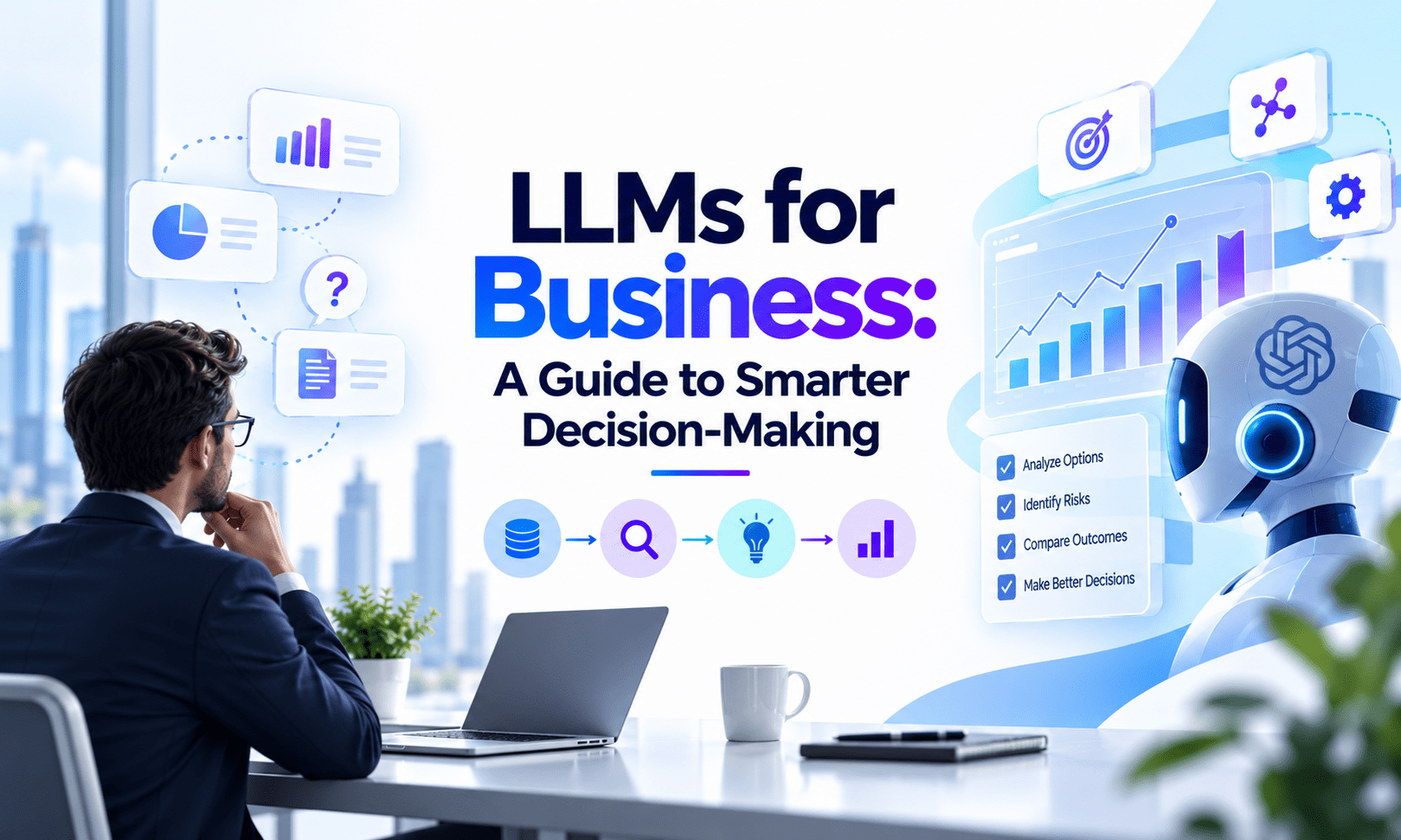
Learn how LLMs for business improve decision-making, automate tasks, summarize documents, and drive smarter operations across your organization.
Large language models are fundamentally transforming the way businesses make sense of information, document processes, automate procedures, and more. Each LLM deployed in a business setting carries a key advantage: the ability to give meaning to data used in day-to-day operations. In contrast to rule-based algorithms, LLMs understand and create natural language texts, and when the right model is integrated into existing business processes, it can assist in doing routine tasks better and helping leadership make well-informed decisions.
LLMs designed for businesses are essentially AI systems modified or enhanced to fulfill a company’s particular needs in terms of processing and analyzing textual information. They are typically used to perform various language tasks, ranging from customer care assistance to document summarization, within the confines of a given business’s information landscape.
Companies can use these models in combination with the information held in the corporate knowledge base or databases to accomplish day-to-day goals and objectives more efficiently. For example, instead of sifting through hundreds of documents in search of the answers to a given question, an employee or a program can ask an LLM agent to provide them with a summary, relevant text snippets, and other types of evidence.
Business applications of LLMs typically include:
LLMs become a valuable asset when integrated into a given company’s information processing workflow, which enables them to operate on the data that is pertinent to the decision-making process within the organization. Firms leveraging professional AI development services for this integration gain access to structured implementation paths that reduce risk and accelerate time-to-value.
Decisions made by businesses are rarely based exclusively on the information contained in a single report, contract, customer review, or any other document. Moreover, the information present in such documents may be hard to digest for a human reader, especially if there are hundreds or even thousands of them to be reviewed. This is precisely the point where LLMs can prove especially useful, as they are capable of transforming mountains of text into easily digestible highlights and summaries. This function becomes a part of the broader process of supporting human agency in managerial decision-making.
Another crucial skill of LLMs in terms of business operations is the ability to find trends and patterns in textual data. Customer e-mails, tickets, and surveys, as well as meeting minutes, can be analyzed by a language model to give the leadership team additional insights into customers’ preferences and market trends. Advances in large language model development continue to expand these capabilities — making models more accurate, context-aware, and adaptable to specific industry domains. However, it is important to emphasize that in all aforementioned cases, LLMs are tools for human operators, and therefore, humans are at all times in charge and should be certain that critical matters require proper consideration.
LLMs typically generate value for businesses that understand the key benefits of these algorithms and take an organized approach to their integration into the existing information landscape. The technology in question is particularly valuable from the perspectives of businesses’ operational and decision-making needs, and these needs often include:
When used in tandem with other existing AI infrastructure to make decisions, organize and retrieve data, manage customer relations, or any other purpose, LLMs offer significant benefits to experienced businesses. Organizations that invest in professional AI app development services gain the advantage of purpose-built integrations that align LLM capabilities with existing workflows and data systems.
Despite the promise and potential benefits of LLM technology in the workplace or at the corporate level, several barriers and risks must be considered when contemplating the use of any large language model in a business setting. One of the most prominent problems is presented by the potential inaccuracies of information produced by AI systems and the degree of reliability of any conclusions that may be made on their basis.
This problem is particularly acute in situations when decisions must be made about matters pertaining to financial, legal, safety, and other highly sensitive issues. Another potential issue experienced by business decision-makers who contemplate utilizing LLMs for strategic business decisions or recommendations is the question of the degree to which the technology in question can truly be used as an effective source of knowledge.
Beyond the potential inaccuracies, hallucinations, and biases, businesses must consider the questions of LLMs’ integration with the company’s overall information system, the degree to which such integration is seamless, and the ways in which the data and information of the company are secured and protected from external interference.
From this perspective, the most important aspect is the presence or absence of specific measures intended to ensure that LLMs make accurate, reliable, and repeatable recommendations. Businesses should also establish specific performance metrics that will measure the technology’s effectiveness within the given context before its full-scale implementation.
Implementation of large pre-trained language models into the day-to-day functioning of businesses usually entails following a set of best practices and principles, some of which depend on the specific use case scenario in which a given model is used. An experienced implementation partner in the field would advise businesses to first pinpoint potential areas where integration of LLMs would be advantageous and then proceed with data preparation, model selection, and infrastructure preparation. Implementation can be achieved in the following steps:
For businesses seeking to fully utilize the potential applications of large pre-trained language models in their respective fields, and particularly where these LLMs are deployed in production-ready environments that make real-world decisions, partnership with expert artificial intelligence development services and AI development companies becomes crucial.
In a broader sense, LLMs are truly transformative technologies from the perspective of business decision-making operations because they enable faster, more efficient, and more informed decision-making. After all, they serve as the basis for information retrieval and text summarization, which makes them applicable to a broad range of business cases. This technology becomes crucial when relevant data is utilized, carefully monitored, and integrated with the business’s overall information and knowledge architecture in an organized manner.




