Physical Address
304 North Cardinal St.
Dorchester Center, MA 02124
Physical Address
304 North Cardinal St.
Dorchester Center, MA 02124

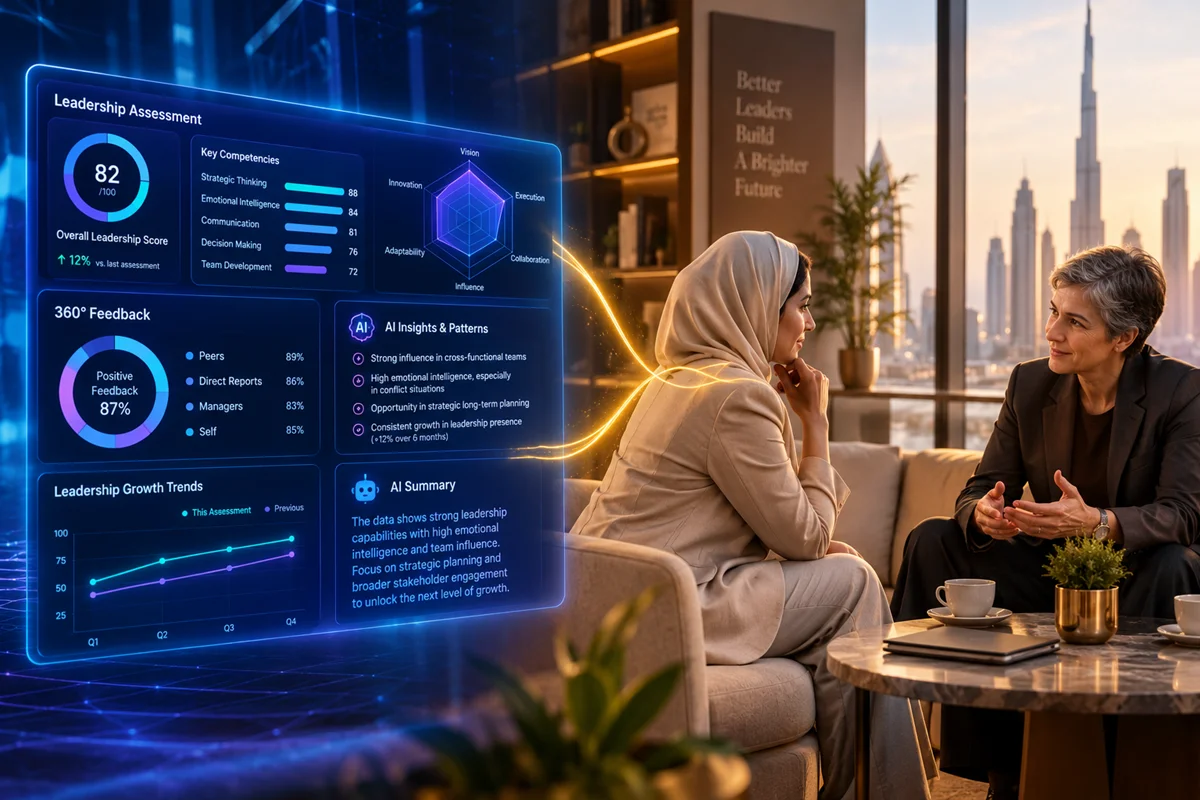
AI and assessment data are reshaping executive coaching, but not the way most headlines suggest. A grounded look at what's actually changing in 2026.
Walk into a coaching session with a senior executive today and there’s a good chance they’ll open their laptop before they open the conversation. Not to pull up revenue figures, but a summary an AI tool has generated from their own leadership assessments, meeting patterns, and 360 feedback over the past year. The question that follows is almost always the same: what does this actually mean, and what am I supposed to do with it? That’s the tension sitting at the center of executive development right now across the GCC, and it deserves a more precise answer than most of what’s being written about it.
Structured assessments have long been a foundation of serious coaching work, tools like EQi-2.0, the Hogan Suite, and Talent Predix give leaders a language for patterns they already sense but can’t quite articulate. What’s changed is the speed and texture of the data feeding into that process. Leaders now arrive at a first session having already generated a fair amount of self-report data through apps, 360 tools, or workplace analytics. That’s a real shift from five years ago, when most of the data-gathering happened inside the coaching engagement itself.
The market reflects this. Corporate investment in leadership development is climbing sharply, and a meaningful share of that growth is tied directly to AI-personalized tools being folded into existing programs rather than treated as a separate initiative. For a region like the GCC, where organizations are often building leadership pipelines from scratch rather than retrofitting decades-old L&D departments, this matters. It means the baseline data leaders bring into coaching is richer than it used to be, though richer data still has to be interpreted by someone who knows how to read it against a leader’s actual context. That interpretation work sits at the core of Wardah Harharah’s coaching practice, and it’s not something a dashboard can do on its own.
There’s a case to be made, and it’s worth making plainly, that AI is now good at certain coaching-adjacent functions. Research from The Conference Board has suggested AI tools can now handle a large share of routine, day-to-day coaching functions: tracking commitments, prompting reflection between sessions, or surfacing patterns across months of notes that would take a human coach hours to spot manually.
What that same research is careful to flag is that the emotionally charged, politically sensitive, and values-based conversations are where human expertise stays essential. A leader deciding whether to confront a board member, navigate a family-business succession, or manage a team through layoffs isn’t looking for pattern recognition. They’re looking for someone who can sit in the discomfort with them and ask the question they’re avoiding. No model does that yet, and that’s not a temporary gap. It’s the actual job.
Gartner’s 2026 research on CHRO priorities makes a point that’s often underappreciated: leaders adopt change far more successfully when support is embedded at the moment they’re going through it, rather than delivered as a standalone program they’re supposed to remember to use later. This is exactly where AI tools tend to add real value, not as a replacement for coaching, but as something that stays present in the gaps between sessions, when a leader is walking into their first board presentation or their first restructuring conversation without a coach in the room.
That’s a genuinely different use of technology than what most “AI coaching platform” marketing describes. It’s not about scaling coaching down to a chatbot. It’s about extending the support that a human coaching relationship provides into the moments that actually determine whether new behavior sticks.
Practically, this shifts how a well-run coaching engagement should operate. Less time needs to go into early sessions gathering baseline information, because much of it already exists, which frees up space for the real work to start sooner. More discernment is required around which parts of the assessment data are actually decision-relevant versus interesting but inert. A Hogan derailer score means nothing without a coach who can connect it to a specific pattern a client is living out under pressure. And there’s growing room for AI-supported tools to handle the maintenance layer of coaching, tracking, prompting, reflection, precisely so the time spent together stays focused on the conversations only a human can hold.
For multicultural leadership teams across the UAE and Saudi Arabia in particular, one caution is worth adding. Data-driven tools trained largely on Western workplace norms don’t always read context well: indirect communication styles, hierarchy dynamics, or how feedback lands differently across a genuinely diverse team. That’s not a reason to avoid the tools. It’s a reason to keep a human coach in the loop who understands the room.
None of this makes coaching less human. If anything, it sharpens where the human part actually needs to show up. For leaders weighing how AI-supported tools fit into their own development, or where a human coach still needs to be the one in the room, that’s a conversation worth having.