Physical Address
304 North Cardinal St.
Dorchester Center, MA 02124
Physical Address
304 North Cardinal St.
Dorchester Center, MA 02124

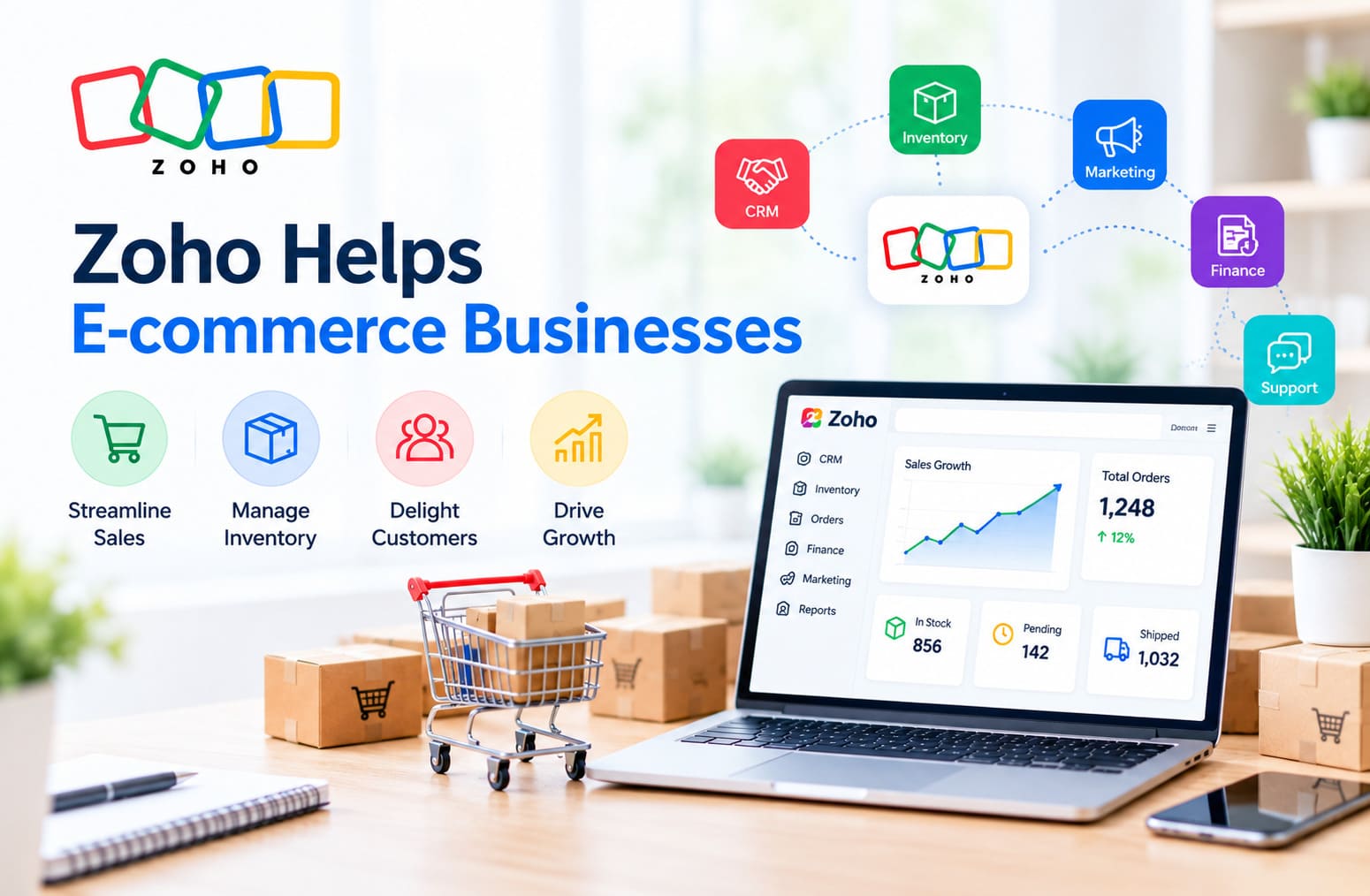
E-commerce companies manage many business-to-consumer interactions, including product details, orders, payments, stock, marketing campaigns, and customer service. With these activities spread across different systems, delays, duplicate data, lost leads, and inconsistent customer experiences can result as an online store grows.
Zoho for Ecommerce Businesses offers an integrated solution that empowers businesses to run these operations more efficiently. With CRM, sales, marketing, inventory, finance, analytics, and automation seamlessly integrated, Zoho can help e-commerce businesses run a more streamlined and organized digital workflow.
Zoho can cater to various touchpoints of the e-commerce customer journey, from online lead capture to follow-up with customers, all the way to repeat purchases, without having to deal with repetitive administration.
Zoho for E-commerce Businesses means managing critical e-commerce processes from a single connected technology hub using the Zoho applications and integrations.
Businesses can integrate applications of Zoho relevant to them as per their requirement instead of maintaining separate systems for customer data, sales activities, marketing, inventory, and finance.
A standard e-commerce technology solution might consist of:
Zoho CRM for customer management and sales. Zoho CRM is customer management and Sales Software.
The specific mix will vary based on the e-commerce business’s size, business model, sales channels, and needs.
Customer data is one of the most valuable assets for an online business. However, its value decreases when information is scattered across different platforms.
Zoho CRM can provide a centralized environment for managing customer and prospect information. E-commerce companies can use customer records to understand interactions, sales activities, inquiries, and follow-up requirements.
For example, businesses can organize customers based on:
This information can help sales and marketing teams create more relevant customer communication instead of treating every buyer in the same way.
Zoho CRM allows ecommerce businesses to collect and organize leads and information from their website forms, campaigns, inquiries, and more. Salespeople can convert leads, keep track of interactions, capture customer needs, and follow up in a single location. This structured process enables businesses to react quickly and effectively turn qualified leads into customers, especially for high-ticket items, subscriptions, bulk orders, and personalized products.
As an ecommerce business expands, keeping track of orders on the website, marketplaces, social media, and wholesale platforms can become complex. Businesses can use Zoho Inventory to manage sales orders, purchase orders, inventory, shipping, warehouses, returns, and backorders. Order Information Centralization provides teams with enhanced visibility into the operations, enabling them to react rapidly to changes in stock, fulfillment challenges, and customer needs.
True and accurate inventory counts are critical to avoid overselling, cancellations, refunds, and customer dissatisfaction. Connecting to a Zoho Ecosystem can help eCommerce stores consolidate inventory data from various sales channels and warehouses. Teams are able to track stock levels and manage inventory more easily, and have a better view of product levels and changes in levels in response to demand.
The Zoho marketing tools can help e-commerce businesses automate customer communication based on their behavior, preferences, and their lifecycle stages. There are numerous opportunities for businesses to produce campaigns for abandoned shopping trips, new customers, repeat purchases, seasonal promotions, product recommendations, and re-engagement. Automated workflows can send out relevant messages if a customer fits into a certain condition, ensuring that marketing teams are always on the right page when communicating with customers, without having to do a lot of repetitive tasks.
Customer information can be used to provide more tailored experiences rather than blasting the same messages out to all customers. There are many different ways in which a business can segment its customers, such as by purchasing habits, interests, product categories, or engagement. They can be used to target campaigns, personalise recommendations, and to offer relevant offers. By increasing customer engagement, repeat purchases, and long-term relationships, better personalization can help.
As ecommerce grows, so does the demand for precise financial management. As the eCommerce business expands, the demand for accurate financial management also grows. Businesses can handle their invoices, payments, expenses, taxes, receivables, and financial transactions in an organized environment with the help of Zoho Books. Linking accounting data to sales and order activities can cut down on manual data entry and enhance financial visibility. This enables businesses to monitor income and run their day-to-day financial activities more effectively.
Ecommerce teams have to perform a lot of repetitive tasks like assigning leads, notifications, updating records, follow-up, and checking order statuses on a regular basis. This can be automated and integrated with Zoho automation and integration tools, which can enable the automation of these tasks based on predetermined conditions. For instance, an action by a customer could trigger a task or alert a team member. This saves employees time and energy from manual duties and enables them to concentrate on sales, service, and growth.
With Zoho Analytics’ help, eCommerce businesses can convert their operational data into meaningful insights using reports and dashboards. Teams can examine sales, revenue patterns, product performance, customer acquisition, order volume, repeat purchases, inventory movement, and marketing results. These insights provide management with an understanding of business performance, valuable information to determine which products and channels are successful, and improved information to allow better decision-making based on customer and sales information.
Zoho Desk can handle customer support requests regarding delivery, return, refund, exchange, and product enquiries in e-commerce businesses. Tickets can be categorized, assigned, prioritized, and monitored by support teams using a single central platform. Having the necessary information about customers can also enable staff to have a better understanding of their interactions, minimize customer questions that have already been addressed, and maintain a consistent approach to supporting customers throughout their interactions.
A properly designed Zoho ecosystem can provide several operational advantages.
A connected Zoho environment can help e-commerce businesses organize customer information in one place. Teams can access contact details, purchase history, inquiries, interactions, and other relevant records without switching between multiple systems.
Zoho CRM can give sales teams better visibility into leads, opportunities, customer interactions, and follow-up activities. Teams can track where prospects are in the sales process and identify actions that require attention. This organized approach helps sales representatives manage prospects more effectively, maintain consistent follow-ups, and identify opportunities that may otherwise be overlooked.
Automation can help e-commerce businesses reduce repetitive administrative tasks that consume employee time. Zoho workflows can automate activities such as lead assignment, notifications, record updates, follow-up tasks, and routine communication. Reducing manual data entry can also minimize avoidable errors and allow employees to spend more time on customer service, sales activities, and business growth.
Connected inventory processes can provide e-commerce businesses with better visibility into product availability, stock movements, sales orders, and purchase orders. Zoho Inventory can help teams monitor inventory across different locations and sales channels. Better visibility makes it easier to identify stock shortages, manage replenishment, reduce overselling, and maintain smoother order fulfillment operations.
Zoho marketing tools can help e-commerce businesses create more targeted and relevant customer communication. Businesses can segment customers based on purchasing behavior, interests, engagement, or other criteria and create campaigns accordingly. Automated marketing workflows can support promotions, product recommendations, abandoned-cart communication, and customer re-engagement, helping businesses maintain consistent communication throughout the customer journey.
A centralized support workflow can help e-commerce businesses manage customer requests more efficiently. Zoho Desk allows support teams to organize, assign, prioritize, and track customer tickets related to orders, deliveries, returns, refunds, and products. Access to customer and order information can help support representatives understand issues faster and provide more consistent responses.
Zoho Analytics can help e-commerce businesses transform data into actionable business insights. Management teams can analyze sales performance, customer behavior, product demand, inventory movement, marketing results, and revenue trends through reports and dashboards. These insights can help businesses identify opportunities, understand changing customer preferences, evaluate performance, and make more informed decisions based on reliable data.
Every e-commerce business has different workflows. A standard software configuration may not always provide the required level of synchronization between existing platforms.
Zoho integration services can help businesses design connections between Zoho applications and their existing e-commerce technology stack.
A professional integration approach may include:
The objective is not simply to connect applications. The objective is to create a reliable workflow in which information moves between systems with minimal manual intervention.
E-commerce businesses need technology that helps them grow with customers and run internally. Vision Infotech can help businesses plan, tailor, combine, and improve Zoho solutions to fit their e-commerce workflows. From Zoho CRM and inventory tracking to API connections, automation, reporting, and streamlining business steps, the focus can stay on building a linked technology environment that cuts down on work and supports scalable operations. For businesses that want to improve their e-commerce sales process, customer care, or operational automation, working with a Zoho consulting and development partner can make the implementation more organized and in line with business goals.
Zoho for E-commerce Businesses can bring customer management, sales, inventory, marketing, accounting, analytics, and support into a connected operational environment.
Instead of relying on isolated tools and repetitive manual processes, e-commerce companies can use Zoho solutions to bring better visibility and to automate key workflows.
As an online business grows, the right technology foundation becomes more and more important. By combining Zoho CRM, Zoho Inventory, Zoho Books, Zoho Analytics, Zoho Desk, and automation or integration capabilities, businesses can build efficient processes and create better experiences for customers.
Zoho can help e-commerce businesses manage customer relationships, sales, inventory, marketing, accounting, customer support, reporting, and workflow automation through connected applications.
Yes. Depending on the platform and requirements, Zoho applications can be connected with e-commerce websites through standard integrations, automation tools, or APIs.
Yes. Businesses can start with the Zoho applications they need and expand their technology environment as their sales volume, customer base, and operational requirements increase.
Yes. Zoho automation capabilities can support repetitive activities such as lead assignment, notifications, follow-ups, record updates, and other business workflows.
Zoho consulting services can help businesses identify the right applications, design workflows, integrate existing systems, customize processes, and optimize the platform around their operational requirements.