Physical Address
304 North Cardinal St.
Dorchester Center, MA 02124

Open ten blog posts on any competitive topic right now, and you’ll notice something strange. They all say roughly the same thing, in roughly the same order, with roughly the same tone. Different logos, same content.
That’s the real challenge in SEO in 2026. It’s not that good content is hard to write. It’s that “good enough” content is now everywhere, produced faster than ever, and none of it stands out. So the question isn’t how to write content anymore. It’s how to build EEAT strong enough that Google — and actual humans — trust you over the next ten identical-looking sites.
Google introduced E-E-A-T to answer a simple question: can this content be trusted? That question used to be easy to sidestep with clever keyword placement. Not anymore.
As AI tools make it effortless to publish at scale, search engines have leaned harder into trust signals that are much harder to fake. A page can be well-structured and keyword-perfect and still get outranked by a thinner page written by someone with obvious, demonstrated authority.
For AI search and Generative Engine Optimization (GEO) too, the pattern holds. AI models pull answers from sources they consider credible. If your content can’t prove it deserves that trust, it won’t get cited — even if it technically answers the question.
This isn’t a coincidence. A few things pushed content toward sameness:
The result is a content landscape where everyone’s technically doing SEO best practices, and almost nobody is doing anything memorable.
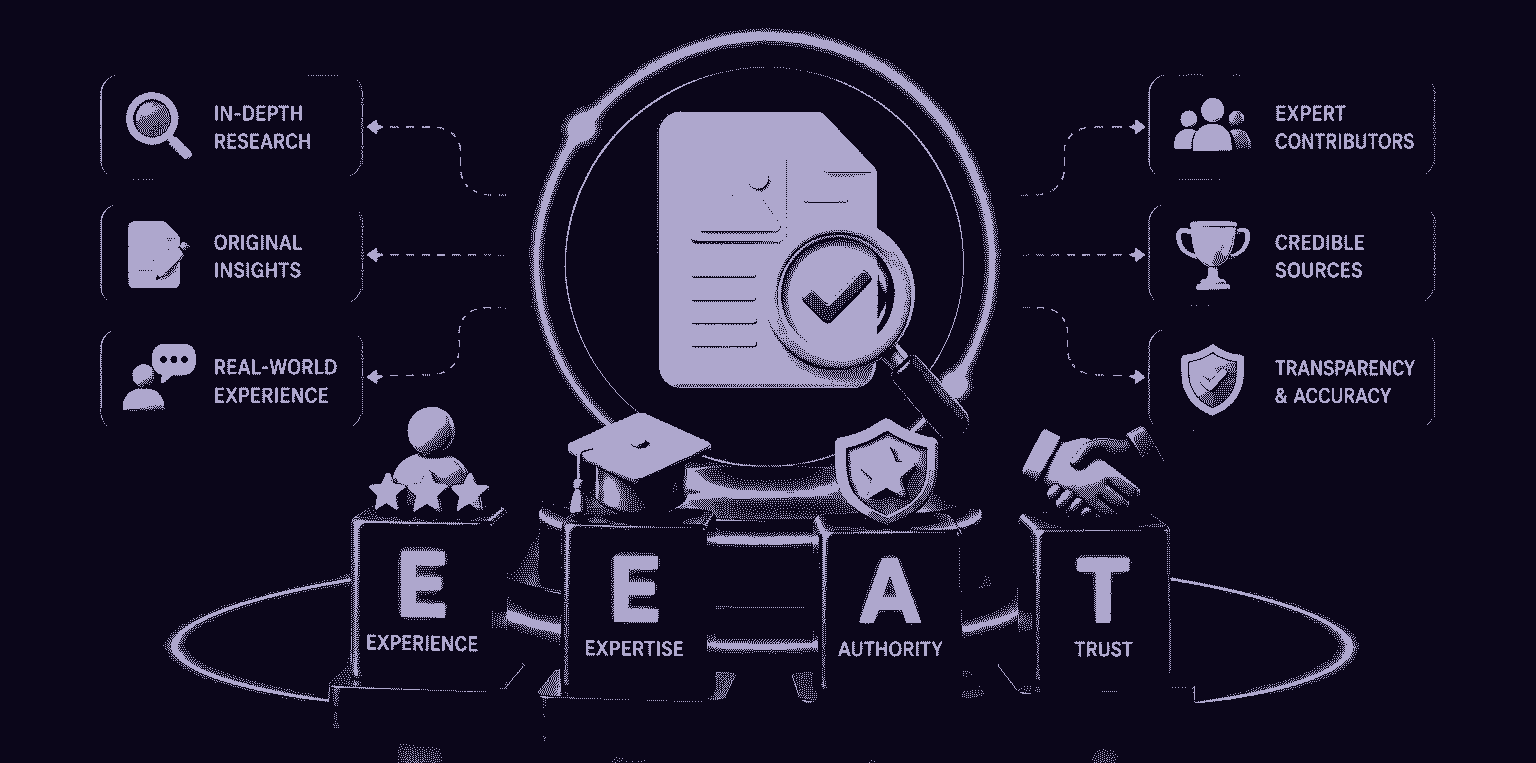
Trust isn’t one signal — it’s a pattern built from many small proofs stacked together. Google looks at whether a site’s authors have real credentials, whether the site is cited elsewhere, whether claims are backed by evidence, and whether the content reflects real understanding rather than surface-level summary.
Experience — Have you actually done the thing you’re writing about?
Expertise — Do you understand the subject deeply enough to add real insight?
Authoritativeness — Do other credible sources treat you as a go-to reference?
Trust — Is your information accurate, transparent, and verifiable?
Trust sits at the top because it depends on the other three. You can’t fake your way into it with formatting alone.
For example, a SaaS company writing about onboarding shouldn’t just describe “best practices.” It should show its own onboarding flow, its own drop-off data, and what changed after a redesign.
Content authority is earned outside your own website as much as inside it. Getting referenced by industry publications, appearing in podcasts or interviews, and having other credible sites link to your work all signal that you’re a recognized voice, not just another blog.
Building topical authority also means going deep on a subject area instead of spreading thin across unrelated topics. A site that publishes twenty focused, connected articles on one subject usually outperforms a site with two hundred scattered, shallow ones.
Small details matter more than most teams realize:
These signals are easy to overlook and easy to fix — often within a single afternoon.
As AI-generated summaries take over more search results, the sites that survive will be the ones AI systems trust enough to quote. That trust will keep tracing back to the same fundamentals: real experience, verifiable expertise, and consistent authority — the exact things that are hardest to copy.
When everyone’s content looks the same, EEAT is the difference between blending in and being the source people — and AI — actually trust. It’s not a quick fix, but it’s one of the few SEO advantages that compounds instead of expiring.
Ready to strengthen your site’s EEAT? Start with one article this week — add real data, a named expert author, and one credible citation. Small, consistent proof beats a total content overhaul.
Key Takeaways