Physical Address
304 North Cardinal St.
Dorchester Center, MA 02124
Physical Address
304 North Cardinal St.
Dorchester Center, MA 02124

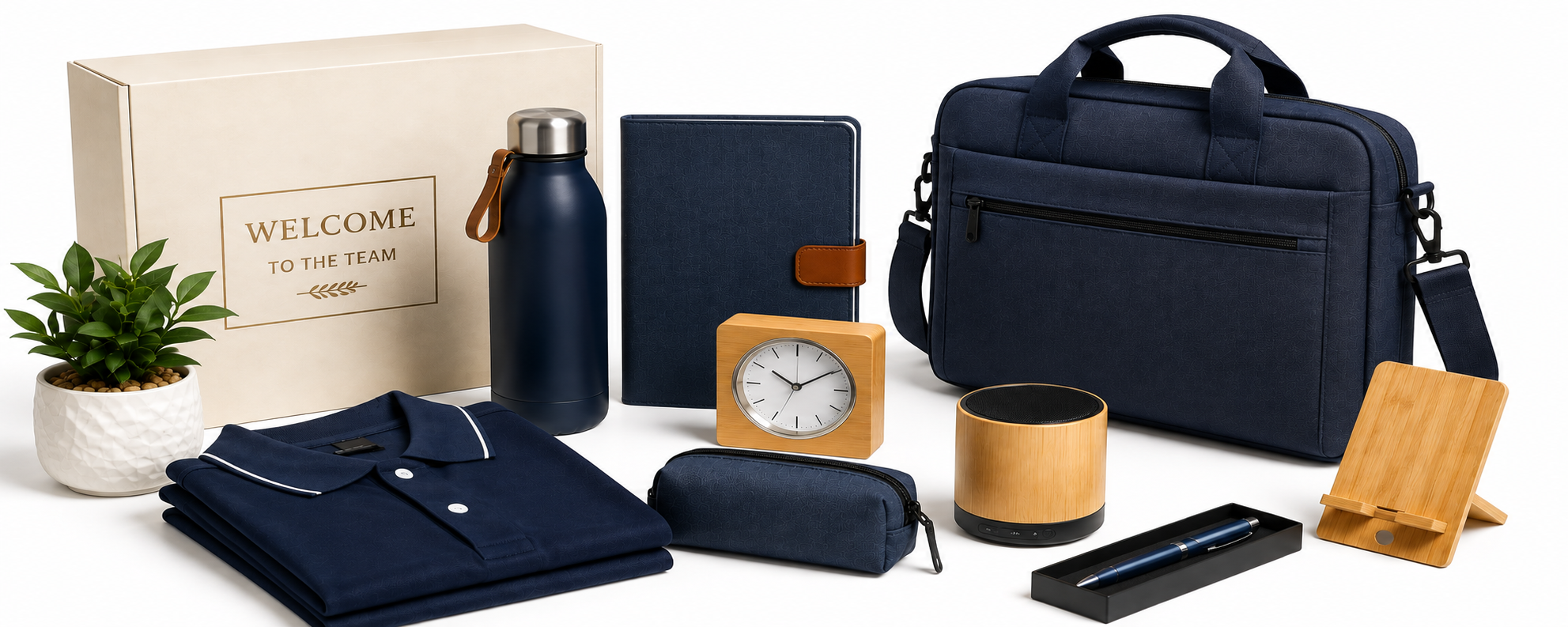
A new employee welcome does not have to create unnecessary waste. Companies can make the first-day experience thoughtful while also choosing products and packaging that employees can use repeatedly.
A well-planned welcome kit for employees can include reusable, durable, and practical items instead of disposable merchandise. This approach is especially useful for businesses that want their employee gifting practices to reflect responsible workplace values without making the kit feel ordinary.
Sustainability, however, should not become a reason to compromise on quality. An attractive product that breaks quickly is not necessarily a responsible choice. The better approach is to select useful products, reduce unnecessary packaging, and choose materials carefully.
This guide explores practical ways businesses can create sustainable employee welcome kits without losing the professional feel expected from corporate gifting.
Sustainability is not limited to using bamboo products.
A more complete approach considers the entire kit:
For example, replacing a single-use plastic bottle with a durable reusable bottle can be a meaningful improvement. Similarly, using a reusable tote instead of disposable packaging can give the employee something useful after the kit has been opened.
The important principle is simple:
Choose fewer products that employees can use for longer.
Employee gifting is increasingly connected with workplace culture. A company’s values are communicated not only through policies and presentations but also through everyday decisions.
A welcome kit provides one of the earliest physical touchpoints between an employee and the organization.
If the company talks about responsible business practices but sends a box filled with unnecessary disposable merchandise, the experience may feel disconnected.
On the other hand, a carefully selected kit can demonstrate that the company thinks about practicality and resource use.
Current Indian welcome-kit offerings increasingly include reusable bottles, bags, eco-friendly stationery, and other products positioned around sustainability.
Reusable products are one of the easiest ways to make a welcome kit more practical.
Consider:
The key is quality.
A reusable product only makes sense when it is durable enough to be used repeatedly. Therefore, material quality should be considered alongside appearance and price.
Stationery is a natural part of an employee welcome kit, but companies have many options beyond conventional plastic-heavy products.
Possible choices include:
However, avoid selecting a product only because it is labelled “eco-friendly.”
Check what the product is actually made from and whether it will remain useful.
A refillable pen, for instance, can have greater practical value than a disposable promotional pen.
Packaging can contribute significantly to the overall impression of a welcome kit.
Instead of excessive layers, companies can explore:
The objective is not necessarily to eliminate packaging. Products need protection during storage and delivery.
Instead, ask:
Can the packaging serve another purpose after the employee opens the kit?
A sturdy box can become a document-storage box. A fabric bag can become a daily office tote. A reusable pouch can store cables or accessories.
This gives the packaging a second life.
One of the simplest sustainability strategies is also one of the most effective: give employees fewer unnecessary items.
Many corporate kits contain products such as:
These products may add visual volume but not necessarily employee value.
Instead, use the budget to improve the quality of products employees are more likely to keep.
For example:
Instead of:
Six low-cost promotional items.
Consider:
One quality notebook, one reusable bottle, one useful bag, and one thoughtful welcome card.
A smaller kit can still feel premium when every item has a purpose.
Sustainable products still need to represent the company.
However, branding does not have to be large.
Options include:
The branding method should match the product.
For example, a subtle engraved logo on a stainless-steel bottle can look more professional than a large printed logo covering most of the surface.
This also makes the product easier for employees to use outside the workplace.
A bag can solve two problems at once.
First, it can carry the employee’s welcome products.
Second, the employee can continue using it for:
Canvas, cotton, recycled-fabric, and other durable bag options can be considered depending on the company’s requirements.
The important factor is durability. A reusable bag that tears after a few uses defeats the purpose.
Sustainability does not have to mean giving employees products that look rustic or informal.
A modern desk-focused kit could include:
The visual style can remain clean and professional.
This is particularly suitable for companies that want sustainability to be part of their workplace identity without making the kit look overly themed.
A welcome kit does not need to contain printed information for everything.
Instead of adding a thick company handbook, businesses can use a small printed card with a QR code leading to:
This can reduce unnecessary paper while keeping important information accessible.
The printed card itself can remain simple and useful.
A sustainable product is most valuable when employees genuinely use it.
For example, a reusable bottle may be useful for almost everyone. But an unusual eco-themed desk product may have limited value.
Ask practical questions:
This prevents sustainability from becoming a purely visual concept.
One sustainable kit does not have to suit every employee.
A core kit can remain consistent while a few items change.
Possible products:
Consider:
Useful options include:
This approach keeps sustainability practical rather than simply adding green-themed products.
Local sourcing can be another consideration when planning a corporate welcome kit.
Companies can explore products made by local manufacturers, artisans, or specialized suppliers where appropriate.
Potential categories include:
However, “locally made” should not automatically be treated as synonymous with sustainable. Businesses should still consider product quality, material sourcing, packaging, durability, and transportation.
The right approach is to evaluate the complete product rather than rely on one label.
Sustainability and quality often work well together because durable products have a longer useful life.
Suppose a company has a fixed budget for every new hire.
Instead of spending the entire amount on many small products, it can allocate more toward two or three products that employees are likely to use regularly.
For example:
| Product | Purpose | Long-Term Value |
|---|---|---|
| Steel bottle | Daily hydration | High |
| Recycled notebook | Work notes | High |
| Canvas bag | Carrying items | High |
| Refillable pen | Writing | Medium to high |
| Welcome card | Personal connection | Emotional value |
| Novelty item | Decoration | Often limited |
This does not mean novelty products should never be used. It simply means every item should have a clear reason for being included.
A practical sustainable kit could include:
1. Reusable insulated bottle
For daily office, home, or travel use.
2. Recycled-paper notebook
For meetings, training, and planning.
3. Refillable metal pen
A durable alternative to disposable stationery.
4. Canvas tote bag
Useful for commuting and everyday carrying.
5. Personalized welcome card
Adds a human touch without requiring a large product.
6. QR onboarding card
Provides access to digital company resources.
7. Reusable packaging pouch
Gives the packaging another purpose.
The exact products can change according to company culture and budget.
Some companies hesitate to choose sustainable products because they associate them with plain or basic designs.
That does not have to be the case.
A professional sustainable kit can use:
Sustainability is a product-selection principle, not a visual style.
A premium-looking welcome kit can still use responsible material choices.
A green color or leaf symbol does not make a product sustainable.
If the product breaks quickly, its practical value decreases.
Too many items can create unnecessary consumption.
An eco-friendly product inside several layers of unnecessary plastic weakens the overall concept.
Companies should be careful with words such as “100% sustainable,” “zero impact,” or similar claims unless they have appropriate evidence.
A product is more responsible when employees actually use it.
For companies planning employee gifting programs, GlobalWare can support customized corporate gifts, branded merchandise, employee welcome kits, corporate gift hampers, personalized products, and professional packaging.
For a sustainability-focused program, the selection process can start with practical questions about product durability, material, packaging, branding, and expected usage.
The objective should be to create a welcome kit that reflects the company’s workplace culture while giving employees products they can genuinely use.
Before approving a sustainable welcome kit for employees, HR teams can ask:
If the answer is yes to most of these questions, the kit has a stronger sustainability foundation.
A sustainable kit can include reusable bottles, recycled-paper notebooks, refillable pens, durable tote bags, reusable pouches, personalized welcome cards, and digital onboarding resources. The exact combination should depend on employee needs.
No. Material alone does not determine the overall environmental impact of a product. Businesses should also consider durability, manufacturing, packaging, sourcing, transportation, and actual product usage.
Companies can use recyclable or reusable packaging, reduce unnecessary layers, replace plastic cushioning where appropriate, and design packaging that employees can reuse for storage or daily activities.
Not necessarily. Companies can control costs by reducing the number of products and investing in a smaller selection of durable, useful items. Sustainability is more about thoughtful selection than simply choosing premium-priced materials.
Yes. Products such as notebooks, bottles, bags, and cards can be personalized using suitable branding or name customization. Personalization should remain subtle and appropriate to the product.
Start with three areas: reduce unnecessary products, replace disposable items with reusable alternatives, and simplify packaging. These changes can make a meaningful difference without completely redesigning the program.
Yes. Sustainable kits can be designed to look polished and professional. The key is to focus on quality, practical products, clean branding, and thoughtful presentation.
For a corporate gifting website, this article can naturally link to:
A sustainable welcome kit for employees does not need to look completely different from a traditional corporate gift box. The difference is in the decisions behind it.
Choose products employees will use. Reduce unnecessary items. Select durable materials. Give packaging a second purpose. Use digital resources where practical. Most importantly, avoid treating sustainability as a decorative theme.
When responsible choices are combined with good design and everyday usefulness, an employee welcome kit can support both the new-joiner experience and the company’s broader workplace values.