Physical Address
304 North Cardinal St.
Dorchester Center, MA 02124
Physical Address
304 North Cardinal St.
Dorchester Center, MA 02124

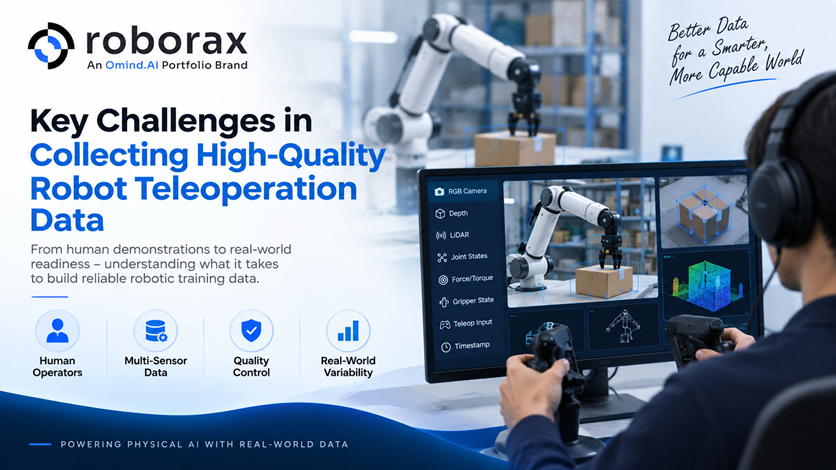
Robots are moving beyond controlled industrial environments into warehouses, healthcare facilities, homes, and other dynamic settings. As these systems become more capable, they need large volumes of reliable data to learn how to perceive environments, make decisions, and execute physical tasks. One of the most valuable sources of this information is human-guided robot operation, where skilled operators demonstrate tasks that robots can later learn to reproduce.
However, collecting useful demonstrations is not simply a matter of recording a human controlling a robot. Robot teleoperation data collection involves coordinating hardware, operators, sensors, task instructions, and data-quality processes. Small inconsistencies in any part of this pipeline can reduce the usefulness of the resulting dataset.
For teams developing embodied AI and physical AI systems, understanding these challenges is essential for building dependable robotic training data.
Human operators naturally perform the same task in slightly different ways. One operator may approach an object from the left, while another may use a different trajectory. Even experienced operators can vary their speed, grip position, force, and timing.
Some variation is useful because it exposes models to different strategies. Excessive or unexplained variation, however, can introduce noise into the dataset.
To address this challenge, teleoperation projects need clear task definitions, standardized operating procedures, operator training, and quality-control criteria. Demonstrations should capture meaningful behavioral diversity without allowing avoidable inconsistencies to dominate the dataset.
Modern robots rarely depend on a single sensor. Teleoperation datasets can include RGB cameras, depth cameras, LiDAR, joint positions, force and torque measurements, gripper states, robot poses, controller inputs, and other signals.
These streams must be synchronized accurately.
Even a small timing mismatch can create problems. For example, a camera frame might indicate that an object is in one position while the corresponding robot-action signal represents a slightly earlier or later state. When these records are used together for model training, the relationship between observation and action can become ambiguous.
Reliable timestamping, sensor synchronization, calibration, and data validation are therefore critical components of robot teleoperation data collection.
Not every demonstration should automatically become training data.
An operator may accidentally collide with an object, lose control of the robot, pause unexpectedly, or execute an inefficient movement. Sensor failures can also result in incomplete or corrupted recordings.
Without systematic quality control, these demonstrations can enter the training dataset unnoticed.
A robust pipeline should identify failed episodes, missing sensor streams, abnormal trajectories, unexpected collisions, and other quality issues before data is approved. Depending on the training objective, imperfect demonstrations may either be removed, flagged, or separately labeled as failure examples.
Teleoperation can require sustained concentration, especially when operators control complex robots or perform precision tasks repeatedly.
As sessions become longer, fatigue can affect reaction time, precision, consistency, and decision-making. This creates another source of variability in the dataset.
Organizations collecting large-scale demonstrations need practical operator-management strategies. These may include reasonable session lengths, scheduled breaks, ergonomic workstations, operator rotation, and monitoring of task performance.
The goal is not merely to maximize the number of recorded hours. It is to maintain the quality and consistency of demonstrations throughout the collection process.
A robot trained only on predictable demonstrations may struggle when conditions change.
Objects can appear in different orientations. Lighting can change. Backgrounds may vary. Objects may be partially occluded, misplaced, damaged, or surrounded by clutter. Human operators may also encounter unexpected obstacles during a task.
High-quality teleoperation datasets therefore need carefully designed diversity.
This can involve collecting demonstrations across different environments, object configurations, viewpoints, lighting conditions, task variations, and levels of clutter. Such diversity helps create robotic training data that better represents the conditions robots are expected to encounter after deployment.
It may seem logical to collect only successful demonstrations. However, failure information can also be valuable for robot learning.
A dataset containing only successful trajectories provides limited information about what should happen when a robot approaches a mistake. Carefully documented failures can help researchers understand unsafe actions, inefficient trajectories, recovery behaviors, and task boundaries.
The challenge is distinguishing useful failure data from simple recording errors.
Failures should be captured with sufficient context, including the task state, environment, robot actions, and outcome. Appropriate labeling can then make these examples useful for evaluation, corrective learning, or preference-based training.
Collecting a few demonstrations in a laboratory is very different from producing thousands or millions of episodes.
At scale, organizations may need multiple robots, operators, locations, task categories, and sensor configurations. As the operation grows, maintaining identical standards becomes increasingly difficult.
A scalable robot teleoperation data collection pipeline should therefore include standardized schemas, automated validation, metadata management, dataset versioning, and clear acceptance criteria.
Automation can handle repetitive checks, while human reviewers can focus on ambiguous or high-value samples.
Raw recordings alone do not provide enough context for many machine-learning applications.
A useful teleoperation dataset may need metadata describing the task, environment, robot configuration, operator session, sensor setup, object category, success status, and relevant events.
Without this information, teams may struggle to filter datasets, reproduce experiments, identify problematic samples, or construct task-specific training subsets.
Well-structured metadata transforms a collection of recordings into a more usable training resource.
Teleoperation quality is closely tied to hardware reliability.
Camera interruptions, communication latency, controller issues, calibration drift, battery limitations, and mechanical problems can all affect demonstrations. If such issues are not detected, corrupted samples may be mixed with valid data.
Routine calibration, equipment checks, automated system-health monitoring, and post-session validation can reduce these problems.
For multi-robot deployments, maintaining consistent hardware configurations and documenting hardware changes is equally important.
The final challenge is converting raw teleoperation recordings into structured data that machine-learning systems can actually use.
This often requires data cleaning, segmentation, synchronization, annotation, quality assessment, labeling of task outcomes, and dataset organization. Different learning approaches may also require different representations of the same demonstration.
For example, one project may focus on state-action trajectories, while another may need task-level labels, object interactions, human preferences, or failure classifications.
This is why teleoperation should be treated as a complete data pipeline rather than simply a recording activity.
High-quality robot teleoperation data sits at the intersection of human expertise, robotics hardware, sensor systems, data engineering, and quality assurance. The objective is not simply to gather more demonstrations but to collect data that is accurate, diverse, well-structured, and relevant to the robot’s intended tasks.
Organizations developing physical AI systems can improve dataset quality by establishing standardized collection protocols, synchronizing sensor streams, training operators, validating demonstrations, capturing meaningful edge cases, and maintaining detailed metadata.
At Roborax, we focus on building structured data-collection workflows that help robotics teams turn human demonstrations into usable robotic training data. By combining teleoperation workflows with systematic quality control and dataset preparation, teams can develop data resources designed around the behaviors and environments their robots need to master.
As embodied AI continues to evolve, the quality of the data pipeline will remain a fundamental factor in how effectively robots learn from human experience.




