Physical Address
304 North Cardinal St.
Dorchester Center, MA 02124
Physical Address
304 North Cardinal St.
Dorchester Center, MA 02124

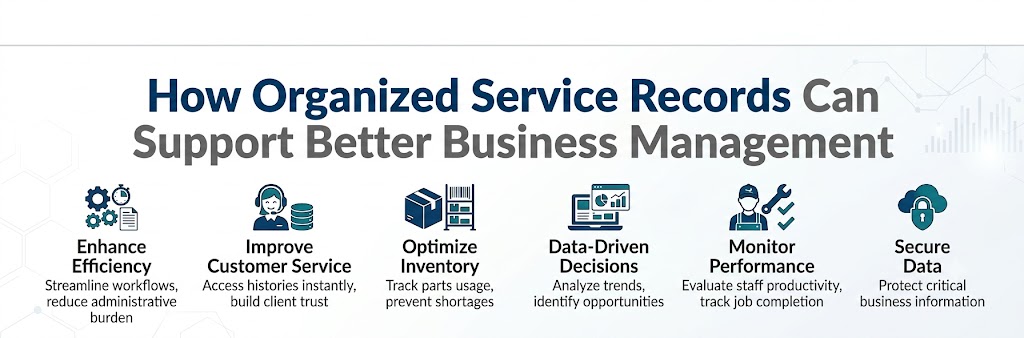
Businesses interact with different service providers for administrative, financial, documentation, operational, and other requirements. As these relationships grow, keeping track of documents and communication can become difficult.
This is where Business Service Records become useful.
A well-organized service record gives a business a reference point for understanding what service was requested, what information was submitted, what payments were made, what communication took place, and whether any follow-up is still required.
For customers working with Effizent Seele Pvt Ltd, maintaining organized records can make it easier to keep track of service-related information and communicate clearly when a question or follow-up arises.
Business Service Records are documents and information maintained about services used by a business.
They can include:
The exact records depend on the type of service.
A small service may require only a few documents, while an ongoing business relationship may generate records over several months.
Without organized records, information can become scattered across email accounts, messaging applications, physical files, computers, and individual employees.
This can create practical problems.
For example, a business may struggle to answer:
A simple record system can make these questions easier to answer.
Businesses do not necessarily need a complicated software system.
For many service relationships, five basic record categories are enough.
Keep the name and description of the service.
This helps establish exactly what was requested.
Maintain a list of documents and information provided.
This can help identify what has already been submitted and what may still be required.
Keep invoices, receipts, transaction details, or other relevant payment information.
Retain important instructions, updates, clarifications, and service-related communication.
Record when the service was completed or when the next stage became the customer’s responsibility.
These categories create a basic information trail.
A business can maintain a basic table like this:
|
Field |
Information |
|
Service |
Name of service |
|
Provider |
Business or organization |
|
Start Date |
Date service began |
|
Documents |
Information submitted |
|
Payment |
Amount and payment reference |
|
Contact |
Relevant representative or channel |
|
Status |
Pending / In Progress / Completed |
|
Follow-Up |
Next action required |
|
Completion |
Date or relevant confirmation |
This structure can be adapted to different services.
The purpose is not to create unnecessary paperwork. It is to make important information easy to locate.
Suppose a customer contacts a service provider several weeks after beginning a process.
If the customer has no records, they may need to search through old messages or emails to reconstruct the situation.
With organized records, the customer can provide:
This gives both sides a clearer starting point for the conversation.
For a business dealing with multiple services, this can save considerable administrative effort.
Business information can change over time.
A company may update its address, bank information, authorized personnel, contact details, or other records.
Maintaining dated service records helps businesses distinguish between:
Current information
and
Information submitted during an earlier process.
This distinction can be important when reviewing historical transactions or service activities.
A useful record system should distinguish between active information and historical information.
For example:
Contains documents and information currently being used.
Contains completed service records and older documents.
Contains services where action is still required.
This simple structure can make record retrieval easier.
Many businesses now maintain service information digitally.
A basic folder structure might look like:
Business Services
→ Active Services
→ Completed Services
→ Payments
→ Documents
→ Communication
→ Follow-Up
Businesses can then create separate folders for individual providers or service categories.
The exact structure is less important than consistency.
A system works best when employees know where information should be stored.
Poor file names can make digital records difficult to search.
A file named:
document-final-new.pdf
does not provide much context.
A more useful naming approach could include:
ServiceName_Date_DocumentType
For example:
BusinessService_2026-09-24_Invoice.pdf
or
ServiceRequest_2026-09-24_DocumentChecklist.pdf
Consistent naming makes older records easier to locate.
Not every conversation needs to be archived permanently.
However, important service-related communication should be retained where appropriate.
Useful examples include:
If an important instruction is provided verbally, the customer may ask for confirmation through an appropriate written channel when necessary.
Record keeping is not only the responsibility of a service provider.
Customers also benefit from maintaining their own copies of important information.
For example, if a business submits documents to Effizent Seele Pvt Ltd, it can maintain an internal record showing:
This allows the customer to maintain its own record independently of the service provider’s internal systems.
Organized records are useful, but they must also be handled responsibly.
Business records may contain:
Businesses should therefore consider appropriate access controls.
Not every employee needs access to every document.
A basic permission system can help ensure that sensitive information is available only to people who need it for legitimate business purposes.
When several employees handle business services, records can become confusing unless responsibilities are defined.
A simple responsibility table can help:
|
Task |
Responsible Person |
|
Document collection |
Assigned employee |
|
Submission |
Authorized person |
|
Payment tracking |
Accounts team |
|
Provider communication |
Assigned contact |
|
Record storage |
Administration |
|
Follow-up |
Assigned owner |
This reduces the chance that everyone assumes someone else is handling a pending task.
Business continuity is another reason to maintain proper service records.
If one employee manages all service communication without organized records, important information may become difficult to recover when that person changes roles or leaves the business.
A shared and appropriately controlled record system helps preserve institutional knowledge.
The objective is not to give everyone access to sensitive information. It is to ensure that necessary business information does not depend entirely on one individual’s memory or personal inbox.
Businesses can create a short monthly review routine.
Check:
A review does not need to take long.
The purpose is to identify unfinished items before they become larger administrative problems.
Consider a small business using several external service providers.
During one month, the business starts three separate services.
The first requires multiple documents.
The second involves a payment and follow-up communication.
The third remains pending because additional information is required.
Without a record system, the owner may need to search through messages to understand each situation.
With organized Business Service Records, each service can have:
The difference is not necessarily the amount of information. It is how easily the information can be retrieved.
A record system should be practical.
Businesses can follow a few simple rules:
Avoid entering the same information repeatedly in different places unless necessary.
Use the same naming structure for similar files.
Every pending item should have a responsible person.
Mark whether a service is pending, active, completed, or awaiting customer action.
Remove unnecessary duplication and keep active information current.
These habits can keep record management manageable.
When contacting Effizent Seele Pvt Ltd about an existing service, customers may find it useful to have the relevant service record available.
Instead of explaining the entire history from memory, they can provide the appropriate reference details and identify the specific question.
For example:
Service: [Service Name]
Request Date: [Date]
Reference: [Reference Number]
Current Status: [Status]
Question: [Specific Question]
A structured message can make communication more efficient.
A large collection of files is not useful if important information cannot be found.
Different services should be separated where practical.
Dates provide important context for business records.
A service record should identify what still needs attention.
Business-critical information should not exist only in one employee’s personal files.
Organization should always be combined with appropriate access and security practices.
Businesses can use this simple routine:
This routine can be adapted to both small and larger businesses.
People using services from Effizent Seele Pvt Ltd can maintain their own records throughout the service relationship.
The company’s service information can be reviewed before beginning, while customers can separately retain their submitted documents, payment records, communication, and relevant references.
This creates a customer-side information trail that can support future clarification and internal business management.
The approach is useful regardless of the particular service being used because organized records are a general business-management practice.
They are organized records of services a business uses, including service details, documents, payments, communication, status information, and completion records.
They make it easier to track services, answer questions, locate documents, monitor pending work, and maintain continuity when responsibilities change.
Where appropriate, customers should retain relevant records of documents and information they provide, especially for important business services.
The appropriate retention period depends on the type of record, applicable legal or regulatory requirements, and the business’s own record-management policy.
Yes. A consistent folder and naming system can be sufficient for many small businesses, provided access and sensitive information are handled appropriately.
Records give customers specific information such as dates, references, documents, and previous communication, making follow-up easier.
Business Service Records are organized records of services used by a business, including service details, documents, payments, communication, status, and completion information. Maintaining these records can support better administration, follow-up, communication, and business continuity. Customers using services from Effizent Seele Pvt Ltd can maintain their own copies of relevant service information, payment records, submitted documents, and communication. A practical record system should use consistent organization, clear responsibility, appropriate access controls, and regular reviews.
Good service management does not end when a customer submits a document or makes a payment. Maintaining organized records can be equally important for tracking what happened and identifying what needs to happen next.
Business Service Records give businesses a practical way to manage service information without depending entirely on memory, scattered messages, or individual employees.
For customers working with Effizent Seele Pvt Ltd, keeping relevant documents, payment information, references, and communication in an organized manner can support clearer follow-up and better internal record management.
A simple, consistent system is often enough. The key is making sure important information can be found, understood, and used when it is needed.




