Physical Address
304 North Cardinal St.
Dorchester Center, MA 02124
Physical Address
304 North Cardinal St.
Dorchester Center, MA 02124

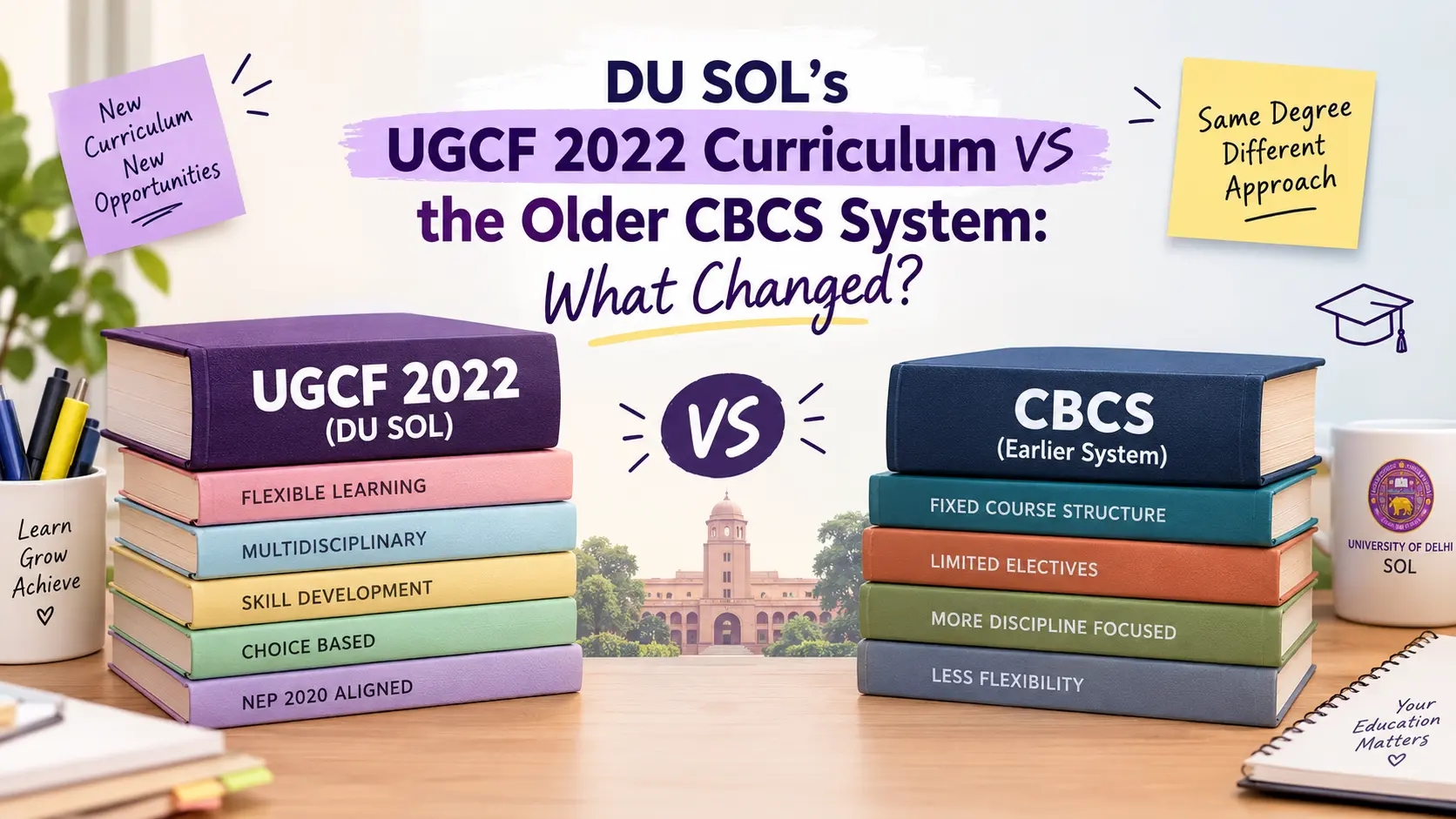
If you’ve come across both “CBCS” and “UGCF” while researching DU SOL’s course structure and weren’t sure which one actually applies to you, you’re not alone — the terminology shift reflects a genuine curriculum overhaul, not just a rebranding. Here’s what actually changed and why it matters.
Delhi University, including DU SOL, moved from the Choice Based Credit System (CBCS) to the Undergraduate Curriculum Framework 2022 (UGCF) starting with the 2022-23 academic session, as part of aligning with the National Education Policy (NEP) 2020. This wasn’t an isolated DU SOL decision — it reflects a nationwide shift in Indian higher education policy, with Delhi University implementing its own specific version of the NEP-mandated changes through the UGCF.
This depends entirely on when you were admitted:
Students don’t get automatically shifted onto the newer framework mid-degree — you generally continue under whichever curriculum was in effect when you were admitted, which is worth keeping in mind if you’re referencing syllabus material online and want to make sure it matches your specific admission year.
Multiple entry and exit points. This is one of UGCF’s most talked-about features. Rather than committing to a full multi-year program with no formal recognition if you leave early, UGCF allows students to exit at defined points with a corresponding credential — an Undergraduate Certificate after one year, an Undergraduate Diploma after two years, and a full Bachelor’s degree after three (or an Honours degree with research, after four). CBCS didn’t offer this same structured, credentialed exit flexibility.
Course categorization. UGCF organizes papers into clearer categories — Core Courses (DSC), Discipline Specific Electives (DSE), Generic Electives (GE), Skill Enhancement Courses (SEC), Ability Enhancement Courses (AEC), and Value Added Courses (VAC) — giving students a more explicit map of what each paper is meant to contribute to their overall degree, compared to CBCS’s somewhat less granular structure.
Credit distribution changes. UGCF’s credit structure differs from CBCS’s, with adjustments to how credits are distributed across core, elective, and skill-based papers — a change that generated genuine debate within the university when it was first introduced, given concerns raised by some academic council members about overall credit totals.
Greater emphasis on skill and vocational learning. UGCF places more explicit weight on internships, vocational training, and skill-based papers compared to CBCS, reflecting NEP 2020’s broader push toward making higher education more directly connected to employability.
Digital and blended learning integration. UGCF’s rollout has coincided with greater integration of online study resources and blended learning modules, complementing DU SOL’s already digital-friendly study material and portal system.
Under UGCF, DU SOL’s BA Programme is structured as a genuine dual-discipline degree — students study two core disciplines together (for instance, History and Political Science, or Economics and Education) across six semesters, rather than one discipline studied at an advanced level with a secondary minor, which is closer to how BA (Honours) is structured instead. Understanding this distinction matters specifically when downloading syllabus material or comparing subject combinations, since a “BA Programme with History and Political Science” student needs the BA Programme syllabus specifically, not the Honours syllabus for either individual subject.
Not in any way that disadvantages students — both the older CBCS-based degrees and the newer UGCF-based ones remain fully valid, UGC-recognized qualifications. The shift is a curriculum design and structural change, not a recognition or credibility change. Students who completed or are completing their degree under CBCS aren’t holding a “lesser” qualification compared to UGCF-based graduates; they simply followed a different — now superseded — version of the university’s curriculum.
The shift from CBCS to UGCF 2022 reflects Delhi University’s broader alignment with NEP 2020, bringing genuine structural changes like multiple exit points, refined course categorization, and greater skill-orientation to DU SOL’s curriculum. Whichever framework applies to you depends purely on your admission year, and both remain fully valid, recognized pathways to a degree. If you’re a prospective student exploring DU SOL’s distance BA or another program, you’ll be admitted under the current UGCF 2022 framework, so it’s worth reviewing its specific structure — including exit-point options — before finalizing your course choice. For the latest curriculum notifications, check DU SOL’s official website directly.




