Physical Address
304 North Cardinal St.
Dorchester Center, MA 02124
Physical Address
304 North Cardinal St.
Dorchester Center, MA 02124

A single missing geolocation coordinate can now keep an entire shipment of palm oil off European shelves. That’s not a hypothetical. It’s the new baseline under the EU Deforestation Regulation, and most palm oil companies aren’t built for it. Not because they’re careless, but because their systems were never designed to track where every tonne of fruit actually came from.
Compliance meant submitting the correct certificate once a year. Now it means providing proof, on demand, of the exact plot that your fruits were picked from, the mill they went through, and the truck they were shipped into the port. Get one link in that chain wrong, and your shipment sits at customs while your buyer looks for a supplier who has their data in order.
Four trends occurred simultaneously, and all of them are here to stay.
EUDR enforcement dates have moved more than once, and grace periods have been extended. That’s given plenty of companies a false sense of breathing room. But buyers aren’t waiting for the regulation to bite before they start asking for the data behind it. If your traceability records aren’t ready now, the deadline slipping a few months doesn’t fix that; it just delays when the problem becomes visible.
Here’s the uncomfortable part: most compliance failures in palm oil aren’t caused by companies trying to cut corners. They’re caused by data that’s scattered across five systems that were never meant to talk to each other.
Procurement tracks supplier and smallholder information in one place. Mills log fresh fruit bunch intake on paper logs or a local spreadsheet. Logistics runs on a separate transport system with zero connection back to where the fruit originated. By the time the audit question comes up, you will need to stitch three shipments from three systems with no common identifier.
When compliance teams have to manually match delivery notes to mill receipts to shipping manifests, a single audit response can take two or three weeks to assemble. Multiply that across a dozen mills and hundreds of smallholder suppliers, and you’ve got a full-time job that exists purely to patch over disconnected systems.
Ask most palm oil operations who can trace a single tonne of CPO from plantation to port in under an hour, and you’ll usually get silence. Responsibility gets split across procurement, mill operations, and logistics, and none of them hold the end-to-end record. That gap is exactly where compliance failures happen.
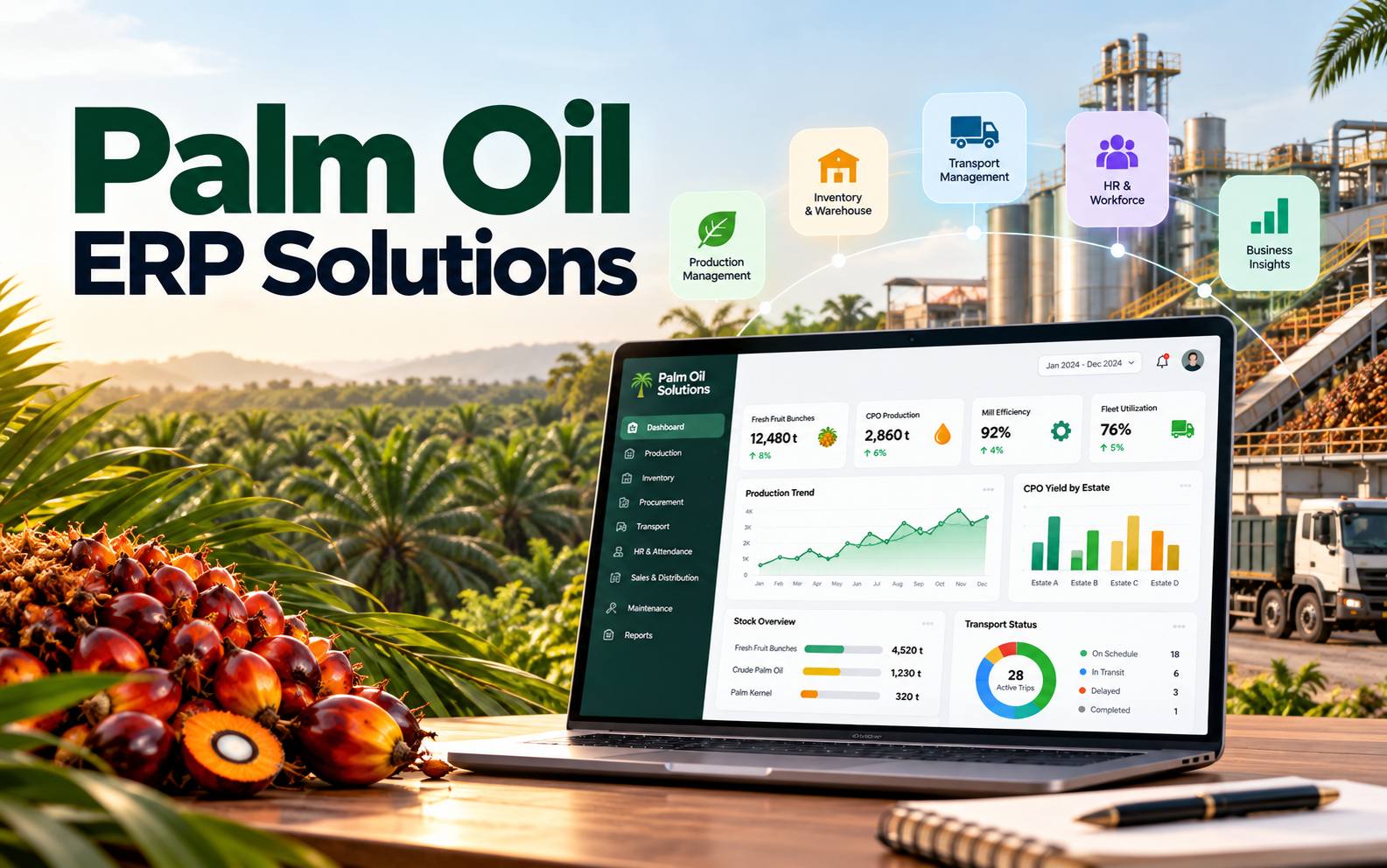
This is where purpose-built palm oil ERP solutions earn their cost. Not as another dashboard to check, but as the single system that connects the field to the final shipment.
A properly configured ERP captures geolocation at the first point of collection and keeps that data attached to the product through every processing step. No re-typing, no separate spreadsheet, no gap between what happened at the plantation and what shows up on the compliance report.
Instead of a team assembling audit packages by hand, the ERP generates them from data that’s already been captured during normal operations.
When procurement, production, and transport run on the same platform, a compliance question doesn’t trigger a scramble across departments. Anyone with the right access can pull the full chain of custody for a shipment in minutes, while it’s still in transit, not after a buyer has already flagged it.
Not every ERP built for agriculture or manufacturing will handle palm oil’s specific compliance load. A few things separate the systems that actually help from the ones that just add another login.
Picture a refinery in Sumatra processing around 800 tonnes of CPO a day, sourcing from roughly 300 smallholders across a dozen collection points. Before consolidating onto a single ERP, their compliance team spent close to three weeks assembling documentation for a single major buyer’s NDPE audit, cross-referencing paper delivery slips, a mill spreadsheet, and a separate export system that didn’t share supplier IDs with either.
After moving mill intake, supplier records, and export documentation onto one platform, that same audit package took under four days to compile. Nothing about their sourcing practices changed. What changed was that the data already existed in one place instead of three.
Compliance in palm oil isn’t getting simpler, and there’s no sign of that reversing. EUDR, RSPO, ISPO, MSPO, and buyer-specific NDPE requirements are stacking on top of each other, each wanting the same underlying data presented a different way.
Companies that keep treating this as a paperwork problem will keep losing weeks to every audit. Companies that treat it as a data infrastructure problem, with one ERP system holding the full chain of custody from plot to port, are the ones that answer an audit request in an afternoon instead of a month.
The regulations aren’t slowing down to let anyone catch up. The systems you run your supply chain on decide whether you’re ready for the next one or scrambling again.