Physical Address
304 North Cardinal St.
Dorchester Center, MA 02124
Physical Address
304 North Cardinal St.
Dorchester Center, MA 02124

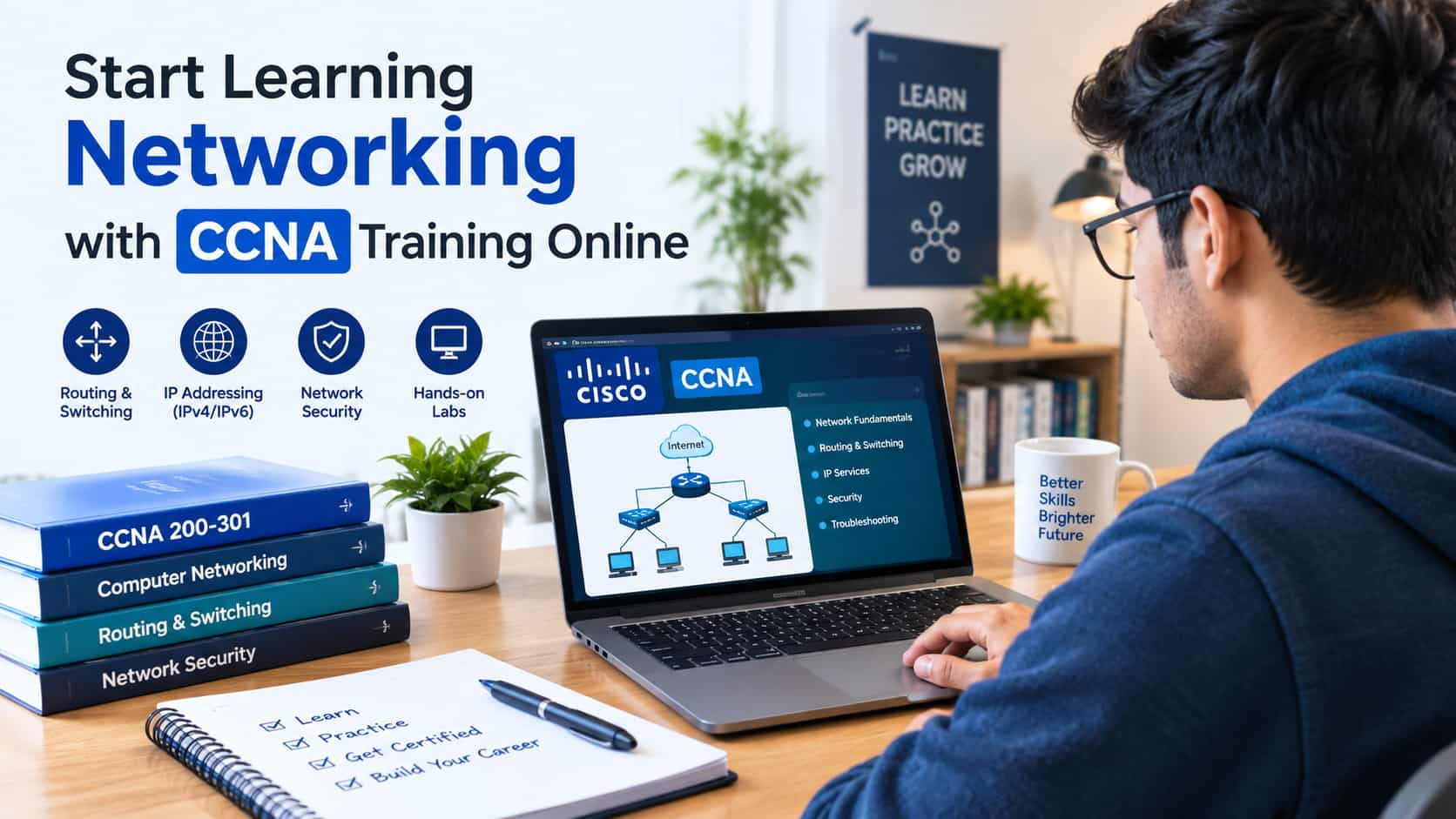
If you want to build a career in IT, learning computer networking is a practical place to start. Networks connect computers, servers, cloud platforms, and business applications, allowing people and organizations to share information securely. Understanding how these systems communicate can help you prepare for roles in network support, IT infrastructure, and network engineering.
CCNA training online offers a structured way to learn networking concepts from the basics to more advanced topics. With the right learning approach, practical lab exercises, and regular practice, beginners can develop the technical knowledge needed to understand and troubleshoot computer networks.
Whether you are a student, an IT fresher, or a working professional, this guide explains what CCNA training covers, why networking fundamentals matter, and how to begin your learning journey.
CCNA stands for Cisco Certified Network Associate. It is an entry-level networking certification that validates knowledge of networking fundamentals, IP connectivity, network access, IP services, security fundamentals, and automation and programmability. Cisco does not require formal prerequisites for the CCNA certification exam.
CCNA training helps learners understand how networks operate and how network engineers configure and troubleshoot network devices. It provides a foundation for people who want to explore computer networking, IT support, and network administration.
Computer networking plays an important role in modern IT infrastructure. Businesses use networks to connect employees, servers, applications, cloud services, and other digital resources.
Learning networking fundamentals can help you:
Understand how computers communicate across networks.
Configure basic network devices and connections.
Identify and troubleshoot connectivity issues.
Learn how routing and switching work.
Understand network security and access control.
Prepare for further learning in cybersecurity, cloud networking, and network automation.
These skills can also help you understand how enterprise IT environments operate.
A structured CCNA course covers several important networking topics. Cisco’s official CCNA exam outline provides a useful reference for organizing your study plan.
Start by learning how networks work. Study the OSI and TCP/IP models, network devices, common protocols, and the differences between LANs and WANs. These concepts help you understand how information travels between devices.
IP addressing identifies devices on a network. Learn IPv4, IPv6, subnet masks, and subnetting to understand how networks divide and manage address spaces.
Practise subnetting regularly because it supports routing, network design, and troubleshooting.
Routing helps move packets between different networks, while switching connects devices within a local network. Learn about VLANs, trunking, static routes, and introductory routing protocols such as OSPF.
Practical exercises can help you understand how routers and switches handle network traffic.
Explore services such as DHCP, DNS, and NAT. Learn how access control lists, secure device management, and basic security practices help protect network resources.
These topics build a foundation for understanding enterprise networking and network security.
Modern networking also involves automation and centralized management. The CCNA syllabus includes introductory concepts related to automation, programmability, and AI in network operations.
Understanding these areas can prepare you to explore Python scripting and more advanced network automation later.
Choosing the right learning format can make your networking journey more organized. Before enrolling in CCNA training online, consider the following factors.
Structured syllabus: Check whether the course covers the relevant CCNA 200-301 exam topics.
Practical lab exercises: Look for opportunities to configure devices and troubleshoot network scenarios.
Beginner-friendly explanations: Choose lessons that explain technical concepts clearly before introducing complex configurations.
Doubt-clearing support: Access to an instructor or learning community can help you resolve difficult topics.
Flexible study options: Select a schedule that fits your education, work, and personal commitments.
A course should support both theoretical understanding and practical application. Watching lessons alone may not provide enough experience to solve real networking problems.
Yes. Beginners can start learning networking without previous professional experience. You should begin with basic computer concepts, IP addressing, and network devices before moving to routing, switching, and security.
Students, IT freshers, technical support professionals, and working professionals can all use CCNA training to develop networking knowledge.
Set aside regular study time, practise configurations, review your mistakes, and test your understanding with practice questions. A consistent learning routine can make complex topics easier to understand.
After developing relevant networking skills, you can explore entry-level roles such as:
Network Support Engineer
IT Support Engineer
Junior Network Engineer
Network Operations Center (NOC) Engineer
Technical Support Associate
The responsibilities and requirements vary by employer. Some positions may require additional experience, operating system knowledge, troubleshooting ability, or other certifications.
CCNA certification can demonstrate foundational networking knowledge, but it does not guarantee a job. Practical experience, communication skills, and continuous learning also matter.
If you want a structured introduction to computer networking, explore the CCNA 200-301 Online Course by PM Networking .
The course page describes networking fundamentals, IP addressing, switching, routing, security, IP services, and practical lab learning. Review the syllabus, course format, and available support to see whether the program matches your learning goals.
Begin with the basics, practise regularly, and gradually build your technical knowledge. With a clear study plan and hands-on experience, you can develop a stronger foundation for learning enterprise networking and related IT technologies.
Yes. You can begin with basic networking concepts and gradually progress to IP addressing, routing, switching, and security.
It is Cisco’s associate-level networking certification exam, covering networking fundamentals, network access, IP connectivity, IP services, security fundamentals, and automation and programmability.
Online training can provide structured lessons and flexible study options. Practical lab work and regular troubleshooting exercises help reinforce what you learn.
Review the official exam topics, study each subject systematically, practise network configurations, and use practice questions to identify gaps in your knowledge.
Depending on your interests, you can explore CCNP, network automation, cybersecurity, cloud networking, or specialized firewall training.




