Physical Address
304 North Cardinal St.
Dorchester Center, MA 02124
Physical Address
304 North Cardinal St.
Dorchester Center, MA 02124

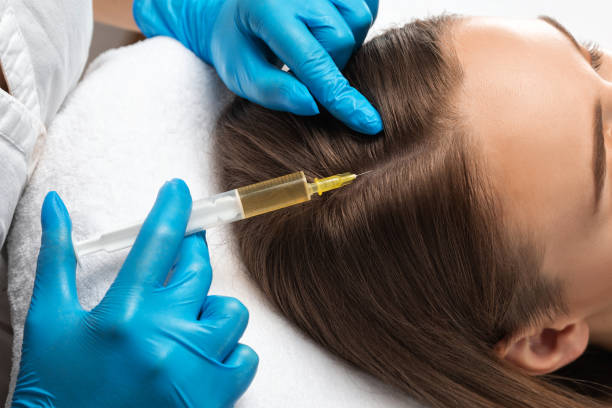
Yes, Hair Fillers Treatment in Dubai may be considered for selected cases of thinning hair, particularly when viable follicles remain in the affected areas. The treatment involves targeted scalp injections using a specialized formulation; Tajmeels describes its formula as combining hyaluronic acid with biomimetic peptides.
The important distinction is that hair filler is not simply a way of “adding hair” to the scalp. Its potential role is to support the local scalp environment and existing hair structures, while the underlying cause of thinning still needs to be identified.
That makes diagnosis one of the most important parts of the process.
Two people can have the same amount of visible thinning but completely different underlying causes.
One person may have gradual pattern hair loss. Another may have temporary shedding after a physiological stressor. Someone else may have inflammation, traction-related damage, nutritional issues, or a scalp disorder.
The visual appearance alone does not tell the complete story.
A clinician therefore looks beyond the number of hairs visible in a photograph. The distribution of thinning, strand caliber, scalp condition, history, and follicular health can all influence the treatment plan.
Hair thinning often involves a change in the caliber of individual strands.
A person may still have hair growing from an area, but the strands can become progressively finer. This can make the scalp more visible even before a clearly bald area develops.
This distinction is important because injectable scalp treatments generally work around existing tissue and follicles. They are not designed to manufacture follicles where none remain.
For an individual with early or moderate thinning, preserving and supporting viable hair may therefore be part of a broader treatment conversation.
Hair fillers can be considered as one tool within a larger hair-restoration strategy.
At Tajmeels, the treatment is described as a nonsurgical or minimally invasive injectable procedure intended to improve hair volume and thickness and support hair growth.
However, a patient’s suitability depends on more than whether the hair looks thin.
A consultation should determine whether the pattern is compatible with the treatment and whether another intervention should be prioritized.
There is a significant difference between a thinning zone and an area where follicles have been permanently lost.
With thinning hair, follicles may continue producing progressively finer strands. With established follicular loss, there may be little or no viable follicular activity in the area.
Hair fillers cannot be expected to replace a missing donor follicle or recreate a follicular unit that has been permanently destroyed.
That is one reason why early assessment can be useful. The earlier the cause and pattern are understood, the more treatment options can potentially be considered.
Hair filler treatment is not administered randomly across the scalp.
During treatment planning, the clinician identifies the regions where density, strand caliber, or overall fullness has changed. Small injections are then placed into selected areas according to the product and clinical protocol.
The injection depth and distribution matter because the scalp contains important anatomical structures, including blood vessels and nerves.
This is why professional administration is essential.
It may, depending on the formulation and the individual’s response.
Hair density is not determined solely by the number of follicles. The thickness of individual strands, their distribution, the contrast between hair and scalp, and the length and styling of the hair can all affect how dense the scalp appears.
A treatment that supports existing hair characteristics may therefore influence visual fullness without increasing the absolute number of follicles.
This is a useful distinction when evaluating before-and-after photographs.
Research into injectable scalp treatments is growing, but it is not accurate to treat all hair fillers as clinically identical.
For example, a small study examined a specific stabilized hyaluronic-acid complex containing additional components and reported improvements in several hair-related parameters. The study was limited in size and concerned a particular formulation.
Other research has investigated different injectable approaches for hair loss, but results from one ingredient or product should not automatically be transferred to another.
For patients, the practical question is not simply “Does hair filler work?” It is “What evidence supports the exact formulation being recommended for my scalp and type of hair loss?”
Pattern hair loss is a common cause of progressive thinning in both men and women.
The condition can affect the frontal scalp, temples, crown, or central parting depending on the individual. The follicles may gradually produce finer hairs over time.
Hair filler may be discussed as part of management in selected cases, but it should not automatically replace evidence-based medical assessment or other established treatments.
If pattern hair loss is suspected, the clinician may discuss broader options according to the patient’s diagnosis and circumstances.
Not necessarily. Hair thinning can have several causes, and an injectable treatment does not remove the underlying cause in every case.
The amount used should be determined by the treatment plan and product requirements, not by the assumption that a larger quantity produces a better result.
The terminology can be misleading. Hair-focused formulations may have different compositions and intended uses from aesthetic facial fillers.
An area with permanent follicular loss requires a different discussion. Injectable treatment does not replace a missing follicle.
Hair fillers may not be the first-line consideration when the primary issue is:
This does not mean injectable treatment can never be considered. It means the underlying issue deserves attention first.
A useful consultation can include several elements.
There is no universal number of sessions for every hair filler formulation.
Treatment frequency depends on the product, the patient’s response, the degree of thinning, and the clinician’s protocol. Tajmeels notes that the duration of results can vary according to formulation and maintenance.
Patients should therefore be cautious about packages that promise an identical number of sessions for everyone.
A personalized schedule is more clinically meaningful than a fixed treatment count.
Hair thinning is often a continuing biological process rather than a one-time cosmetic event.
Even when an injectable treatment produces a noticeable improvement, the underlying reason for thinning may continue to influence future hair density.
That is why long-term management can involve monitoring, scalp care, lifestyle considerations, and other treatments when appropriate.
The goal should be to understand the hair-loss pattern rather than repeatedly treating the appearance without reassessing the cause.
It can be an option worth discussing when the scalp has viable follicles and the treatment formulation is appropriate for the patient’s condition.
But suitability cannot be determined from the word “thinning” alone.
A proper consultation should establish what is causing the change, how advanced it is, which follicles remain active, and whether hair filler offers a reasonable role within the wider treatment plan.
For patients exploring Hair Fillers Treatment in Dubai, Tajmeels Clinic offers a consultation-based approach that considers the scalp, existing hair, treatment goals, and appropriate options.
Medical note: Hair filler products vary substantially in formulation and evidence. Results are individual, and injectable treatment should be performed by a qualified medical professional following an appropriate scalp assessment.




