Physical Address
304 North Cardinal St.
Dorchester Center, MA 02124
Physical Address
304 North Cardinal St.
Dorchester Center, MA 02124

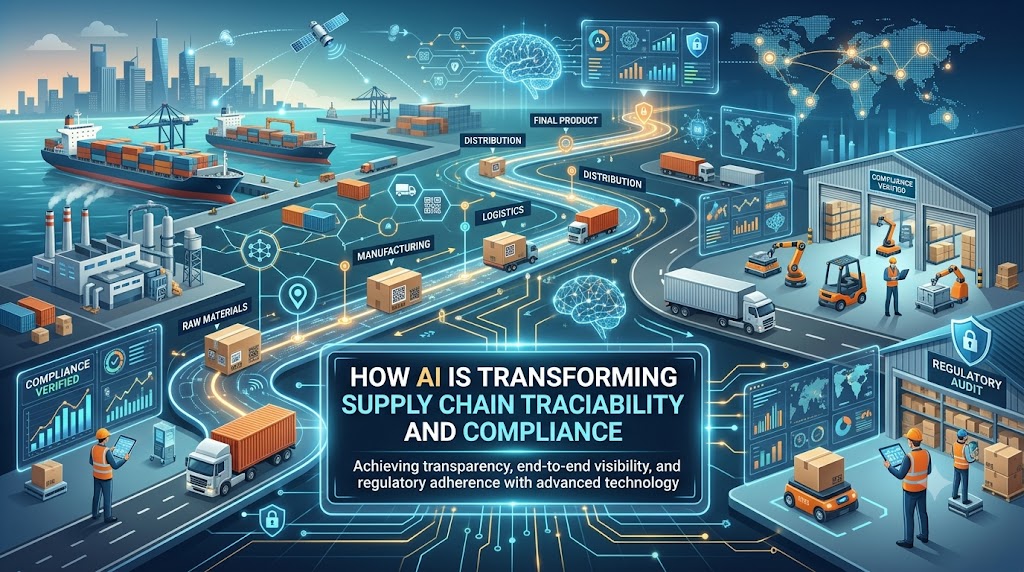
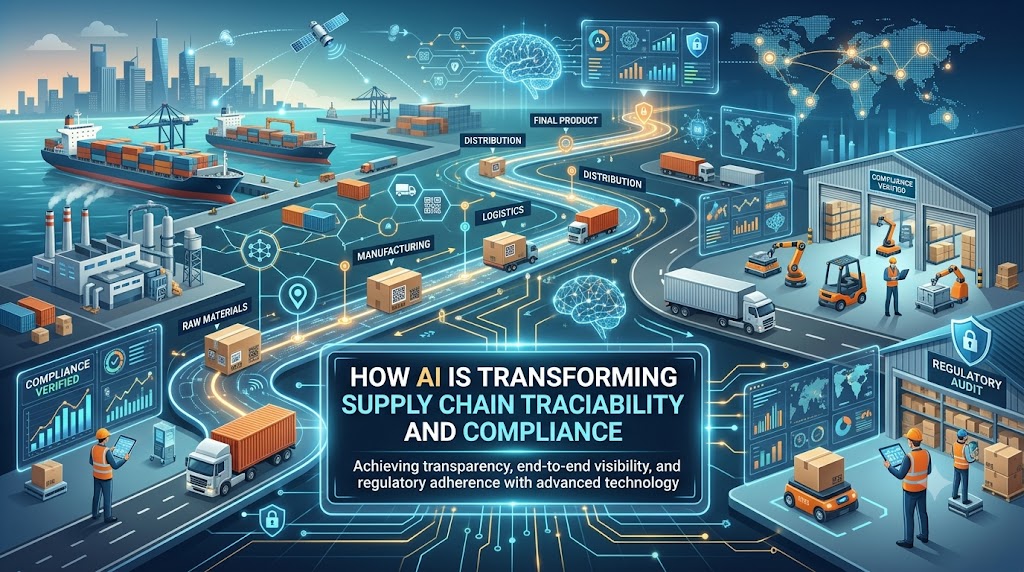
Supply chains are becoming increasingly complex. Businesses now manage products, materials, suppliers, manufacturers, logistics providers, warehouses, distributors, and customers across multiple locations and systems. As this complexity grows, organizations need better ways to understand what is happening across their supply networks.
Traditional supply chain tracking systems can provide valuable information, but the growing volume of data creates another challenge: how can businesses turn that information into useful decisions?
This is where artificial intelligence is becoming increasingly important.
AI supply chain traceability combines traceability data with artificial intelligence to help organizations identify patterns, detect anomalies, analyze risks, automate processes, and improve decision-making.
Instead of using traceability only to understand what happened in the past, businesses can increasingly use AI to identify potential problems and opportunities before they become major operational issues.
In 2026, the combination of AI, supply chain visibility, digital traceability, IoT, QR codes, RFID, and analytics is creating new opportunities for businesses across industries.
This article explains how AI is transforming supply chain traceability, how it can support compliance, what technologies are involved, and how businesses can prepare for an AI-enabled supply chain.
AI supply chain traceability refers to the use of artificial intelligence and machine learning technologies to analyze and improve the tracking, monitoring, and management of products, materials, suppliers, and events across a supply chain.
A traditional traceability platform may answer questions such as:
AI can add another layer of intelligence.
An AI-enabled system may also help answer:
This changes traceability from a primarily historical record into a more intelligent decision-support system.
Supply chain organizations generate huge amounts of data.
Every shipment, purchase order, production event, inspection, warehouse movement, delivery, and product transaction can create information.
As supply networks become more connected, the challenge is no longer simply collecting data.
The challenge is understanding it.
AI can analyze large datasets much faster than manual processes and help identify relationships that may otherwise be difficult to see.
This can support businesses in areas such as:
Traditional digital traceability systems are designed primarily to capture and retrieve information.
For example:
Supplier → Batch → Production → Shipment → Customer
A user can search the system and understand the product’s journey.
AI-enabled traceability adds an analytical layer.
The system can analyze historical and real-time information to identify patterns.
For example:
Supplier Data + Production Data + Logistics Data + Quality Data → AI Analysis → Risk Insight
This can help businesses move from simply knowing what happened to understanding what might happen next.
One of the most useful applications of AI is anomaly detection.
An anomaly is a data point or event that differs significantly from an expected pattern.
For example, an AI system may detect:
The system can flag these events for further investigation.
This does not necessarily mean the event is a problem. Instead, it helps teams focus their attention on events that deserve investigation.
Businesses often work with large numbers of suppliers.
Monitoring every supplier manually can be difficult.
AI can analyze supplier-related information and identify patterns across:
Organizations can use these insights to identify suppliers that may require additional attention.
For example, if a supplier’s delivery performance is declining while quality incidents are increasing, an AI system could highlight the pattern for the procurement or supply chain team.
Product recalls require fast and accurate decision-making.
When a product issue is discovered, businesses need to determine:
A connected traceability system can provide the underlying data.
AI can help analyze that data and identify relationships between products, batches, suppliers, locations, and distribution events.
This can support faster investigations and more targeted recall decisions.
Quality problems can occur at different points in a supply chain.
A defect may originate from a supplier, manufacturing process, material, storage condition, or transportation event.
AI can analyze historical quality information alongside traceability records.
For example, an organization may discover that certain defects occur more frequently when:
Identifying these relationships can help businesses investigate root causes.
Compliance requires accurate and accessible records.
Businesses may need to demonstrate information about product origins, suppliers, production processes, transactions, materials, or other supply chain events.
AI does not replace compliance systems or regulatory requirements.
Instead, it can help organizations analyze compliance-related data and identify potential gaps.
AI can help flag:
This can make compliance teams more efficient.
Compliance processes often involve repetitive activities.
Employees may need to check whether required information exists, compare records, review supplier documentation, or identify inconsistencies.
AI can assist with these activities by automatically analyzing large volumes of data.
For example, an AI system may identify that certain product records are missing required information.
Instead of manually checking thousands of records, a compliance team can investigate the records flagged by the system.
This can reduce manual effort while improving visibility into potential issues.
Real-time visibility is becoming increasingly important for modern supply chains.
IoT sensors, RFID systems, GPS technologies, warehouse systems, and other connected technologies can generate information continuously.
AI can analyze these data streams and identify events that may require attention.
For example, in a temperature-sensitive supply chain, sensors may generate temperature information throughout transportation.
AI can analyze that information and identify unusual patterns.
The combination can create a powerful model:
IoT Sensors → Real-Time Data → Traceability Platform → AI Analysis → Alerts and Insights
This approach can help businesses respond to potential issues more quickly.
Cold chains are particularly dependent on environmental conditions.
Products such as food, pharmaceuticals, and other temperature-sensitive goods may need controlled transportation and storage.
An AI-enabled cold chain traceability system can analyze information such as:
If the system detects an unusual pattern, it can alert the appropriate team.
This can support proactive intervention rather than waiting until a product reaches its destination and a problem is discovered.
One of the most important developments in AI-enabled supply chain management is the ability to move from reactive to predictive operations.
Traditional traceability often tells businesses what has already happened.
Predictive analytics attempts to identify what could happen next.
For example, AI may analyze:
The resulting insights can help businesses prepare for potential disruptions.
Predictive capabilities depend heavily on the quality, quantity, and relevance of the data available to the AI system.
QR codes can provide a simple connection between physical products and digital product information.
When a QR code is scanned, it can connect the user to a digital record containing product information.
AI can analyze the data associated with these product records.
For example, businesses can use product interaction data to understand:
QR codes therefore provide the identification and access layer, while AI can provide an analytical layer.
RFID can generate large volumes of product movement information.
In warehouses and manufacturing environments, RFID can help identify and track tagged objects.
AI can analyze RFID data to identify:
This can help businesses improve inventory visibility and operational efficiency.
Digital Product Passports are becoming increasingly important for product transparency.
A Digital Product Passport can contain information about a product’s materials, components, manufacturing, sustainability, repair, recycling, and lifecycle.
As businesses create larger volumes of product data, AI can help analyze that information.
AI could potentially support:
The combination of Digital Product Passports and AI could therefore create more intelligent product information ecosystems.
Traceability is only effective when the underlying information is accurate.
Supply chain data may contain:
AI can help identify unusual or inconsistent data patterns.
For example, if a product identifier suddenly appears in an unexpected location or a supplier record contains conflicting information, the system can flag it for review.
Improving data quality can make the broader traceability system more reliable.
Supplier collaboration is an important component of supply chain traceability.
A business may have excellent internal traceability but limited visibility into upstream suppliers.
AI can help analyze supplier information and highlight areas where additional data may be needed.
For example, a system could identify:
This can help procurement and supply chain teams prioritize supplier engagement.
Organizations can potentially gain several benefits by combining AI with digital traceability.
AI can analyze large volumes of information and highlight important events.
Anomaly detection and predictive analytics can help identify potential problems earlier.
AI can help identify missing or inconsistent compliance-related data.
Connected traceability data can help organizations identify affected products and supply chain relationships.
AI can analyze supplier performance and identify emerging risks.
Automation can reduce repetitive data review and monitoring tasks.
Better visibility and predictive insights can help organizations respond to disruptions.
AI offers significant potential, but businesses should not treat it as a simple plug-in technology.
AI systems depend on data.
If the underlying traceability information is incomplete or inaccurate, AI outputs may also be unreliable.
Businesses often operate multiple systems.
Connecting ERP, warehouse, manufacturing, supplier, logistics, and traceability systems may require significant integration work.
AI cannot analyze information that businesses do not have.
Supplier participation and data-sharing processes are therefore important.
Businesses may need to understand why an AI system generated a particular alert or recommendation.
For critical operational and compliance decisions, human oversight remains important.
Supply chain information can contain sensitive business data.
Organizations need appropriate access controls, security practices, and governance.
Businesses can improve their chances of success by taking a structured approach.
Do not implement AI simply because it is trending.
Identify a specific problem, such as:
Then determine whether AI can provide meaningful value.
AI should sit on top of reliable data.
Businesses should first establish:
Where possible, connect existing business systems instead of creating another isolated data environment.
A focused pilot can help businesses evaluate AI performance before expanding across the entire organization.
AI-generated insights should support decision-making rather than automatically replacing responsible business teams for critical decisions.
The future of supply chain traceability will likely involve increasingly intelligent systems.
Instead of simply recording supply chain events, platforms will increasingly analyze those events and provide recommendations.
A future traceability architecture may look like:
Product Identification → Real-Time Data → Traceability Platform → AI Analytics → Risk Detection → Automated Workflow → Human Decision
AI agents may also increasingly support operational tasks by monitoring supply chain information, identifying exceptions, generating reports, and routing issues to the appropriate teams.
This could make traceability more proactive and operationally valuable.
However, the success of AI will continue to depend on strong foundations: accurate data, standardized identifiers, connected systems, reliable integrations, and clear governance.
AI requires reliable supply chain data to deliver useful insights.
TransGenie’s traceability capabilities can help businesses establish the digital foundation needed to connect product, batch, lot, supplier, and supply chain information.
By using technologies such as QR codes, NFC, RFID, and digital traceability platforms, businesses can create structured product and supply chain data.
Once this foundation is established, organizations can explore advanced analytics and AI-driven capabilities to gain deeper insights into their operations.
For businesses planning an AI-enabled supply chain strategy, building reliable traceability should be an important first step.
AI is changing the role of supply chain traceability.
Traditional traceability helps businesses understand where products came from, how they moved through the supply chain, and where they went.
AI can take this information further by identifying patterns, detecting anomalies, analyzing risks, improving compliance monitoring, and supporting predictive decision-making.
The combination of AI, supply chain traceability, IoT, RFID, QR codes, cloud platforms, and digital product information can create a more intelligent and connected supply chain.
However, businesses should not begin with AI alone.
The strongest strategy starts with accurate product identification, reliable traceability data, standardized information, supplier collaboration, and connected systems.
Once that foundation is established, AI can turn traceability data into actionable intelligence.
For organizations looking to improve visibility, resilience, compliance, and operational efficiency, AI-powered supply chain traceability represents an important opportunity for the future.
AI supply chain traceability combines digital traceability systems with artificial intelligence to analyze product, supplier, batch, shipment, and supply chain data. It can help identify patterns, anomalies, risks, and potential operational issues.
AI can analyze large volumes of traceability data and identify unusual events, supplier risks, quality patterns, missing information, and other issues that may be difficult to identify manually.
Yes. AI can analyze connected traceability information to help identify relationships between products, batches, suppliers, production processes, and distribution locations during recall investigations.
AI can assist compliance teams by identifying missing information, inconsistent records, unusual transactions, and potential data gaps. It should support rather than replace appropriate compliance processes and human oversight.
QR codes can connect physical products to digital product records. The data associated with those records can then be analyzed using AI and other analytics technologies.
RFID can generate product movement and identification data. AI can analyze that information to identify inventory discrepancies, unusual movements, process patterns, and operational risks.
No. AI generally works best when built on top of a reliable traceability and data foundation. Product identification, event capture, data integration, and governance remain essential.




