Physical Address
304 North Cardinal St.
Dorchester Center, MA 02124
Physical Address
304 North Cardinal St.
Dorchester Center, MA 02124

In today’s digital-first business environment, mobile and web applications have become essential tools for improving customer experiences, streamlining operations, and creating new revenue opportunities. From small startups launching their first digital product to established enterprises modernizing their operations, businesses increasingly rely on applications to remain competitive and meet changing customer expectations.
However, one important question arises before starting any app project: should a business choose a ready-made application or invest in custom app development?
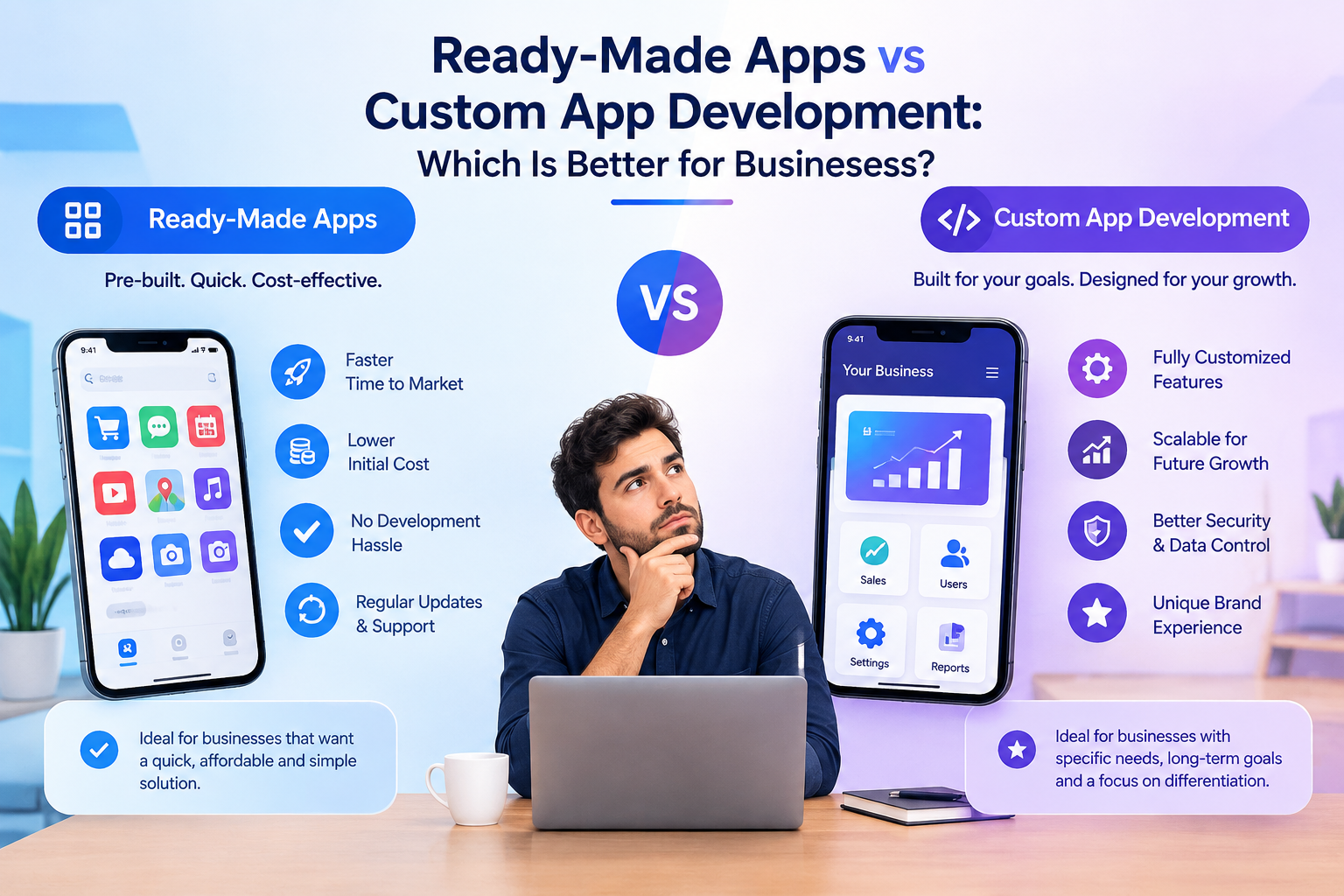
Both options offer distinct advantages, and the right choice depends on several factors, including business objectives, budget, implementation timelines, scalability requirements, and the level of customization needed. Ready-made apps provide pre-built functionality that businesses can implement quickly, while custom applications are developed specifically around an organization’s processes, customers, and long-term goals.
Choosing the wrong approach can result in unnecessary expenses, operational limitations, integration challenges, or missed growth opportunities. On the other hand, selecting the right solution can help businesses improve efficiency, deliver better services, and build a stronger digital presence.
In this blog, we will explore the differences between ready-made apps and custom app development, examine their advantages and limitations, and explain how businesses can determine which approach best supports their needs.
Ready-made applications are software solutions developed for a broad audience or a specific industry. They include predefined features and functionalities that businesses can use with minimal development effort. Depending on the product, these applications may be available through subscriptions, one-time licenses, or freemium pricing models.
Examples include ready-made customer relationship management (CRM) platforms, accounting applications, inventory management systems, project management tools, and e-commerce software.
Businesses can generally configure these applications by adjusting settings, selecting available features, adding users, and connecting supported third-party services. However, the extent of customization depends on the software provider and its pricing plan.
For example, a small online retailer may use an existing e-commerce platform to launch a digital storefront without building a complete shopping application from scratch. The platform may already provide product listings, payment integrations, order management, and basic reporting.
1. Faster implementation
One of the biggest advantages of ready-made applications is speed. Since the software is already developed, tested, and deployed, businesses can often start using it within days or weeks rather than waiting months for a complete development cycle.
This is particularly valuable for startups and businesses that need to respond quickly to market opportunities.
2. Lower initial investment
Ready-made apps typically require less upfront spending than developing a fully customized solution. Many providers offer monthly or annual subscriptions, making it easier for businesses to manage their initial technology costs.
This approach can be especially practical for companies with limited budgets or uncertain requirements.
3. Established functionality
Popular ready-made applications often include features that have been refined through customer feedback and regular updates. Depending on the provider, businesses may benefit from existing reporting tools, security improvements, automated workflows, and customer support.
4. Reduced development responsibility
The software provider generally handles product maintenance, bug fixes, infrastructure updates, and feature releases. This reduces the amount of technical work that the business must manage internally.
Despite their convenience, ready-made applications may not fit every business requirement.
Ready-made applications are often an excellent starting point, but their limitations can become more noticeable as a business grows and its operational needs become more complex.
Custom app development is the process of designing and building an application specifically for a business’s unique requirements. Instead of adapting operations to an existing product, the business works with an internal development team or an external technology partner to create software aligned with its goals.
Custom applications can include mobile apps for Android and iOS, web applications, enterprise management platforms, customer portals, booking systems, logistics solutions, and specialized business tools.
The development process generally involves requirement analysis, planning, user experience design, software architecture, development, testing, deployment, and ongoing maintenance.
For example, a logistics company managing complex delivery routes, multiple warehouse locations, real-time shipment tracking, and specialized billing requirements may need an application designed around its specific workflows.
A custom solution can bring these functions together in one system rather than relying on several disconnected products.
1. Tailored functionality
Custom applications are built around the organization’s actual requirements. Businesses can prioritize the features that matter most instead of paying for unnecessary functionality or accepting limitations imposed by an existing platform.
This can improve operational efficiency and make the application more relevant to employees and customers.
2. Greater scalability
A well-designed custom application can be developed with future growth in mind. New modules, integrations, user roles, and business processes can be introduced as requirements evolve.
However, scalability is not automatic. It depends on architecture, infrastructure, code quality, and ongoing technical investment.
3. Better integration with business systems
Organizations often use multiple tools for finance, customer management, inventory, communication, and analytics. Custom development allows these systems to be connected according to the business’s operational requirements.
Better integration can reduce duplicate data entry, improve information accuracy, and help teams make decisions using consistent data.
4. Competitive differentiation
A custom application can support features and experiences that directly reflect a company’s value proposition.
For instance, a healthcare booking platform might offer specialized appointment workflows, while a retail business might create personalized shopping experiences based on its own loyalty program and customer service model.
These capabilities can help a business stand apart from competitors.
5. Greater control over the product
Depending on the development agreement, businesses may gain greater control over the source code, product roadmap, interface, and release schedule.
Ownership, intellectual property rights, licensing terms, and access to source code should always be clearly defined in the contract.
Custom development also comes with challenges that businesses must consider.
Custom development can provide substantial long-term value, but only when the investment is supported by a clear business strategy and realistic expectations.
Understanding the practical differences between these two approaches can help decision-makers select a solution that fits their business priorities.
| Comparison factor | Ready-made apps | Custom app development |
|---|---|---|
| Initial cost | Usually lower | Usually higher |
| Launch time | Generally faster | Usually longer |
| Customization | Limited to available options | Designed around specific requirements |
| Scalability | Depends on the provider and plan | Can be planned around business growth |
| Maintenance | Mostly handled by the provider | Shared between the business and development team, depending on the agreement |
| Integrations | Based on supported connectors and APIs | Can be tailored to required systems |
| Product control | Depends on the vendor’s policies | Potentially greater control under suitable ownership terms |
| Differentiation | Limited by the product’s capabilities | Greater opportunity for unique features |
| Cost structure | Subscriptions, licenses, and add-ons | Development, infrastructure, maintenance, and enhancements |
| Best suited for | Standard business requirements | Specialized or strategically important requirements |
These differences are general guidelines rather than universal rules. Some ready-made platforms offer extensive customization, while simple custom applications can be relatively affordable and quick to develop.
Cost is one of the most important factors when comparing ready-made apps with custom development. However, businesses should look beyond the initial price and evaluate the total cost of ownership over time.
Ready-made applications may appear more affordable because they eliminate much of the initial development expense. Nevertheless, subscription charges, additional user licenses, premium modules, transaction fees, and integration costs can accumulate as usage increases.
Custom applications require a larger initial investment, but their economics may become more attractive when they replace several separate tools, automate expensive manual processes, or support a high-volume business operation.
Consider a business that spends heavily on manual data entry across multiple systems. A custom application that connects these systems could reduce administrative effort and improve productivity. Its value would come not only from the software itself but also from the operational savings it creates.
Before making a decision, businesses should calculate:
A useful way to compare both options is to estimate their total cost over three to five years. The appropriate evaluation period depends on the business, software lifecycle, and expected growth.
The cheapest option at launch is not necessarily the most cost-effective option over the long term.
For most startups and small businesses, ready-made applications offer a practical way to begin operations without committing substantial capital to software development.
A new company may need a website, basic CRM, accounting software, appointment scheduling, or an online store. These requirements are often well served by existing platforms.
Using ready-made software also allows founders to validate their business models before investing in specialized technology. They can learn what customers actually need, identify workflow problems, and test demand with fewer upfront commitments.
However, startups developing technology as their core product may have different requirements. If the application’s unique features create the main competitive advantage, custom development may be essential from the beginning.
For example, a startup creating a specialized learning platform with adaptive learning paths, proprietary assessments, and advanced progress tracking may need a custom solution to deliver its intended experience.
The best approach is to invest in custom technology where it directly supports the business model, while using ready-made tools for standard activities wherever practical.
Large enterprises often manage complex processes, substantial data volumes, multiple departments, and strict operational requirements. Their existing technology environments may include legacy systems, specialized databases, and industry-specific workflows.
Custom app development can be valuable when standard software cannot support these requirements efficiently.
For example, a manufacturing company may need an application that connects production equipment, warehouse operations, supplier information, quality checks, and enterprise resource planning systems.
A tailored solution can help centralize information and improve coordination across departments.
Nevertheless, large organizations do not necessarily need to develop every application from scratch. Ready-made enterprise platforms can be highly effective for standard functions such as payroll, collaboration, customer support, and accounting.
A hybrid approach often works best: use established software for common business activities and build custom applications for specialized processes that create measurable value.
Security should be part of the decision-making process rather than an afterthought.
Ready-made applications may provide mature security controls, regular patches, monitoring, and compliance certifications. However, businesses must verify that the provider’s security practices, data handling policies, hosting arrangements, and contractual commitments meet their requirements.
Custom applications provide greater flexibility in designing access controls, audit trails, data retention policies, and security workflows. At the same time, the business becomes responsible for ensuring that these protections are implemented correctly and maintained over time.
Neither option is automatically more secure.
Organizations handling sensitive customer information or regulated data should assess authentication, encryption, backup procedures, disaster recovery, vulnerability management, incident response, and applicable legal requirements.
They should also examine data portability and exit arrangements. Being able to export business data and migrate to another provider can reduce long-term vendor dependency.
Businesses do not always need to choose one option exclusively. Combining ready-made software with custom development can provide a balanced approach that controls costs while preserving flexibility.
For example, a retail company might use a ready-made e-commerce platform for product listings and payments while building a custom application for loyalty management, supplier coordination, and personalized customer experiences.
Similarly, a service business could use an existing CRM while developing a tailored customer portal connected to its scheduling and billing systems.
This approach allows businesses to benefit from established software where requirements are standard and invest in custom functionality where differentiation matters most.
However, hybrid systems require careful integration planning. Businesses should consider API availability, data consistency, system reliability, access permissions, and the long-term cost of maintaining connections between platforms.
The objective is not to customize everything. It is to identify the areas where customization produces meaningful business value.
Before making a decision, businesses should evaluate their requirements against several practical criteria.
1. Define your business objectives
Identify the specific problem the application needs to solve. Is the goal to improve customer engagement, automate internal operations, increase sales, reduce manual work, or launch a new digital product?
A clear objective makes it easier to assess whether an existing product can deliver the required outcome.
2. Evaluate your functional requirements
Separate essential features from optional enhancements. Compare these requirements with the capabilities of available ready-made applications.
If a platform meets most essential needs without major workarounds, it may be the better starting point.
3. Consider your growth plans
Think about expected users, transaction volumes, new locations, future integrations, and additional features. Determine whether the chosen solution can accommodate this growth without creating excessive costs or technical restrictions.
4. Establish a realistic budget
Include implementation, subscriptions, development, infrastructure, maintenance, and future enhancements. Avoid allocating the entire budget to the initial launch while ignoring long-term operating costs.
5. Assess your timeline
If you need to launch quickly, ready-made software may offer a clear advantage. If your application requires specialized features that existing platforms cannot provide, a longer development timeline may be justified.
6. Review integration and ownership requirements
Check whether the application must connect with existing systems and whether you need control over source code, data, design, or future development.
These factors can influence both technical feasibility and long-term flexibility.
7. Test before committing
Where possible, trial a ready-made application with real users and representative workflows. For custom development, begin with a discovery phase, prototype, or minimum viable product (MVP).
Testing early can reveal usability problems, unclear requirements, and unnecessary features before they become expensive to change.
The distinction between ready-made and custom applications continues to evolve as technology advances.
Low-code and no-code platforms allow businesses to create internal tools and automate workflows with less traditional programming. These platforms can shorten development timelines, although complex requirements may still need specialist development.
Artificial intelligence is also changing application capabilities. Businesses can increasingly introduce intelligent search, customer support automation, forecasting, document processing, and personalized recommendations through existing platforms or custom integrations.
Cloud infrastructure enables applications to scale more flexibly, while API-driven architectures make it easier to connect different software products.
These developments do not eliminate the need to choose carefully. Instead, they expand the available options.
Businesses should evaluate technologies based on measurable outcomes, integration requirements, reliability, security, and long-term maintainability rather than adopting new tools simply because they are popular.
There is no single solution that is best for every business. Ready-made applications are often the right choice when speed, affordability, and standard functionality are the primary priorities. Custom app development is more suitable when specialized workflows, unique customer experiences, complex integrations, or long-term product differentiation justify the investment.
For many organizations, the smartest strategy is to combine both approaches: use ready-made applications for established business functions and develop custom software where it can create a genuine competitive advantage.
Ultimately, the decision should be guided by business objectives, not technology trends. Evaluate your requirements, calculate the total cost of ownership, assess future growth, and identify the capabilities that matter most to your customers and employees.




