Physical Address
304 North Cardinal St.
Dorchester Center, MA 02124
Physical Address
304 North Cardinal St.
Dorchester Center, MA 02124

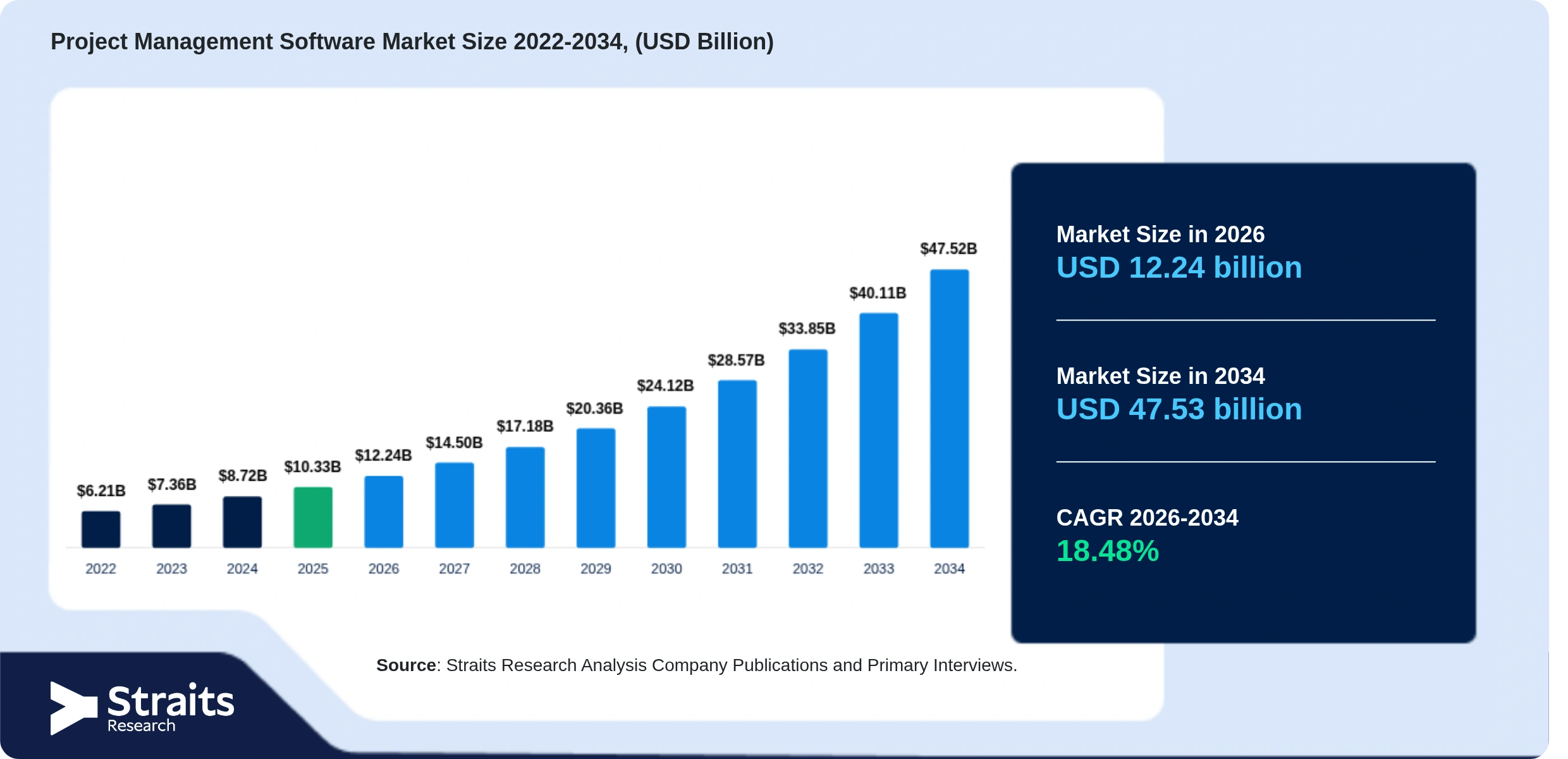
The global project management software market was valued at USD 10.33 billion in 2025 and is projected to grow from USD 12.24 billion in 2026 to USD 47.52 billion by 2034, registering a CAGR of 18.48% during the forecast period 2026–2034. Project management software enables organizations to plan schedules, allocate resources, track budgets, monitor milestones, manage documents, and coordinate project activities. These platforms support project delivery by providing centralized visibility into tasks, responsibilities, deadlines, and performance.
The market outlook reflects the increasing complexity of business operations and the need for efficient coordination across departments and distributed teams. Cloud deployment, workflow automation, artificial intelligence (AI), and integration with enterprise applications are expanding software capabilities beyond traditional task tracking. Organizations are increasingly seeking platforms that connect project planning with operational data, helping managers identify delays, improve resource utilization, and make informed decisions.
The need for coordinated project execution is supporting project management software market growth across industries. Businesses use centralized platforms to assign responsibilities, track milestones, automate notifications, and monitor progress across geographically distributed teams. These capabilities reduce communication gaps and repetitive administrative work while improving accountability and project visibility. In April 2026, Oracle introduced AI-enabled capabilities for Primavera Unifier to automate workflows, improve project tracking, and enhance reporting, illustrating how software providers are addressing demand for more efficient project execution.
High subscription fees, customization requirements, employee training, and ongoing maintenance can increase the total cost of adopting project management software. These expenses may discourage small and medium-sized enterprises (SMEs), particularly when the benefits are difficult to quantify during initial implementation. Integration with legacy systems can further complicate deployment, while concerns about confidential project information and unauthorized access can require additional security controls. These factors influence purchasing decisions and may slow adoption among organizations with limited budgets or complex technology environments.
Artificial intelligence, predictive analytics, and intelligent automation create opportunities for providers to develop more advanced project management platforms. AI-enabled tools can assist with task prioritization, resource allocation, schedule estimation, and early identification of potential delays. Cloud-based delivery also enables vendors to serve organizations that require scalable collaboration across locations without maintaining extensive local infrastructure. Providers that combine automation, integration, and user-friendly interfaces can strengthen their competitive positioning and address evolving enterprise requirements.
The growing complexity of project schedules and cross-functional responsibilities is encouraging software providers to introduce AI agents that assist with planning, task coordination, and routine administrative activities. These capabilities are moving project management platforms beyond passive progress tracking toward more proactive execution support. The transition can reduce manual workloads and help teams respond more quickly to changing priorities, resource constraints, and project risks.
The use of separate applications for task management, communication, document sharing, and software development creates demand for connected project management platforms. Integrations that synchronize information across enterprise applications can improve task visibility and reduce the need to switch between disconnected systems. As a result, integrated workflow capabilities are becoming an important consideration for organizations seeking consistent information, coordinated decisions, and more efficient project delivery.
The project management software market is segmented by component, solution, services, deployment, enterprise size, and end-use.
By component, the solution segment accounted for a share of 72% in 2025, supported by demand for centralized planning, workflow automation, and real-time project monitoring. Within solutions, project portfolio management accounted for 24% in 2025, owing to its role in aligning multiple projects with business objectives and optimizing resource allocation. Resource management is projected to grow at a CAGR of 11.1% during the forecast period.
By services, integration and deployment accounted for 57% in 2025, reflecting the importance of implementation and connecting software with existing enterprise systems. The integration and deployment segment is projected to grow at a CAGR of 10.7%, while support and maintenance is expected to grow at 10.2%.
By deployment, cloud-based software is projected to grow at a CAGR of 12.3%, supported by scalability, remote accessibility, and reduced infrastructure requirements. On-premise solutions are expected to grow at 8.4%, reflecting demand from organizations prioritizing direct infrastructure control and internal data management.
By enterprise size, large enterprises accounted for 61% of the market in 2025, owing to their complex project portfolios and cross-departmental coordination requirements. The SME segment is projected to grow at a CAGR of 12.2%, supported by accessible cloud solutions and demand for streamlined workflows.
By end-use, IT and telecom accounted for 23% in 2025, supported by software development, network infrastructure projects, and technology service delivery. Healthcare is projected to grow at a CAGR of 11.4%, driven by technology implementations, facility upgrades, and operational improvement initiatives.
North America dominated the market with a 38% share in 2025, supported by enterprise software adoption, cloud collaboration, and demand for centralized project planning. The region’s organizations use project management platforms to improve team productivity, monitor performance, and coordinate complex initiatives. The United States and Canada provide demand opportunities across commercial and public-sector organizations.
Europe is projected to be the fastest-growing region, with a CAGR of 12.1% during 2026–2034. Enterprise digitalization, cloud-based business applications, and collaborative work environments support regional demand. Adoption across automotive, industrial, and other business sectors creates opportunities for providers offering integrated planning and workflow capabilities.
Asia-Pacific accounted for 23% of the market in 2025, supported by enterprise digitalization, cloud adoption, and modernization of business operations. China, Japan, and India present opportunities as organizations invest in technology infrastructure, improve operational processes, and expand digital capabilities.
The project management software competitive landscape includes enterprise technology providers and specialized software developers. Key companies include Oracle Corporation, Microsoft Corporation, SAP SE, Broadcom Inc., Basecamp LLC, AEC Software, Adobe Workfront, ServiceNow, Inc., Unit4 N.V., and Atlassian Corporation. Competition centers on scalability, enterprise integration, collaboration features, automation, security, and ease of use. Vendors are also differentiating their platforms through AI-assisted planning and flexible deployment models.
In April 2026, Atlassian strengthened its project management portfolio through AI-driven planning, sprint management, and cross-team collaboration enhancements for Jira. In February 2026, Asana expanded its work management platform with intelligent project orchestration capabilities, including AI-assisted task prioritization, risk identification, and workflow automation.
Straits Research – Project Management Software Market
Straits Research provides market intelligence, industry analysis, and strategic insights to help businesses evaluate opportunities, understand industry dynamics, and make informed decisions.
For further information, customized research, or report inquiries, visit Straits Research or contact its research team.
Germany’s digital industry association Bitkom reported that 60% of people aged 16–29 had tried online dating, with 49% having used dating apps such as Tinder, Bumble, or Hinge and 32% having used social networks for online dating. The survey also found that online dating was more common in metropolitan areas than in smaller towns. These usage patterns create opportunities for dating platforms to expand mobile-first matchmaking
The UK market is shaped by stronger online safety requirements and continued investment in user verification. In July 2026, Ofcom reported that more than one in ten 15–17-year-olds continued to visit and spend time on three of the most-used dating apps in December 2025, highlighting gaps in age-assurance systems.
Digital transformation consulting is a service that helps businesses integrate digital technologies into their operations, enhancing efficiency, customer experience, and innovation. Consultants assess a company’s existing processes, technology stack, and market positioning to develop strategies that leverage artificial intelligence, cloud computing, data analytics, automation, and other emerging technologies. They are generally classified under HSN Code 9983 (Other professional, technical, and business services) and SIC Code 8742 (Management Consulting Services), covering consulting activities related to business strategy, technology adoption, and digital process transformation.
Emphasis on Customer Retention and Digital Workforce Development Offer Growth Opportunities
Emphasis on customer retention and service quality creates opportunities for digital transformation consultants to help businesses redesign customer journeys across digital and physical channels. Consulting firms can support the implementation of customer data platforms, personalized service workflows, and integrated customer relationship management systems to improve engagement and service consistency.
The need to prepare employees for changing digital workflows creates opportunities for consulting firms to provide digital skills assessments, workforce training, and organizational capability development. Businesses require structured support to help employees use digital platforms effectively, adapt to new operating models, and improve collaboration across departments.




