

Physical AI is transforming how robots perceive their surroundings, understand complex situations, and perform tasks in dynamic real-world environments. From autonomous mobile robots navigating warehouses to humanoid robots manipulating objects, these systems must interpret information from multiple sources and respond to changing conditions with precision. Their ability to perform reliably depends on more than advanced algorithms. It requires high-quality, synchronized, and diverse training data that reflects the complexity of the physical world.
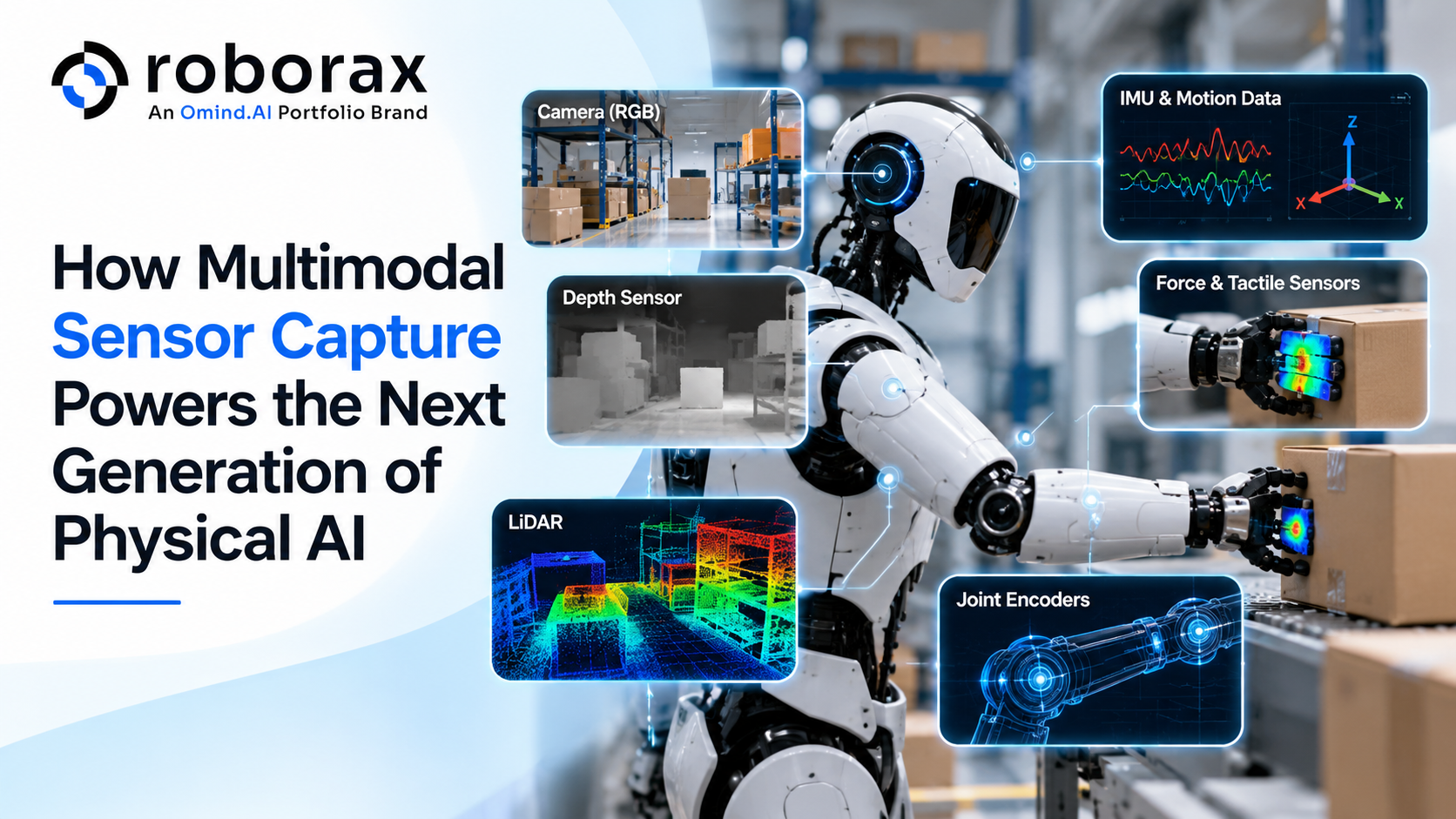
This is where Multimodal Sensor Capture for Robotics becomes essential. By combining information from cameras, depth sensors, LiDAR, inertial measurement units (IMUs), force sensors, and joint encoders, robotics teams can develop a comprehensive understanding of environmental conditions and physical interactions. When collected and organized effectively, these data streams provide the foundation for building intelligent, adaptive, and reliable Physical AI systems.
What Is Multimodal Sensor Capture in Physical AI?
Multimodal sensor capture is the process of collecting data from multiple sensor types to represent an environment, an object’s properties, a robot’s movements, and its interactions with the physical world.
Each sensor provides a different perspective. RGB cameras capture visual details, depth cameras estimate distances, LiDAR measures spatial geometry, and IMUs record acceleration and angular velocity. Force-torque sensors and joint encoders provide additional information about contact forces, joint positions, and robot movement.
Individually, these signals offer only a partial view of a situation. Combined through accurate synchronization and calibration, they enable robotics models to understand relationships between visual observations, spatial structures, movement, and physical interactions.
For Physical AI, this integrated information is particularly valuable because robots must do more than recognize objects. They need to determine where objects are located, how they can be manipulated, and how their actions affect the surrounding environment.
1. Improving Robotic Perception Through Sensor Fusion
Reliable perception is a fundamental requirement for Physical AI. Robots operating in warehouses, manufacturing facilities, healthcare environments, and outdoor spaces encounter changing lighting, unexpected obstacles, moving objects, and unpredictable human activity.
A single sensor may struggle under certain conditions. Cameras can lose visual clarity in poor lighting, while depth sensors may encounter limitations with reflective or transparent surfaces. LiDAR can provide valuable geometric information, but it may not capture the fine visual details required to distinguish similar objects.
Multimodal sensor capture addresses these limitations by combining complementary information.
For example, a mobile robot navigating a busy warehouse can use camera images to identify workers and packages, depth data to estimate obstacle distances, and IMU measurements to track its own motion. Together, these signals help the robot construct a more complete representation of its surroundings.
Well-designed sensor fusion datasets allow AI models to learn how different modalities complement one another. This can improve perception robustness and help robots make more informed decisions when individual sensor inputs become unreliable.
2. Building High-Quality Robotic Training Data
The performance of Physical AI models depends heavily on the quality and relevance of their training datasets. Models trained on incomplete, poorly synchronized, or unrepresentative data may struggle when deployed outside controlled environments.
High-quality robotic training data should capture not only what a robot observes but also how it moves, interacts with objects, and responds to changing conditions.
Multimodal datasets can include synchronized video, depth maps, point clouds, joint states, end-effector poses, force measurements, and action trajectories. This combination enables models to associate environmental observations with physical outcomes.
Consider a robotic arm learning to pick up a small object from a cluttered surface. Camera data can help identify the object, depth measurements can estimate its position, and joint encoders can record the arm’s configuration. Force-torque measurements can reveal whether the gripper has established contact or applied excessive pressure.
When these signals are accurately aligned, the resulting dataset provides richer supervision for learning manipulation tasks.
Roborax supports robotics teams in developing structured, task-relevant data resources that help bridge the gap between sensor observations and real-world robotic performance.
3. Enabling More Natural Robot Learning and Manipulation
Next-generation Physical AI systems must learn complex behaviors involving sequences of coordinated actions rather than isolated movements.
Tasks such as opening a drawer, stacking containers, handling tools, or transferring objects between workstations require robots to interpret visual information, estimate object positions, coordinate their joints, and adjust their actions based on feedback.
Multimodal sensor capture makes these relationships observable within training datasets.
For instance, during a drawer-opening task, synchronized video can show the drawer and handle, joint-state data can describe arm movement, and force measurements can indicate when the robot establishes contact or encounters resistance. These signals help connect an intended action with its physical consequences.
Such datasets can support imitation learning, behavior cloning, reinforcement learning, and other approaches to robot learning. They can also help researchers investigate why a particular action succeeded or failed.
By capturing both successful interactions and meaningful failure cases, robotics teams can develop models that respond more effectively to variations in object position, resistance, and environmental conditions.
4. Supporting Sim-to-Real Transfer
Simulation enables robotics teams to generate training scenarios, test control strategies, and evaluate models without repeatedly using physical hardware. However, simulated environments cannot perfectly reproduce every real-world condition.
Differences in lighting, material properties, friction, sensor noise, mechanical tolerances, and contact dynamics can cause models trained in simulation to perform poorly after deployment.
Multimodal sensor capture helps address this challenge by providing real-world reference data.
When simulated sensor outputs are compared with corresponding observations from physical robots, developers can identify discrepancies and improve simulation parameters. Real-world datasets can also be used alongside synthetic data to expose models to more representative environmental conditions.
For example, a warehouse robot trained in simulation may navigate accurately across idealized floors but struggle with uneven surfaces or changing illumination. Capturing synchronized camera, depth, and motion data during real-world operation can help researchers identify these gaps.
A carefully designed combination of simulated and physical-world observations can improve model generalization and support more reliable deployment.
5. Why Synchronization and Calibration Matter
Collecting multiple sensor streams does not automatically produce a useful multimodal dataset. The data must be synchronized, calibrated, and validated to ensure that each measurement corresponds to the correct event.
Even small timing discrepancies can create misleading relationships between observations and actions. A camera frame captured before a robot begins moving, for example, may be incorrectly associated with a later joint position. Similarly, inaccurate spatial calibration can cause objects detected by a camera to appear misaligned with LiDAR point clouds.
Effective Multimodal Sensor Capture for Robotics should therefore include:
-
Temporal synchronization: Align sensor timestamps and account for differences in sampling rates and processing delays.
-
Spatial calibration: Establish accurate coordinate transformations between sensors and robot components.
-
Data validation: Detect missing frames, corrupted records, timestamp inconsistencies, and sensor dropouts.
-
Metadata management: Record sensor configurations, environmental conditions, task identifiers, and collection parameters.
-
Quality assurance: Review representative samples and investigate inconsistencies before datasets are used for model training.
These practices help maintain dataset integrity and reduce the risk of training models on contradictory or misleading signals.
6. Scaling Physical AI With Task-Relevant Datasets
As Physical AI applications expand, robotics teams need datasets that reflect specific operational requirements rather than simply maximizing the volume of collected data.
A humanoid robot performing household tasks requires different sensor combinations and behavioral coverage from an autonomous mobile robot transporting materials through an industrial facility. Similarly, a manipulation model may require detailed contact measurements, while a navigation model may prioritize spatial geometry and motion information.
Dataset design should begin with the intended task, identify the relevant sensors, define the required labels, and establish quality standards before collection begins.
Robotics teams should also capture variations in object types, operating conditions, viewpoints, motion patterns, and failure scenarios. This diversity helps reduce dependence on narrow training conditions and provides a stronger foundation for evaluating generalization.
Roborax helps organizations develop robotics data strategies aligned with their Physical AI objectives, including multimodal sensor capture, structured dataset preparation, and the development of training resources for complex robotic behaviors.
Conclusion
Multimodal sensor capture is becoming a critical component of Physical AI development because intelligent robots must connect perception, movement, and physical interaction within a unified learning process. By combining synchronized visual, spatial, motion, and force-related data, robotics teams can build richer datasets for navigation, manipulation, and adaptive decision-making.
However, meaningful results require more than collecting information from multiple sensors. Synchronization, calibration, data validation, and task-specific coverage are essential to ensure that datasets provide reliable learning signals.
As robotics moves toward more capable autonomous systems, high-quality robotic training data will play an increasingly important role in translating AI capabilities into practical performance. Roborax helps robotics teams build the data foundations needed to advance Physical AI, strengthen robot learning, and support more capable real-world robotic applications.



