
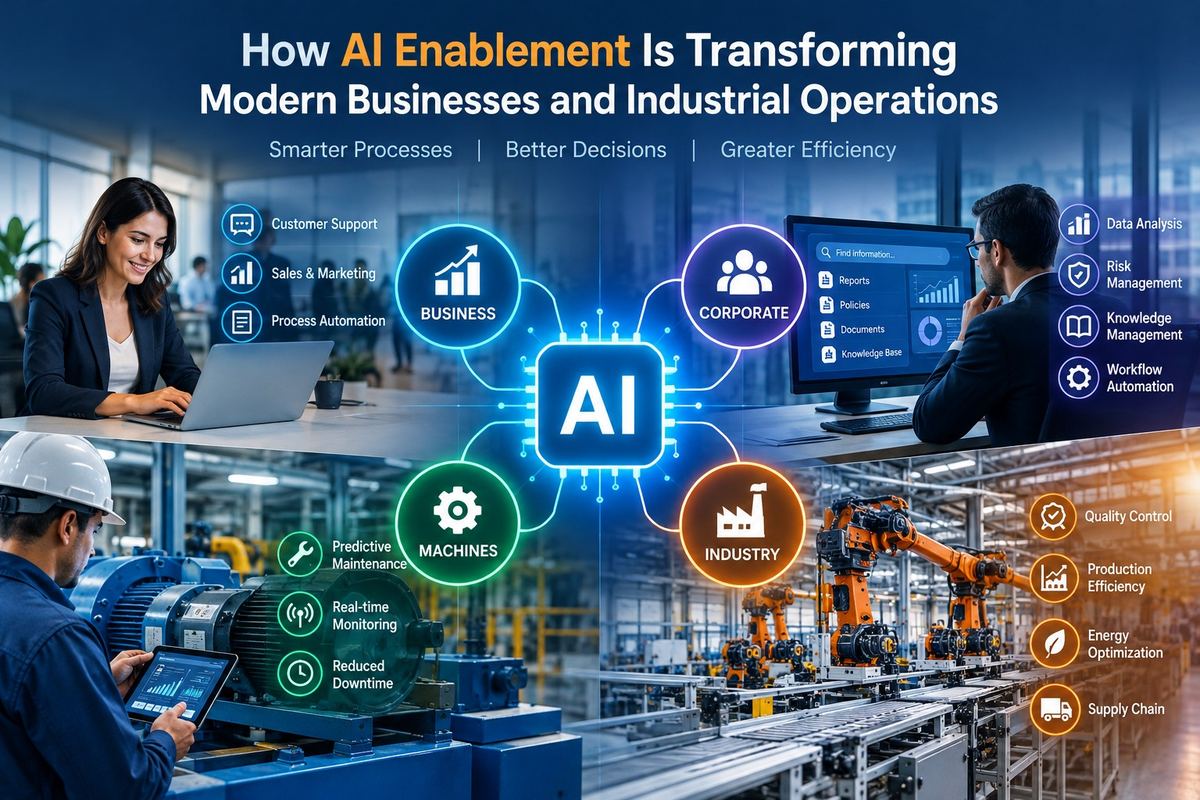

Artificial intelligence has moved beyond being a futuristic concept. Today, businesses, corporations, manufacturers, and industrial organizations are exploring practical ways to use AI to improve efficiency, automate repetitive work, analyze information, and make better decisions.
However, successful AI adoption is not simply about installing an AI tool. Organizations need to understand where AI can create real value and how it can work alongside their existing people, processes, machines, and software. This is where AI enablement becomes important.
What Is AI Enablement?
AI enablement is the process of preparing an organization to use artificial intelligence effectively. It can involve software, data, automation, machine learning, computer vision, analytics, and intelligent workflows.
The objective is to connect AI with real business requirements rather than using technology simply because it is becoming popular.
For example, a company might use AI to automate document processing, while a manufacturing facility could use machine-learning models to analyze equipment data and identify potential problems.
Businesses interested in exploring these possibilities can learn more about AI enablement and its applications through AIEnablings.com.
AI for Business Operations
Almost every business has repetitive processes that consume employee time. These may include data entry, customer inquiries, document processing, reporting, scheduling, and information management.
AI can assist with many of these activities.
Customer service is one common example. AI systems can classify customer requests, answer frequently asked questions, summarize conversations, and direct more complicated cases to human employees.
Sales teams can also use AI to analyze customer information, identify potential opportunities, summarize meetings, and improve follow-up processes.
Administrative departments may use AI to extract information from documents, organize data, generate reports, and reduce manual processing.
The objective is not necessarily to replace employees. Instead, AI can handle suitable repetitive tasks while employees concentrate on work that requires creativity, communication, expertise, and judgment.
AI in Corporate Environments
Large corporations often face a different challenge: information overload.
Corporate organizations may have thousands of documents, reports, policies, emails, databases, and technical resources. Employees can spend considerable time searching for the information they need.
AI-powered knowledge systems can make this information easier to access. Employees may be able to ask questions using natural language and receive relevant information from approved internal sources.
AI can also support corporate functions such as:
-
Business intelligence
-
Risk analysis
-
Forecasting
-
Workflow automation
-
Document analysis
-
Knowledge management
-
Employee support
-
Customer relationship management
For larger organizations, security and governance are particularly important. AI systems should be designed with appropriate permissions, data protection, monitoring, and human oversight.
AI and Industrial Machines
One of the most valuable applications of AI is its ability to work with data generated by physical machines.
Modern industrial equipment can produce large amounts of information through sensors. Temperature, pressure, vibration, speed, energy consumption, and production measurements can all provide useful signals about machine performance.
AI can analyze these signals to identify unusual patterns.
This can support predictive maintenance, where organizations attempt to identify possible equipment problems before a major breakdown occurs. Instead of relying only on fixed maintenance schedules, companies can use equipment data to understand changing machine conditions.
For industries where equipment downtime is expensive, identifying potential problems earlier can be particularly valuable.
AI in Manufacturing
Manufacturing is another area where AI enablement can have a significant impact.
AI can potentially assist with quality inspection, production planning, process optimization, inventory management, energy consumption, and supply-chain analysis.
Computer vision systems, for example, can examine products or components and identify certain visible defects. Machine-learning models can also analyze historical production information to find patterns associated with quality problems or operational inefficiencies.
Energy optimization is another potential application. Industrial facilities often consume significant amounts of electricity, gas, water, and other resources. AI can analyze consumption patterns and help identify opportunities to improve efficiency.
Industries That Can Benefit From AI
AI enablement is not limited to technology companies or large factories. Depending on the available data and operational requirements, AI can be explored across many sectors, including:
-
Manufacturing
-
Engineering
-
Automotive
-
Logistics
-
Retail
-
Agriculture
-
Construction
-
Energy
-
Healthcare operations
-
Financial services
-
Supply-chain management
-
Customer service
The most appropriate application depends on the organization’s specific challenges, infrastructure, data, and goals.
How Organizations Can Get Started
Successful AI adoption usually begins with a problem rather than a technology.
Organizations can start by identifying processes that are repetitive, time-consuming, expensive, or difficult to manage. They can then determine whether AI could improve that particular process.
The next step is to examine available data and existing systems. Not every process requires a complex AI solution. Sometimes a relatively simple automation can produce significant benefits.
A gradual approach can also reduce risk. Organizations can begin with a focused use case, measure its results, and then expand successful solutions to other departments or operations.
The Future of AI Enablement
AI is likely to become increasingly integrated into everyday business and industrial environments. The most valuable implementations may not always be the most visible ones. Instead, AI could quietly operate behind the scenes, helping employees process information, monitoring equipment, improving workflows, and supporting better decisions.
For organizations, the key question is no longer simply whether AI can be used. The more useful question is where AI can solve a genuine problem and create measurable value.
By combining artificial intelligence with existing people, processes, machines, and data, businesses can gradually build smarter and more efficient operations.



