

Excerpt
Managing payments through disconnected banks, platforms, and spreadsheets can create unnecessary complexity for growing businesses.
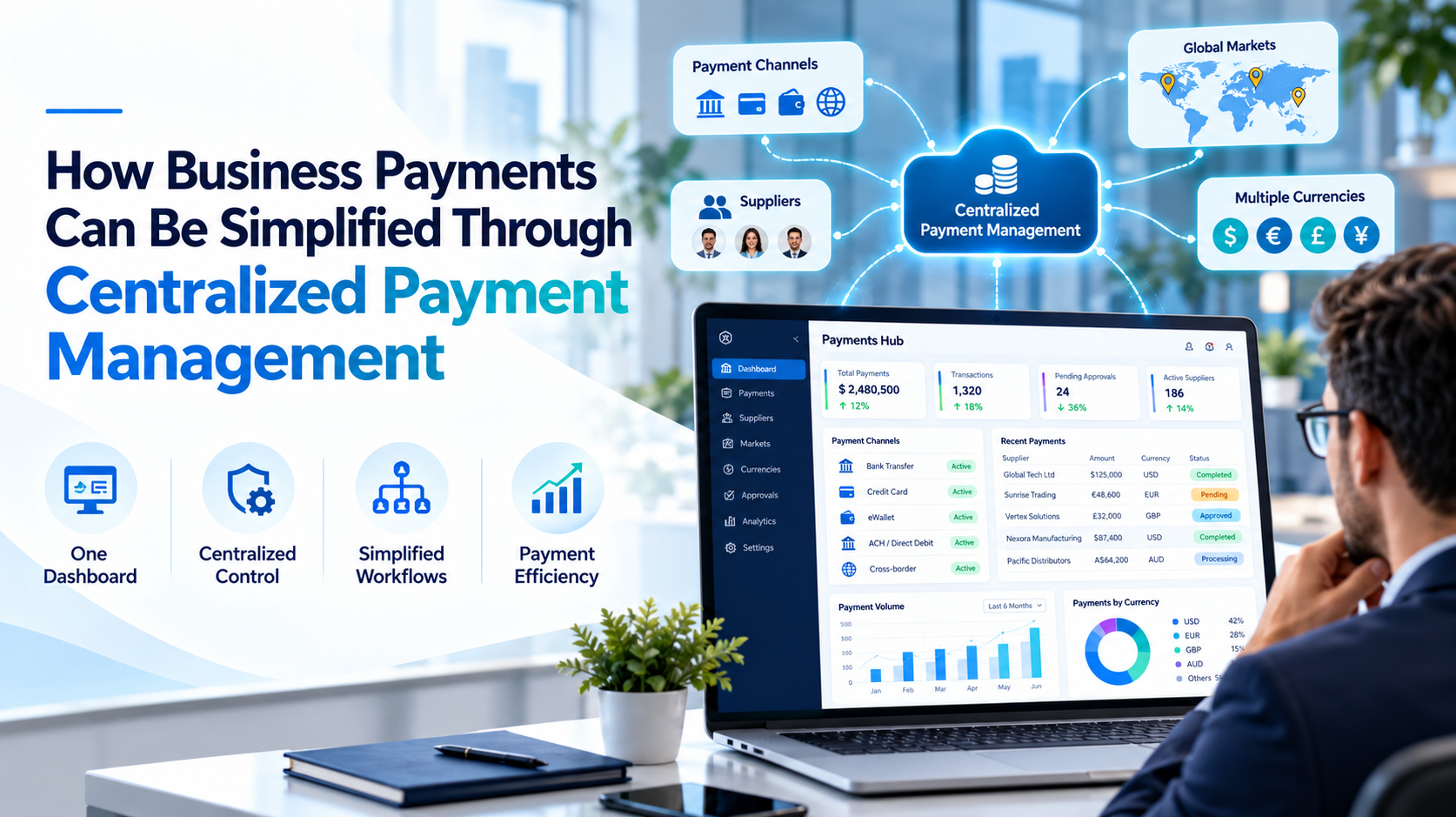
Centralized payment management helps companies organize business payments, improve visibility, and reduce repetitive financial work.
With scalable payment solutions, businesses can create more efficient processes for domestic and international transactions.
Introduction
Payment operations often become complicated gradually.
A company begins with a few customers and suppliers, so manual processes seem manageable. As the business grows, it adds more bank accounts, payment providers, markets, currencies, vendors, and transaction channels.
Eventually, finance teams may find themselves managing payments across several disconnected systems.
This creates inefficiency.
Employees spend more time checking transaction status, downloading reports, reconciling payments, updating spreadsheets, and communicating with other departments.
Centralized payment management can help businesses bring greater structure to these activities.
Instead of treating each transaction channel as a separate process, companies can use suitable payment solutions to create a more organized approach to business payments.
What Is Centralized Payment Management?
Centralized payment management refers to organizing payment activity through a coordinated financial workflow.
This does not necessarily mean every transaction must pass through one identical channel.
Rather, businesses aim to create consistent visibility, processes, controls, and reporting across their payment environment.
Centralization can cover:
-
Customer collections
-
Supplier payments
-
Partner transactions
-
International payments
-
Settlements
-
Reconciliation
-
Reporting
-
Payment approvals
The objective is to reduce fragmentation.
Why Fragmented Payment Processes Become a Problem
Disconnected payment systems can create several operational difficulties.
Finance teams may need to log into several platforms to understand daily payment activity.
Different systems may also use different transaction references, reporting formats, and settlement schedules.
This can result in:
-
Duplicate work
-
Slow reconciliation
-
Inconsistent data
-
Limited financial visibility
-
Difficult reporting
-
Delayed issue resolution
-
Higher administrative workload
The problem becomes more serious as transaction volumes increase.
A centralized business payment solution can help businesses create more consistent processes.
Improving Visibility Across Business Payments
Visibility is one of the main advantages of centralized payment management.
Finance teams need to understand where money is coming from and where it is going.
A structured payment environment can help businesses monitor:
-
Incoming customer payments
-
Supplier transactions
-
Refunds
-
Failed transactions
-
Settlement status
-
International payments
-
Payment fees
Better visibility allows teams to identify problems faster.
It also helps management make more informed cash-flow decisions.
Centralizing Customer Collections
Incoming payments are a major part of the payment lifecycle.
Businesses may collect money through websites, apps, payment links, bank-based methods, or other digital channels.
Reliable Pay-in services can help organize these collections.
When transaction data follows a consistent process, businesses can improve reconciliation and reporting.
Finance teams can also identify outstanding or unsuccessful transactions more easily.
Role of Online Payment Solutions
Digital commerce has increased the number of payment channels businesses need to manage.
Modern online payment solutions allow organizations to accept transactions through digital environments while capturing useful payment data.
When integrated effectively, this information can feed into centralized financial processes.
Businesses can then monitor digital transactions alongside other payment activity rather than treating online payments as a completely separate workflow.
Simplifying Cross Border Payments
International transactions often create additional fragmentation.
A company may use different systems for different countries or currencies.
Managing cross border payments centrally can improve visibility over international financial activity.
Businesses can better monitor:
-
Currency
-
Transaction amount
-
Payment status
-
Settlement timing
-
Supplier information
-
Customer references
This helps reduce uncertainty around global transactions.
Centralizing B2B Cross Border Payments
International B2B payments can involve large values and detailed accounting requirements.
Businesses may need to pay:
-
Overseas suppliers
-
Technology vendors
-
Manufacturers
-
Consultants
-
Distribution partners
-
Logistics companies
Structured b2b cross border payments management helps businesses maintain clearer records of these transactions.
Finance and procurement teams can work with consistent payment information and reduce repeated communication regarding invoice status.
Improving Reconciliation
Reconciliation is one of the areas where centralized payment management can create significant operational benefits.
When payment information comes from multiple disconnected sources, finance teams may need to manually match transactions with invoices or customer records.
Centralized transaction information can make this process more systematic.
Businesses may use:
-
Unique transaction references
-
Automated matching
-
Standardized reports
-
Integrated accounting data
Reducing manual reconciliation saves time and can lower the risk of errors.
Better Cash-Flow Management
Businesses need accurate information about expected inflows and outflows.
Centralized payment visibility helps finance teams understand:
-
Which customer payments have arrived
-
Which settlements remain pending
-
Which supplier invoices need payment
-
When major expenses are due
This information supports stronger cash-flow planning.
Finance teams can make more informed decisions about working capital instead of relying on incomplete information.
Reducing Manual Administrative Work
One of the biggest costs of fragmented payment management is employee time.
Teams may spend hours downloading reports, copying data, verifying payment status, and creating manual summaries.
Automation within modern payment solutions can reduce repetitive work.
Potential automation areas include:
-
Payment notifications
-
Transaction recording
-
Reconciliation
-
Settlement reporting
-
Internal status updates
Automation should remain subject to appropriate controls and review processes.
Maintaining Strong Financial Controls
Centralization should not mean removing controls.
In fact, businesses can use centralized processes to establish more consistent governance.
Companies can define:
-
User permissions
-
Approval levels
-
Payment limits
-
Verification procedures
-
Reporting responsibilities
-
Audit processes
These controls become particularly important when organizations handle high transaction values or operate across several markets.
Improving Collaboration Between Departments
Payments affect more than the finance department.
Sales teams want to know whether customers have paid.
Procurement teams need supplier payment information.
Customer service employees may need transaction status.
Management needs financial reports.
Centralized payment information can reduce the number of internal requests sent to finance teams.
Departments can access appropriate information while finance maintains control over sensitive data.
Supporting Business Growth
A payment environment should be able to grow with the business.
Companies may enter new markets, add currencies, increase transaction volumes, or introduce new digital channels.
If every expansion requires another disconnected payment process, complexity will continue increasing.
A scalable business payment solution can help companies maintain structure as their operations grow.
Businesses should consider future requirements when designing their payment infrastructure.
Using Payment Data for Better Decisions
Centralized payment information can also support business analysis.
Companies may analyze:
-
Payment success rates
-
Settlement periods
-
Transaction volume
-
Revenue by channel
-
Revenue by market
-
Payment costs
-
Failed transaction patterns
This turns payment operations into a useful source of business intelligence.
For example, management may identify markets where payment performance is weaker or channels that generate unnecessary processing costs.
Where Uniteller May Fit
Businesses reviewing providers such as Uniteller should determine whether the available payment capabilities align with their centralized payment strategy.
Important evaluation criteria include:
-
Transaction visibility
-
Market coverage
-
Currency capabilities
-
Payment collection options
-
Reporting
-
Integrations
-
Settlement processes
-
Security
No single provider should be selected solely because it offers a long feature list.
The payment environment should match the company’s operational requirements.
Steps Toward Centralized Payment Management
Businesses do not always need to change every payment process at once.
They can begin by mapping their existing payment environment.
The process may include:
1. Identify Every Payment Channel
List the systems used for incoming and outgoing payments.
2. Document Payment Workflows
Understand how transactions move from initiation to reconciliation.
3. Identify Manual Processes
Find tasks that consume significant employee time.
4. Review Reporting Gaps
Determine which transaction information is difficult to access.
5. Evaluate Integration Opportunities
Identify where systems can exchange information automatically.
6. Define Payment Controls
Establish appropriate approval, access, and verification procedures.
7. Select Scalable Infrastructure
Choose solutions that can support expected business growth.
This structured approach reduces the risk of replacing technology without addressing the underlying process problems.
Centralization Does Not Mean Eliminating Flexibility
Global businesses still need flexibility.
Customers in different markets may prefer different payment methods, and suppliers may have different requirements.
Centralized payment management should therefore focus on creating consistent oversight rather than forcing every transaction through exactly the same process.
Businesses can maintain local flexibility while improving centralized reporting, controls, and visibility.
This balance becomes especially important for companies operating internationally.
Conclusion
As businesses grow, payment complexity can increase quickly.
Managing several providers, currencies, accounts, payment channels, and reporting systems separately creates unnecessary administrative work.
Centralized payment management helps businesses simplify business payments by creating better visibility, standardized processes, stronger controls, and more efficient reconciliation.
Modern payment solutions can bring together information from online payment solutions, Pay-in services, supplier transactions, cross border payments, and b2b cross border payments.
A scalable business payment solution can also support future growth by reducing fragmentation as transaction volumes and international operations expand.
Businesses evaluating payment providers such as Uniteller should focus on how well available capabilities integrate into their broader financial workflows.
With the right combination of technology, automation, controls, and reporting, centralized payment management can help companies create simpler, more transparent, and more scalable financial operations.



