
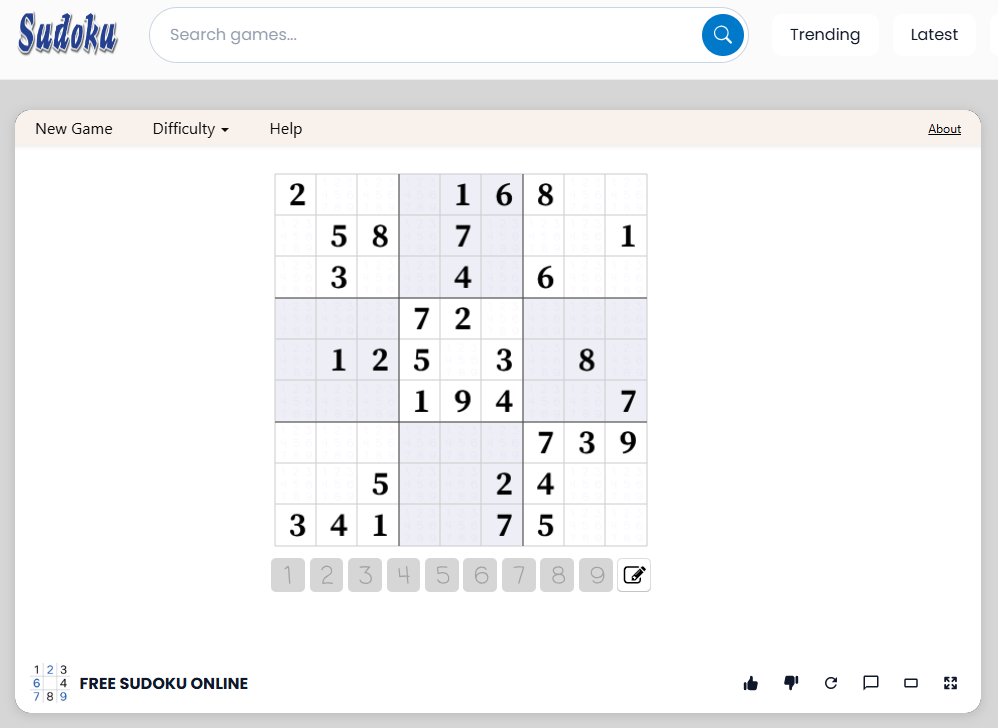

Sudoku is a popular number puzzle that offers an enjoyable way to challenge the mind, improve logical thinking, and develop problem-solving skills. With simple rules and countless possible combinations, Sudoku attracts players of different ages and experience levels. Whether you are a beginner or an experienced puzzle enthusiast, this classic brain game provides an entertaining activity that can fit into almost any daily routine.
Unlike many traditional games, Sudoku does not require advanced mathematical knowledge. Instead, it focuses on observation, concentration, and logical reasoning. Every puzzle creates a new challenge, encouraging players to examine available numbers and discover the correct solutions step by step.
What Is Sudoku?
Sudoku is a logic-based number puzzle played on a nine-by-nine grid divided into nine smaller squares. Each smaller square contains three rows and three columns. The main objective is to fill every empty cell with a number from 1 to 9 while following a set of simple rules.
Each row must contain all nine numbers without repetition. The same requirement applies to every column and each three-by-three box. Players must use logical reasoning to determine which number belongs in each empty position.
Although the standard version uses numbers, Sudoku does not involve mathematical calculations. The challenge comes from understanding relationships between different cells and identifying possibilities that satisfy all puzzle rules.
Why Sudoku Is So Popular
Sudoku has become a favorite activity among people who enjoy mental challenges. Its popularity comes from an effective combination of simplicity, accessibility, and variety. Anyone can understand the basic rules within a few minutes, but solving more difficult puzzles requires patience and careful planning.
Another reason for its popularity is the wide range of available difficulty levels. Beginners can start with simple grids, while experienced players can explore advanced puzzles that require multiple logical techniques.
Sudoku is also suitable for short gaming sessions. Players can complete a quick puzzle during a break or spend more time working through a challenging grid.
How to Play Sudoku
Understanding the basic rules is the first step toward becoming a confident Sudoku player. Every puzzle begins with a partially completed grid containing several given numbers. These numbers provide clues that help players identify the remaining answers.
Follow the Three Essential Rules
The first rule is that every horizontal row must contain the numbers 1 through 9 exactly once. A number cannot appear twice in the same row.
The second rule applies to vertical columns. Each column must also contain every number from 1 to 9 without repetition.
The third rule concerns the nine smaller three-by-three boxes. Every box must include all nine numbers exactly once.
Players must follow all three rules simultaneously. A number that fits one row may still be incorrect if it creates a duplicate in its column or smaller box.
Find Numbers Through Logical Reasoning
A useful starting strategy is to examine rows, columns, and boxes that already contain many numbers. These areas often have fewer empty cells, making it easier to identify missing values.
Players should compare the available numbers and eliminate possibilities that conflict with existing clues. When only one number can legally occupy a particular cell, that position has a definite answer.
This process gradually reveals additional information and makes other empty cells easier to solve.
Best Strategies to Improve Sudoku Skills
Although Sudoku is easy to understand, solving difficult puzzles requires effective strategies. Developing good habits can reduce unnecessary mistakes and improve overall performance.
Start With the Easiest Opportunities
Instead of randomly filling empty cells, begin with rows, columns, or boxes that have the most completed numbers. These sections usually provide clearer opportunities.
Look for missing numbers and check whether each one has only a single possible position. Completing these straightforward cells can reveal new clues elsewhere in the grid.
Working systematically is more effective than guessing because every confirmed answer creates additional information.
Use the Process of Elimination
The process of elimination is one of the most useful Sudoku techniques. Examine an empty cell and identify numbers that cannot fit because they already appear in the same row, column, or box.
Remove those numbers from consideration until only valid possibilities remain.
This method helps players avoid random decisions and encourages a more organized approach. For difficult puzzles, writing small candidate numbers inside empty cells can make the process easier.
Recognize Patterns and Opportunities
As players gain experience, they begin to recognize common patterns. Certain arrangements of numbers can reveal where specific values must appear.
For example, if a number can occupy only two cells within a particular row, those positions provide useful information for solving other cells.
Learning these patterns makes advanced Sudoku puzzles more manageable and helps players develop stronger logical thinking.
Different Difficulty Levels in Sudoku
Sudoku offers several difficulty levels to accommodate different abilities. Choosing an appropriate challenge can make the experience more enjoyable and productive.
Easy Sudoku for Beginners
Easy puzzles contain many starting numbers and usually have straightforward solutions. They are ideal for learning the rules and practicing basic techniques.
New players can focus on identifying missing numbers, checking rows, and completing simple boxes without feeling overwhelmed.
Medium Sudoku for Regular Players
Medium puzzles contain fewer starting clues and require more careful observation. Players may need to compare several possibilities before finding a definite answer.
This level provides a useful balance between accessibility and challenge. It also helps beginners develop confidence before moving toward advanced techniques.
Hard Sudoku for Experienced Players
Hard puzzles demand greater concentration and strategic thinking. Players often need to use candidate notation, identify number pairs, and recognize more complicated patterns.
These challenges can take longer to complete, but they provide satisfying experiences for people who enjoy testing their logical abilities.
Benefits of Playing Sudoku Regularly
Sudoku is more than a simple entertainment activity. It encourages several mental habits that can be useful in everyday situations.
Develop Concentration and Attention
Solving a puzzle requires players to pay attention to individual cells while considering the entire grid. This encourages careful observation and reduces careless decisions.
Regular practice provides an opportunity to build a habit of focusing on one task at a time.
Encourage Logical Thinking
Every correct move must follow the rules of the puzzle. Players learn to compare possibilities, recognize restrictions, and make decisions based on available evidence.
These activities create an enjoyable environment for practicing structured reasoning.
Support Patience and Persistence
Some puzzles cannot be completed immediately. Players may need to review previous decisions, explore different possibilities, and carefully reconsider difficult sections.
This experience encourages patience and persistence, especially when facing complicated challenges.
Tips for Enjoying Sudoku Online
Online Sudoku makes the classic puzzle more accessible than ever. Players can enjoy different difficulty levels without needing printed newspapers or physical puzzle books.
Choose a comfortable difficulty level and take time to understand each grid. Avoid entering numbers without checking all three Sudoku rules.
If a puzzle becomes difficult, review completed sections and examine possible candidates. Taking a short break can also help refresh attention and reveal opportunities that were previously overlooked.
Many online versions provide helpful features such as pencil marks, error checking, timers, and hints. Beginners can use these tools to understand the solving process, while experienced players can challenge themselves by completing puzzles without assistance.
Why Sudoku Remains a Timeless Puzzle
Sudoku continues to attract players because it combines straightforward rules with nearly endless logical challenges. Every grid creates a different experience, giving players a reason to return and improve their skills.
The game does not depend on complicated equipment, expensive accessories, or extensive preparation. A simple puzzle grid is enough to provide an engaging mental activity.
Whether played for relaxation, entertainment, or personal improvement, Sudoku offers a flexible experience for different lifestyles. Players can enjoy a quick challenge during a busy day or dedicate more time to solving advanced grids.
Conclusion
Sudoku is an engaging number puzzle that combines simple rules, logical reasoning, and endless opportunities for improvement. From easy beginner grids to difficult advanced challenges, the game offers something for every skill level.
By practicing regularly, learning effective strategies, and avoiding random guesses, players can become more confident and efficient solvers. Sudoku remains an excellent choice for anyone who enjoys brain games and wants an entertaining way to challenge the mind. Start with a simple puzzle, explore new techniques, and discover how rewarding every completed Sudoku grid can be.



