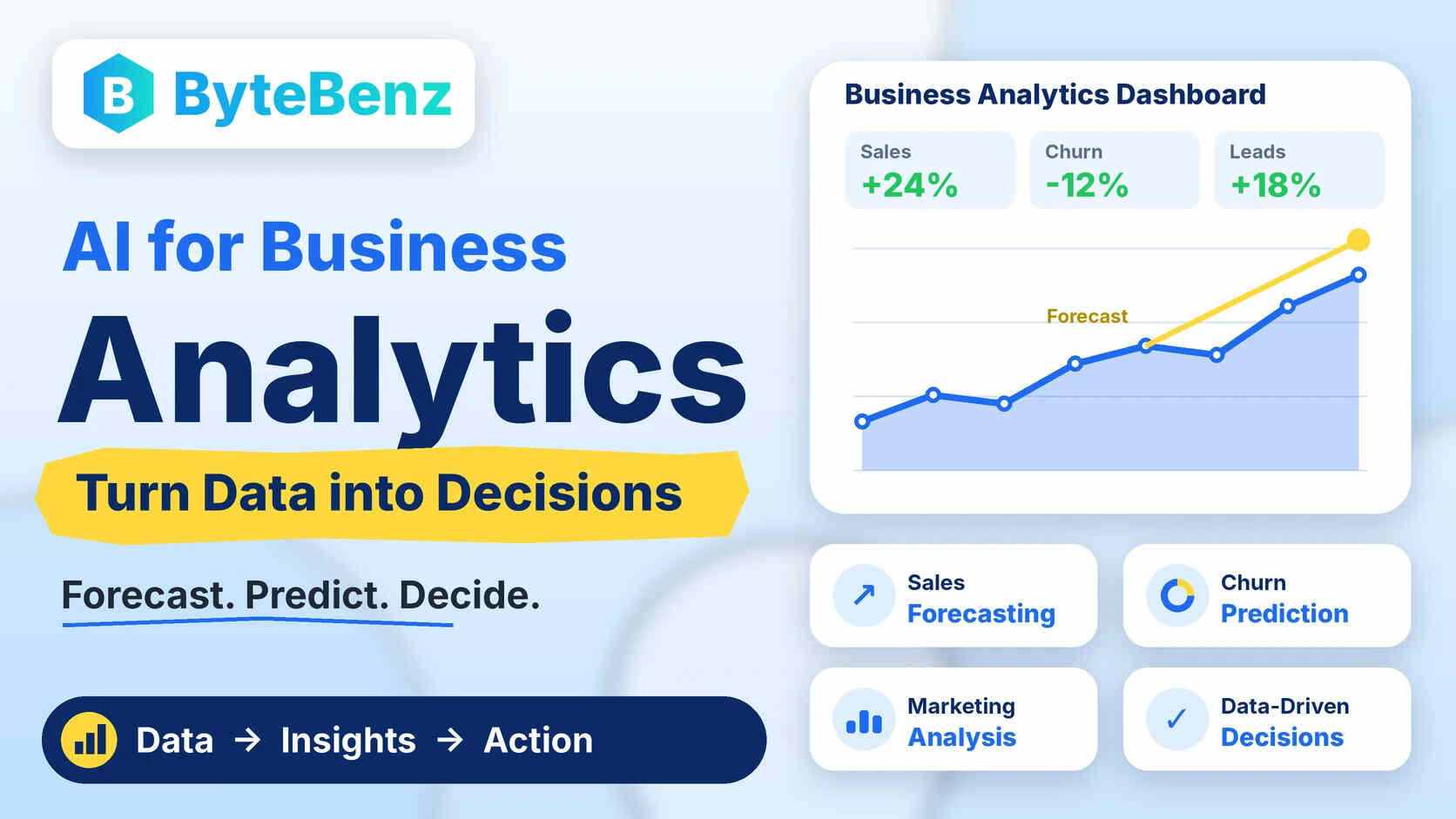

Businesses generate large amounts of data every day through websites, customer interactions, sales platforms, and marketing campaigns. However, collecting data is not enough. Companies need to understand it and use those insights to make better decisions. This is where AI for Business Analytics is becoming increasingly valuable.
Artificial intelligence helps organizations analyze complex datasets, identify patterns, predict future trends, and improve business performance. Instead of spending hours reviewing spreadsheets and reports, businesses can use AI-powered solutions to access meaningful insights faster.
In this article, we will explore how AI is transforming business analytics, its benefits, practical applications, and the challenges companies should consider.
What Is AI for Business Analytics?
AI for Business Analytics refers to the use of artificial intelligence technologies, such as machine learning, natural language processing, and predictive analytics, to examine business data and generate actionable insights.
Traditional analytics mainly focuses on understanding historical performance. AI-powered analytics goes further by identifying hidden patterns, forecasting possible outcomes, and helping businesses make informed decisions.
For example, an e-commerce company can analyze customer purchasing behavior to understand which products may receive higher demand in the coming months.
How Does AI Improve Business Analytics?
AI makes data analysis faster, more efficient, and more insightful. Here are some important ways it improves business operations.
1. Faster Data Processing
AI tools can process large volumes of structured and unstructured data in less time than manual analysis. This allows businesses to access relevant information quickly and reduce repetitive tasks.
2. Better Predictive Analysis
Machine learning algorithms examine historical information to identify trends and forecast future outcomes. Businesses can use these predictions for sales planning, inventory management, and financial forecasting.
3. Improved Decision-Making
AI-powered dashboards convert complicated datasets into understandable reports, charts, and recommendations. Managers can use these insights to make decisions based on actual business performance.
4. Customer Behaviour Analysis
AI helps businesses understand customer preferences, purchasing habits, and engagement patterns. This information supports personalized marketing campaigns and better customer experiences.
5. Real-Time Business Insights
AI-powered analytics platforms can monitor business performance and identify unusual changes. Companies can respond quickly to declining sales, unexpected expenses, or operational problems.
Key Applications of AI in Business Analytics
The use of AI for Business Analytics is expanding across different industries. Some common applications include:
1. Sales and Revenue Forecasting
Businesses can analyze previous sales records, seasonal trends, and customer demand to estimate future revenue. This helps companies create realistic sales targets and improve resource allocation.
2. Marketing Performance Analysis
AI can evaluate campaign performance, audience engagement, conversion rates, and customer acquisition costs. Marketing teams can identify successful strategies and optimize their advertising budgets.
3. Financial Planning and Risk Management
Financial teams use AI to identify unusual transactions, analyze spending patterns, estimate financial risks, and improve budgeting decisions.
4. Supply Chain Optimization
AI analyzes inventory levels, supplier performance, delivery schedules, and product demand. These insights help businesses reduce unnecessary costs and avoid stock shortages.
5. Customer Retention
Businesses can identify customers who may stop using their products or services. By understanding customer behavior, companies can develop targeted retention strategies.
Popular AI Tools for Business Analytics
Several AI-powered platforms help organizations analyze data and improve reporting.
- Microsoft Power BI: Provides interactive dashboards, business intelligence, and AI-assisted data analysis.
- Tableau: Helps businesses visualize data, discover patterns, and communicate insights.
- Google Looker: Supports data exploration, reporting, and business intelligence.
- Qlik Sense: Offers analytics and data visualization capabilities.
- ChatGPT: Can assist with interpreting datasets, generating summaries, and exploring business insights when provided with appropriate data.
The right tool depends on business size, data requirements, budget, and technical expertise.
Benefits of Using AI in Business Analytics
Implementing AI for Business Analytics offers several advantages:
- Time Savings: Automates repetitive reporting and data-processing activities.
- Higher Accuracy: Helps identify patterns and reduce certain types of manual errors.
- Cost Efficiency: Supports better resource planning and operational efficiency.
- Improved Customer Experience: Provides insights into customer needs and preferences.
- Competitive Advantage: Helps businesses respond to changing market conditions.
- Scalable Analysis: Makes it easier to analyze growing volumes of business information.
However, AI-generated insights should always be reviewed before making important business decisions.
Challenges Businesses Should Consider
Despite its advantages, AI adoption comes with certain challenges.
Data Quality: Incomplete or inaccurate data can produce misleading results.
Privacy and Security: Businesses must protect sensitive customer and financial information.
Implementation Costs: Advanced analytics solutions may require investment in software, infrastructure, and training.
Human Oversight: AI cannot fully replace business experience, industry knowledge, and human judgment.
Companies should begin with clear objectives, reliable data, and appropriate security practices.
Future of AI in Business Analytics
The future of business analytics will involve more automation, advanced predictive capabilities, and natural language interaction. Businesses will increasingly be able to ask questions about their data and receive understandable insights without complex technical knowledge.
Generative AI, machine learning, and intelligent reporting systems will continue to influence how organizations evaluate performance and plan strategies.
Companies that combine reliable data, suitable AI tools, and human expertise will be better positioned to make informed decisions.
Conclusion
Artificial intelligence is changing how businesses collect, understand, and use information. From predicting sales to improving customer experiences, AI-powered analytics provides valuable opportunities for organizations of different sizes.
Adopting AI for Business Analytics is not simply about using advanced technology. It is about turning business data into meaningful insights that support smarter decisions, improved efficiency, and sustainable growth.
Explore more AI and technology insights with ByteBenz.
Frequently Asked Questions (FAQs)
1. What is AI for Business Analytics?
It is the use of artificial intelligence technologies to analyze business data, identify patterns, generate predictions, and support better decision-making.
2. How does AI help small businesses with analytics?
AI helps small businesses automate reports, understand customer behavior, forecast sales, and identify opportunities without relying entirely on manual analysis.
3. Which AI tools are best for business analytics?
Popular options include Microsoft Power BI, Tableau, Google Looker, Qlik Sense, and ChatGPT. The best choice depends on business requirements and budget.
4. Can AI improve business decision-making?
Yes. AI can analyze large datasets, identify trends, and provide predictive insights. However, human judgment remains important when evaluating recommendations.
5. Is AI business analytics expensive to implement?
Not necessarily. Businesses can start with affordable or free analytics solutions and gradually invest in advanced tools as their requirements grow.