
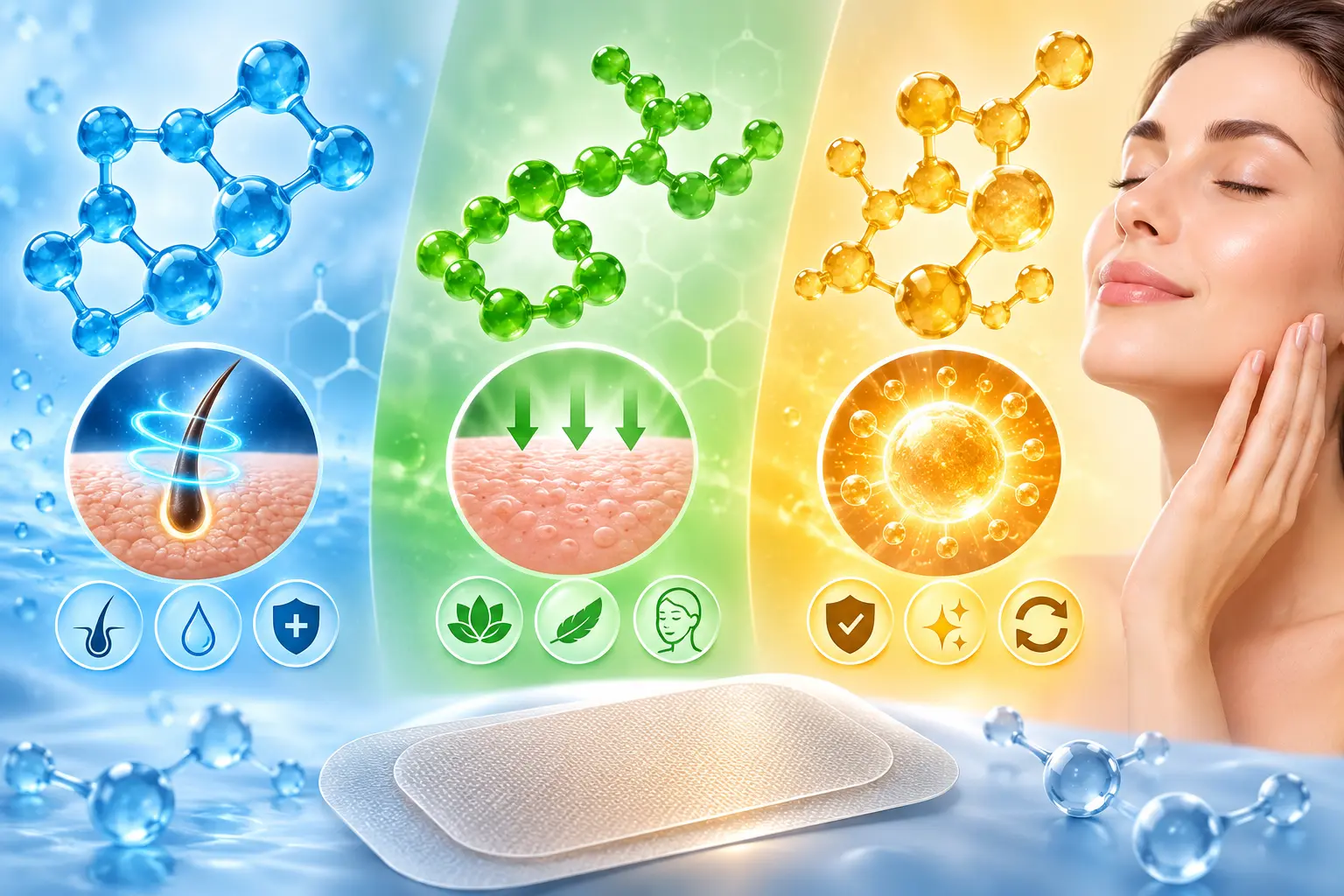

What are GHK-Cu, KPV, and Glutathione?
Before comparing their potential benefits, it helps to understand the basic properties of these three ingredients. Each has a different biological role, which influences how researchers investigate its possible applications in skincare and cosmetic formulations. Similar ingredient discussions also appear in searches for peptides for hair, although haircare and skincare applications require separate evidence.
What Is GHK-Cu?
GHK-Cu is a copper-binding tripeptide consisting of glycine, histidine, and lysine. It naturally occurs in the human body and can bind copper ions to form a biologically active complex. Researchers have investigated this complex because of its relationship with processes involved in tissue maintenance, collagen production, and skin remodeling.
In cosmetic research, GHK-Cu receives attention for its potential to support healthier-looking skin. Studies have explored its effects on fibroblast activity, extracellular matrix components, and wound-healing processes. Nevertheless, promising laboratory findings do not establish that every topical or patch-based formulation produces noticeable cosmetic improvements. GHK-Cu also appears in discussions about a peptide for hair, although its potential haircare applications require further research.
GHK-Cu Peptide Patch: Potential Benefits and Uses
GHK-Cu stands out because of its relationship with copper and biological processes involved in maintaining skin structure. Researchers have examined its interaction with fibroblasts, collagen-related pathways, and components of the extracellular matrix. These areas of investigation also explain why copper peptides sometimes appear in broader discussions about a peptide for hair and cosmetic maintenance.
Supports Collagen-Related Skin Processes
Collagen is an important structural protein that helps maintain skin firmness and elasticity. GHK-Cu has attracted research interest because laboratory studies suggest that it may influence collagen production and other extracellular matrix components.
These findings make copper peptides interesting ingredients in cosmetic research focused on skin texture and visible signs of aging. However, results from laboratory experiments do not guarantee that a GHK-Cu patch will improve firmness, reduce wrinkles, or increase collagen levels in human skin.
Associated With Skin Repair Research
Another area of interest involves the role of GHK-Cu in tissue repair. Experimental research has explored its relationship with cellular migration, fibroblast activity, and processes involved in wound healing.
Consequently, researchers continue to investigate its potential applications in skin maintenance and repair-related formulations. Still, consumers should distinguish between research involving controlled laboratory conditions and the performance of commercially available cosmetic patches. Similar caution applies when evaluating claims about peptides for hair, since skin research does not automatically establish hair-related outcomes.
Supports Antioxidant-Related Research
GHK-Cu has also been studied in connection with oxidative stress and cellular protection. Oxidative stress occurs when reactive molecules accumulate beyond the body’s ability to manage them effectively.
Although this connection adds to the scientific interest surrounding copper peptides, GHK-Cu should not be treated as interchangeable with conventional antioxidants. Its proposed biological activities involve several pathways, and the practical benefits of topical delivery require further investigation.
KPV Peptide Patch: Potential Benefits and Uses
KPV has a different research focus from GHK-Cu. Rather than primarily attracting attention for collagen-related activity, it is studied for its possible influence on inflammatory responses. This distinction is important when comparing ingredients marketed for skincare or discussed alongside a peptide for hair.
May Help Regulate Inflammatory Signaling
Inflammation is a natural biological response that helps the body react to irritation, injury, and other challenges. However, excessive or prolonged inflammatory activity can contribute to tissue discomfort and other problems.
Experimental studies suggest that KPV may influence certain inflammatory pathways. This has encouraged researchers to investigate its potential applications in inflammatory conditions. Nevertheless, these findings do not establish that a KPV patch can treat skin inflammation, eczema, acne, or other medical conditions.
Interesting Applications in Skin Research
Skin researchers are interested in ingredients that may influence inflammatory responses without relying on conventional therapeutic approaches. KPV is one such experimental ingredient because of its relationship with alpha-melanocyte-stimulating hormone.
Its potential role in skin-related formulations remains an area of scientific investigation. However, research specifically examining KPV delivered through consumer skincare patches is limited, so its practical cosmetic performance cannot be assumed.
A Different Approach to Skin Conditioning
Compared with GHK-Cu, KPV is not primarily discussed as a collagen-supporting ingredient. Its scientific interest centers more strongly on inflammatory signaling and related biological responses.
This distinction matters when comparing peptide patch ingredients. Consumers should consider the intended formulation and available evidence rather than assuming that all peptides provide the same skin-conditioning effects or benefits associated with a peptide for hair.
Glutathione Patch: Potential Benefits and Uses
Glutathione has an established role in cellular antioxidant defense. Its scientific background differs from that of GHK-Cu and KPV, making it particularly relevant to discussions about oxidative stress and skin appearance.
Helps Protect Against Oxidative Stress
Cells naturally produce reactive oxygen species during normal metabolic activity. Environmental factors, including ultraviolet radiation and pollution, can also contribute to oxidative stress.
Glutathione helps maintain antioxidant balance by participating in reactions that neutralize harmful reactive compounds. This protective function makes it an important subject in research involving cellular health and skin maintenance.
Investigated for Skin Brightening
Glutathione is frequently discussed in cosmetic products because researchers have investigated its relationship with melanin production and skin pigmentation. Some studies suggest that glutathione may influence processes involved in melanin synthesis.
However, the strength of the evidence varies depending on the formulation and delivery method. Results from oral or other formulations cannot automatically establish the effectiveness of glutathione patches. More well-designed human studies are necessary to clarify its cosmetic potential when delivered through the skin.
Supports the Body’s Antioxidant System
Glutathione works alongside other antioxidant systems to help maintain cellular balance. It also participates in several biochemical reactions that contribute to normal cellular function.
For skincare applications, this role makes glutathione an interesting ingredient in formulations designed around antioxidant support. Nevertheless, the presence of glutathione in a patch does not establish that sufficient quantities reach the intended skin layers or produce measurable cosmetic results.
GHK-Cu vs KPV vs Glutathione: Key Differences
Although these ingredients appear in similar skincare discussions, their structures and research interests differ. Understanding these distinctions makes it easier to compare their potential applications without treating them as interchangeable ingredients. These differences are equally important when separating skincare research from searches related to peptides for hair.
|
Feature |
GHK-Cu |
KPV |
Glutathione |
|
Ingredient type |
Copper-binding tripeptide |
Short tripeptide |
Antioxidant tripeptide |
|
Main research interest |
Skin remodeling and tissue repair |
Inflammatory signaling |
Antioxidant protection |
|
Common cosmetic interest |
Skin firmness and texture |
Inflammation-related research |
Skin appearance and pigmentation |
|
Key characteristic |
Binds copper ions |
Derived from α-MSH |
Helps manage oxidative stress |
|
Evidence for patches |
Limited |
Limited |
Limited |
Which Ingredient Focuses on Skin Structure?
GHK-Cu is the most directly associated with research into collagen-related processes and extracellular matrix maintenance. Therefore, it attracts particular interest in formulations targeting the appearance of aging skin.
Which Ingredient Is Studied for Inflammation?
KPV receives attention for its potential influence on inflammatory signaling. However, its experimental research should not be confused with established evidence that a cosmetic patch can relieve inflammatory skin conditions.
Which Ingredient Has Antioxidant Properties?
Glutathione has the clearest established antioxidant role among these three ingredients. Its contribution to cellular antioxidant defense makes it relevant to research into oxidative stress and skin health.
How Do Peptide Patches Deliver Their Ingredients?
Peptide patches are designed to keep an ingredient-containing formulation in contact with the skin. Depending on their construction, they may function as simple topical coverings or incorporate specialized delivery technologies.
Papa & Filles on Beacons
Papa & Filles on Behance
Papa & Filles on Quora
Papa & Filles on Bandcamp
Papa & Filles on Kick
Papa & Filles on Club
Papa & Filles on Bluesky
Papa & Filles on Pinterest
Papa & Filles on Product Hunt
Papa & Filles on Dribbble
Papa & Filles on Creative Market
Papa & Filles on Bluesky
Papa & Filles on Pinterest
Papa & Filles on 4shared
Papa & Filles on Academia.edu
Papa & Filles on 3D Warehouse
Papa & Filles on About.me



