
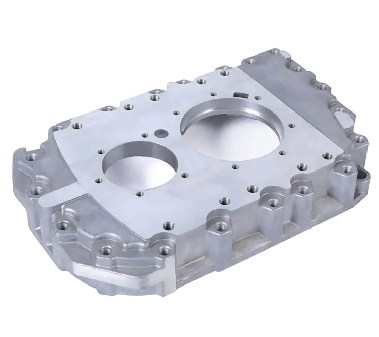

A Motor Aluminum Die Casting Parts category can contain several components that appear similar at first glance. Many use ADC12 aluminum alloy, yet their names, surface finishes and listed production details are not identical. A reducer housing is different from an output cover, just as a motor box is not automatically interchangeable with a motor case. These distinctions matter because each component has its own shape and relationship with the surrounding assembly.
The reducer housing is one of the larger enclosure-related components in this product range. Its listed specification includes ADC12 aluminum alloy, a customizable silver-gray color and plastic spray surface treatment. The stated die-casting machine tonnage is 400. Drilling, tapping, CNC turning and CNC machining are also included in its manufacturing information. These processes indicate that the finished part may involve more than the initial casting operation. Selected surfaces and holes can require additional machining to meet the dimensions and connection requirements shown on the component drawing.
A housing generally needs to be considered as part of a larger mechanical structure. Its overall profile, joining edges and machined areas influence how it connects with adjacent components. For a reducer housing, the relevant assembly drawing provides the necessary information about mounting positions and interfaces. The product name alone cannot establish the exact dimensions or internal structure. When comparing Motor Aluminum Die Casting Parts, it is therefore useful to separate the housing’s general function from the specific geometry of each model.
The motor output cover has a different component identity. Its specification also lists ADC12 aluminum alloy, a customizable silver-gray color and plastic spray finish, but the stated die-casting machine tonnage is 350 rather than 400. Drilling, tapping and CNC turning are included in the manufacturing description. Although it shares several material and finishing details with the reducer housing, its name places it at the motor output end. Its outline, openings and mating surfaces need to correspond with the adjoining motor structure. These features should be checked against the relevant drawing instead of being inferred from another housing or cover.
The output shaft cover is another separately listed product. Its name is close to that of the motor output cover, but the two listings have different surface treatments and machine tonnages. The output shaft cover uses ADC12 aluminum alloy and a customizable silver-gray color, with shot blasting specified as its surface treatment. Its listed die-casting machine tonnage is 200. This difference is worth noting because similar component names do not necessarily indicate the same finishing process or assembly arrangement.
Shot blasting and plastic spraying are two distinct surface-treatment methods. Shot blasting is listed for the output shaft cover and motor box, while plastic spray is specified for the reducer housing, motor output cover and motor case. These details describe the individual product listings. They should not be generalized to every component with a similar name. The required finish for a particular casting depends on its product specification and intended application.
The motor box also uses ADC12 aluminum alloy and has a listed machine tonnage of 200. Its specified color is customizable gray, and its surface treatment is shot blasting. The manufacturing information includes polishing, drilling, tapping and CNC turning. These operations relate to different aspects of the finished component. Polishing concerns surface condition, while drilling and tapping create or finish features used for connections. CNC turning is another machining operation that may be applied to selected areas according to the part’s geometry.
Although the motor box and output shaft cover share the same listed machine tonnage and surface treatment, they remain different products. Their outer profiles, contact areas and fixing features should be evaluated separately. A motor box may form part of an enclosure, while a shaft cover is identified by its relationship with the output shaft area. Their actual dimensions and assembly positions need to be confirmed through product drawings.
The motor case has a different exterior specification. Its product information lists ADC12 aluminum alloy, a customizable black color and plastic spray surface treatment. The stated die-casting machine tonnage is 200. Its equipment description includes a cold-chamber die-casting machine, polishing machine, drilling machine and CNC lathe. The listing also identifies application industries such as automotive, engineering construction, electric power, electronics and household appliances. This range of applications suggests that the product category is not limited to one narrowly defined motor assembly, although the suitability of an individual case still depends on its design and application requirements.
Looking across these five products reveals a common material but several different specification combinations. ADC12 aluminum alloy appears in the reducer housing, motor output cover, output shaft cover, motor box and motor case. Plastic spray is listed for three of them, while shot blasting is specified for the other two. The stated machine tonnages also vary: 400 for the reducer housing, 350 for the motor output cover, and 200 for the output shaft cover, motor box and motor case.
These figures describe the listed products rather than setting universal requirements for motor castings. Machine tonnage alone does not establish casting quality or determine whether a component is suitable for a particular assembly. Part geometry, casting structure, machining requirements and inspection criteria also need to be considered. Likewise, a shared ADC12 material specification does not mean that every component has identical mechanical or dimensional requirements.
When evaluating Motor Aluminum Die Casting Parts, it is useful to read the material, color, surface treatment and manufacturing information as one set of details. The component drawing then provides the reference for dimensions, mounting positions, openings and mating surfaces. This approach makes comparisons more accurate and helps prevent specifications from one product being mistakenly applied to another. Even within a single motor casting category, each housing, cover, box or case should be assessed according to its own design and assembly role.



