
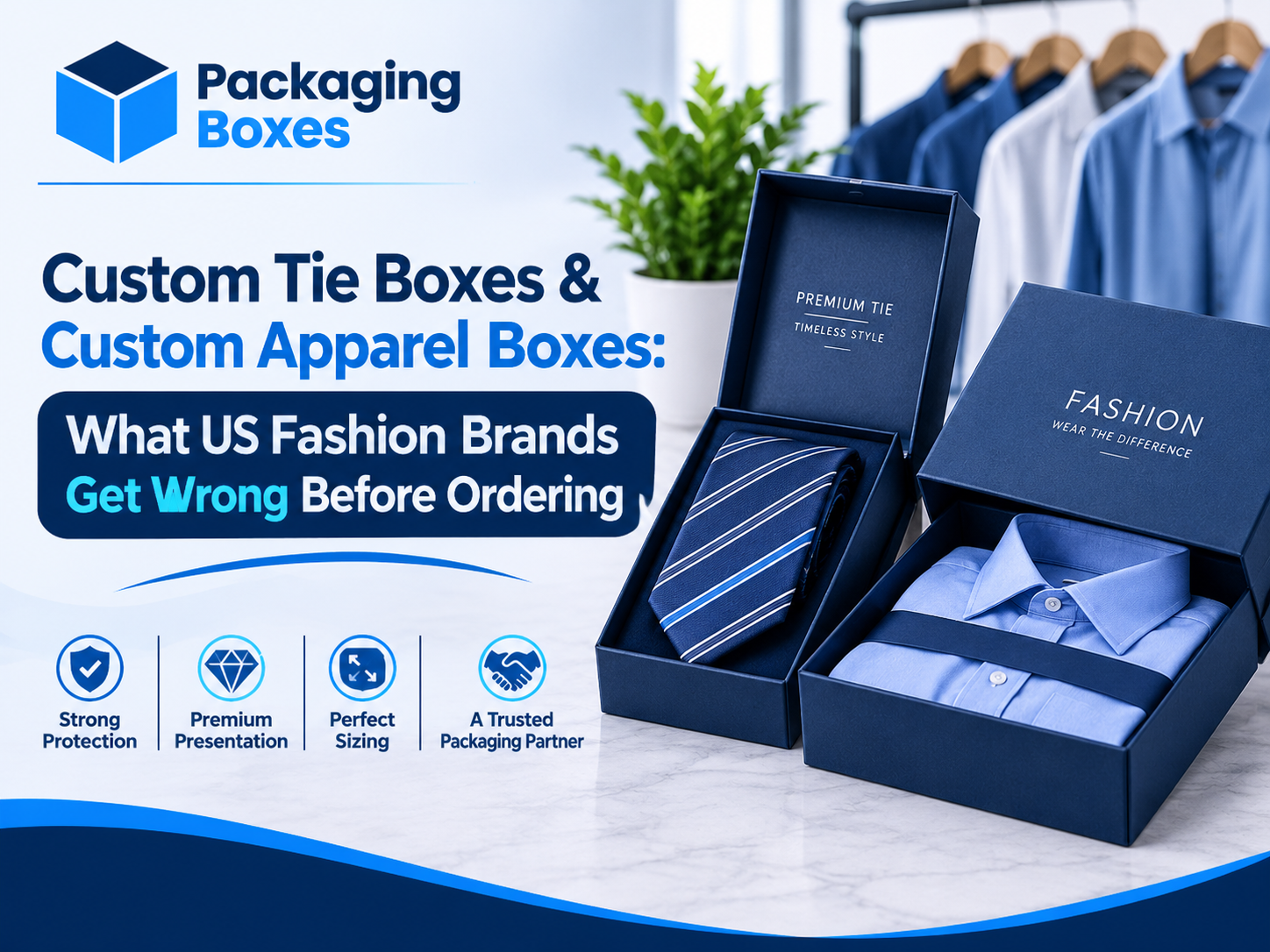

A silk tie arrives with a hard crease across the middle. It happened because someone folded it into a flat mailer and let a heavier package sit on top for 800 miles.
Here’s the thing most US fashion brands learn the hard way: custom tie boxes and custom apparel boxes look similar on the outside but solve completely different problems. A necktie is a long, delicate strip of fabric that must stay rolled or draped, never folded sharp. A dress shirt is a soft folded stack that shifts and creases if the box depth is wrong. Two products. Two specs.
At Packaging Boxes, we build both lines for US sellers who need flexibility-no minimum order, 4–6 day turnaround, and free design support. Before you order from anyone, here’s what actually matters.
Tie Boxes: Never Fold a Tie Flat
A necktie has one structural weakness: a sharp fold leaves a permanent crease in the silk or wool. That crease doesn’t come out with steaming. It’s there for the life of the tie.
So the box has to hold the tie in a gentle roll or a loose drape-not folded in half like a shirt.
The roll, not the fold. A custom tie box with enough interior depth to hold a soft roll is the standard solution. The tie curls loosely inside, no hard edge pressed into the fabric. For a single premium tie, rigid chipboard with a shallow insert works well. For multi-tie gift sets, a deeper rigid tie box with dividers keeps each tie separated.
Corrugated for shipping, rigid for retail. If you’re shipping direct to customers, a corrugated tie box with internal support handles the bumps . If you’re selling in a boutique or department store, rigid tie boxes with magnetic closures or lift-off lids signal the price point the buyer expects . The trade-off is the same as everywhere: rigid looks better, corrugated ships safer.
Kraft for casual brands. Kraft tie boxes suit knit ties, wool ties, and brands with a natural aesthetic. They photograph well on Etsy and Shopify. Just watch the humidity-uncoated kraft warps if your fulfillment center runs damp.
One spec I push US sellers on: interior length. A standard tie is roughly 57–60 inches long. Rolled at about 4–5 inches diameter, it needs a box roughly 6 inches long and 4 inches wide. Get that wrong, and the tie either crushes or rattles. Measure the roll, not the flat tie.
Apparel Boxes: The Folded Stack Decides the Depth
A shirt is a soft product. It settles, spreads, and fills whatever space you give it. Build a custom apparel box around the flat garment, and the folded stack will shift, crease, or arrive looking like it was packed by someone in a hurry.
The internal depth has to match the folded stack. Not the flat shirt. Not the hanger size. The actual folded height.
Mailer boxes for DTC. For US apparel brands selling direct, a corrugated apparel mailer with a snug fit is the workhorse. It protects without the weight of rigid board, ships flat, and prints inside and out. For Shopify and Amazon sellers, this is usually the right call.
Rigid boxes for retail and gifting. Boutiques and gift sets want rigid apparel boxes with lift-off lids or magnetic closures. They hold their shape on a shelf and make a folded shirt feel like a premium product. The catch: they cost more and take warehouse space.
Kraft for the eco-conscious. Kraft apparel boxes fit sustainable branding and photograph well. Just remember that uncoated kraft isn’t waterproof.
Ties and Shirts Together: The Gift Set Problem
Many US brands sell a tie and shirt as a set-wedding parties, Father’s Day, corporate gifting. That’s where the specs collide.
A tie needs roll depth. A shirt needs stack depth. Put them in one box, and the tie gets crushed under the shirt unless you build a divider.
The fix: a rigid gift box with a raised platform for the shirt and a separate roll cavity for the tie. It costs more per unit, but gift sets sell at a premium, and the packaging justifies the price. I’ve seen brands try to save money by using one generic box for both items. The ties arrive creased, and the returns eat the savings.
Why US Brands Order From Packaging Boxes
I’ll be direct because you can get “premium quality” from anyone’s homepage.
No minimum order. Testing a new tie pattern? Launching a two-shirt capsule? Order a small run and see what sells before committing to inventory you haven’t validated. No MOQ tie boxes and no minimum apparel boxes change the math for small brands.
4–6 day standard turnaround. Fashion moves fast. Seasonal drops, wedding season, holiday gifting-you can’t wait weeks for packaging. Our timeline is on the quote.
Free dieline and digital proof. Send your dimensions. Get a dieline you can drop artwork into. Approve a 3D mockup before anything prints. No surprise setup fees.
Free shipping across the USA. Packaging costs already eat into margins. Tie boxes with free shipping and apparel boxes with free shipping keep the landed cost predictable.
Free design support. Can’t visualize the finished box? Our team provides templates, mockups, and revisions before production starts.
Reliable customer support. You’ll have questions before you finalize. Our team answers them quickly.
The trade-off? We’re not the cheapest per-unit at massive volumes. High-volume buyers with rigid specs can find lower quotes elsewhere. For brands doing small-to-mid runs, the flexibility usually beats the per-unit savings.
The Detail That Saves You Returns: Inserts
Most tie creasing and apparel shifting happens because the product moves. A simple cardboard insert-die-cut to hold the tie roll or the folded shirt stack-prevents that movement for pennies per unit.
For ties: a shallow roll cavity that keeps the fabric curled, not folded. For apparel: a shallow tray that holds the folded stack square. Skip foam for eco-conscious brands. Pulp and cardboard recycle curbside.
Custom box inserts aren’t glamorous. But they’re the difference between a customer who reorders and one who requests a refund.
Quick Answers to What US Fashion Sellers Actually Ask
What’s the best box for shipping a silk necktie?
A tie box with enough interior depth to hold a soft roll-never a flat fold. Corrugated with an insert for shipping, rigid for retail and gifting.
Can I order a small batch of tie or apparel boxes?
With Packaging Boxes, yes. No minimum order. Test new patterns or limited drops without tying up cash in inventory.
What’s the difference between a tie box and an apparel box?
A tie box is built around a rolled strip of fabric-the depth holds the roll without creasing. An apparel box is built around a folded garment-the internal depth matches the folded stack, not the flat item.
How long does production and shipping take?
4–6 business days standard turnaround after proof approval, plus free shipping anywhere in the USA. Rush options available if you ask upfront.
Bottom line: A tie box that folds the tie flat is a crease waiting to happen. An apparel box that doesn’t match the folded stack is a return waiting to happen. Don’t order from a supplier who won’t show you a dieline, won’t give you a proof, and won’t tell you the turnaround before you pay.
Packaging Boxes does all three. Send your tie roll diameter and your folded shirt dimensions. We’ll spec the box and get you a quote-no minimum, no pressure.



