

Market Overview
The Automotive Radar Market is experiencing substantial growth, driven by increasing demand for advanced driver assistance systems (ADAS), rising vehicle safety awareness, growing electric vehicle production, and technological advancements in autonomous driving. Automotive radar systems use radio waves to detect surrounding objects, measure their distance and speed, and identify potential collision risks. These systems are widely used in adaptive cruise control, blind-spot detection, automatic emergency braking, parking assistance, and forward collision warning systems.
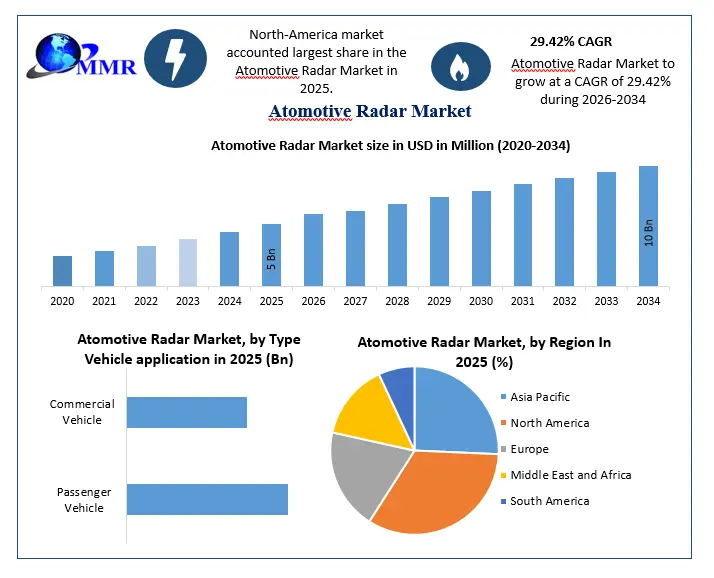
According to Maximize Market Research, the global Automotive Radar Market was valued at approximately USD 8.82 billion in 2025. The market is projected to grow at a CAGR of 29.42% from 2026 to 2034, reaching approximately USD 89.91 billion by 2034. Increasing integration of radar sensors into passenger vehicles, commercial vehicles, and electric vehicles is expected to support market expansion.
Market Estimation, Growth Drivers and Opportunities
The growing adoption of ADAS technologies represents one of the primary factors driving the automotive radar industry. Modern vehicles increasingly incorporate radar-based safety systems to improve driver awareness, reduce accidents, and provide automated driving assistance. Rising road accidents and increasing consumer expectations regarding vehicle safety are encouraging automobile manufacturers to integrate advanced radar sensors into new vehicle models.
Government regulations supporting vehicle safety are another significant growth driver. Mandatory automatic emergency braking, pedestrian detection, and collision warning requirements are encouraging manufacturers to adopt reliable sensing technologies. Automotive radar provides accurate object detection under challenging weather and lighting conditions, making it an important component of modern vehicle safety architecture.
Technological advancements in 77 GHz radar, high-resolution imaging radar, artificial intelligence, and sensor fusion are further strengthening market development. These technologies improve detection accuracy, object classification, and real-time environmental perception. The expansion of electric vehicles and autonomous driving technologies is also creating additional opportunities.
Major growth opportunities are emerging from 4D imaging radar, software-defined vehicles, vehicle-to-everything (V2X) communication, and radar-based cabin monitoring. Manufacturers developing compact, cost-effective, high-resolution radar sensors can benefit from increasing adoption across premium and mass-market vehicle categories.
U.S. Market Trends and Investment Outlook
The United States is an important market for automotive radar because of its advanced automotive industry, strong demand for vehicle safety technologies, and increasing adoption of ADAS-equipped vehicles. In 2025, regulatory developments continued to influence investment in automotive sensing technologies. The National Highway Traffic Safety Administration’s Federal Motor Vehicle Safety Standard No. 127, effective January 27, 2025, established requirements for automatic emergency braking and pedestrian automatic emergency braking, with general vehicle compliance required by September 1, 2029. These requirements are expected to encourage automotive manufacturers and technology suppliers to expand investment in radar sensors, processors, and integrated safety systems. Additionally, growing development of autonomous vehicles and electric mobility is supporting demand for advanced radar technologies. In May 2025, NXP Semiconductors introduced its third-generation S32R47 imaging radar processors, designed for Level 2+ to Level 4 autonomous driving applications, demonstrating continued investment in advanced radar technology.
Market Segmentation Analysis
The Automotive Radar Market is segmented by range, vehicle type, frequency, and application.
-
By Range: Short-range radar represents an important segment because of its extensive use in parking assistance, blind-spot monitoring, proximity detection, and low-speed collision avoidance. Its relatively compact design and suitability for multiple ADAS applications support widespread adoption.
-
By Vehicle Type: Passenger vehicles hold the leading position because of increasing consumer demand for safety features, rising passenger vehicle production, and growing integration of ADAS technologies in mid-range and premium automobiles.
-
By Frequency: The 77 GHz segment is a major category due to its suitability for high-resolution sensing, longer detection ranges, and advanced collision avoidance applications.
-
By Application: Adaptive cruise control represents a major application because radar sensors continuously measure the distance and relative speed of vehicles ahead, helping maintain safe following distances and improving driving convenience.
These applications are expected to benefit from increasing vehicle automation and stricter safety requirements.
Competitive Analysis
The global Automotive Radar Market is highly competitive, with established automotive suppliers and semiconductor manufacturers investing in advanced sensing technologies, research and development, strategic partnerships, and production capabilities. Five important companies shaping the competitive landscape include:
1. Robert Bosch GmbH
Bosch is a leading automotive technology supplier offering radar sensors for adaptive cruise control, collision avoidance, and autonomous driving applications. In July 2025, Bosch introduced its SX600 and SX601 radar system-on-chips built using 22 nm RF CMOS technology. These processors improve computing performance, object detection range, and resolution, supporting next-generation ADAS applications.
2. Continental AG
Continental is a major automotive radar manufacturer providing advanced sensing technologies for passenger and commercial vehicles. In May 2025, the company announced the production of its 200 millionth radar sensor. It also reported approximately EUR 1.5 billion in automotive order intake during the first quarter of 2025. Its continued development of high-resolution radar and intelligent driver assistance technologies strengthens its competitive position.
3. DENSO Corporation
DENSO develops automotive radar sensors and electronic components for vehicle safety and automated driving applications. The company focuses on millimeter-wave radar, advanced signal processing, and integrated ADAS technologies. Its engineering capabilities and collaboration with automotive manufacturers support the development of compact, high-performance radar systems for electric and conventional vehicles.
4. Aptiv PLC
Aptiv provides advanced automotive electronics, sensing technologies, and software solutions. Its radar-related innovations support object detection, collision prevention, and automated driving. The company’s investment in intelligent vehicle architecture, sensor integration, and advanced computing technologies is helping automakers develop more sophisticated ADAS platforms.
5. Valeo SA
Valeo is an important automotive technology supplier offering radar, camera, and LiDAR-based sensing solutions. In May 2025, the company secured an imaging radar nomination from a premium automotive manufacturer for higher-level automated driving functions, with production planned for 2028. Its continued development of imaging radar and sensor fusion technologies is expected to strengthen demand for advanced automotive safety systems.
These companies are strengthening their competitive positions through radar miniaturization, advanced semiconductor technologies, artificial intelligence integration, improved detection accuracy, and partnerships with automobile manufacturers. Their innovations are expected to support wider adoption of automotive radar across vehicle categories.
Regional Analysis
United States: The United States represents an important automotive radar market due to its established automotive manufacturing industry, increasing adoption of ADAS, and stringent vehicle safety requirements. NHTSA’s automatic emergency braking regulation is expected to encourage wider integration of radar-based collision avoidance technologies. Investments in autonomous driving and electric vehicles provide additional growth opportunities.
United Kingdom: The UK market is supported by automotive innovation, electric vehicle adoption, and road safety initiatives. Advanced driver assistance technologies and vehicle safety assessment programmes encourage manufacturers to incorporate radar-based sensing systems into new vehicle models.
Germany: Germany is a major automotive radar technology hub because of its established automotive manufacturing industry and the presence of leading suppliers such as Bosch and Continental. European Union General Safety Regulation requirements and Euro NCAP safety assessments encourage the integration of automatic emergency braking, pedestrian detection, and other advanced safety systems. Germany’s development of automated valet parking and autonomous driving infrastructure also supports radar technology adoption.
France: France benefits from its strong automotive manufacturing base, investments in electric mobility, and increasing demand for intelligent vehicle safety systems. Government support for automotive innovation and European vehicle safety regulations creates opportunities for radar manufacturers.
Japan: Japan’s automotive radar market is supported by major automobile manufacturers, advanced electronics manufacturing, and increasing investment in autonomous driving. Companies such as DENSO are contributing to radar innovation through advanced sensing and vehicle safety technologies. The country’s focus on reducing road accidents and improving mobility for an ageing population further supports demand.
China: China is an important growth market due to its large automotive production base, expanding electric vehicle industry, and increasing adoption of intelligent connected vehicles. Government initiatives supporting new energy vehicles, intelligent transportation, and autonomous driving are encouraging manufacturers to integrate advanced radar systems into passenger and commercial vehicles.
North America holds a significant position in the global market, supported by safety regulations and high ADAS adoption. Europe benefits from strong automotive engineering capabilities, while Asia-Pacific is experiencing rapid expansion because of increasing vehicle production and electric vehicle adoption.
Key Players in the Automotive Radar Market
-
Robert Bosch GmbH
-
Continental AG
-
DENSO Corporation
-
Aptiv PLC
-
Valeo SA
-
ZF Friedrichshafen AG
-
NXP Semiconductors N.V.
-
Infineon Technologies AG
-
Texas Instruments Inc.
-
HELLA GmbH & Co. KGaA
-
Autoliv Inc.
-
Analog Devices Inc.
-
Renesas Electronics Corporation
-
Arbe Robotics Ltd.
-
Magna International Inc.
Conclusion
The global Automotive Radar Market is expected to experience substantial growth through 2034, supported by increasing demand for vehicle safety, expanding ADAS adoption, autonomous driving development, and technological advancements in radar sensing. The growing integration of 77 GHz radar, imaging radar, and artificial intelligence-based perception systems will remain important factors influencing market development.
In my view, the most significant growth opportunity lies in affordable, high-resolution 4D imaging radar systems that can support advanced autonomous driving while maintaining vehicle safety and reliability. Increasing regulatory requirements, electric vehicle production, and investments in intelligent transportation infrastructure will create long-term opportunities for manufacturers. Companies focusing on semiconductor innovation, sensor miniaturization, radar-camera fusion, and cost-effective manufacturing are likely to gain a competitive advantage. The expansion of radar technology from premium vehicles into mass-market passenger cars and commercial vehicles will be a particularly important factor in accelerating global market growth.
About Maximize Market Research
Maximize Market Research Pvt. Ltd. (MMR) is a global market research and consulting company that provides reliable, data-focused, and practical business insights. The firm serves a wide range of industries, including healthcare, pharmaceuticals, technology, automotive, electronics, chemicals, personal care, and consumer goods. Through market forecasts, competitive analysis, strategic consulting, and industry impact assessments, MMR helps organizations understand changing market conditions, identify growth opportunities, and make informed business decisions for long-term success.
Contact Us
Maximize Market Research Pvt. Ltd.
2nd Floor, Navale IT Park Phase 3
Pune Bangalore Highway, Narhe
Pune, Maharashtra 411041, India
Phone: +91 9607365656
Email: [email protected]