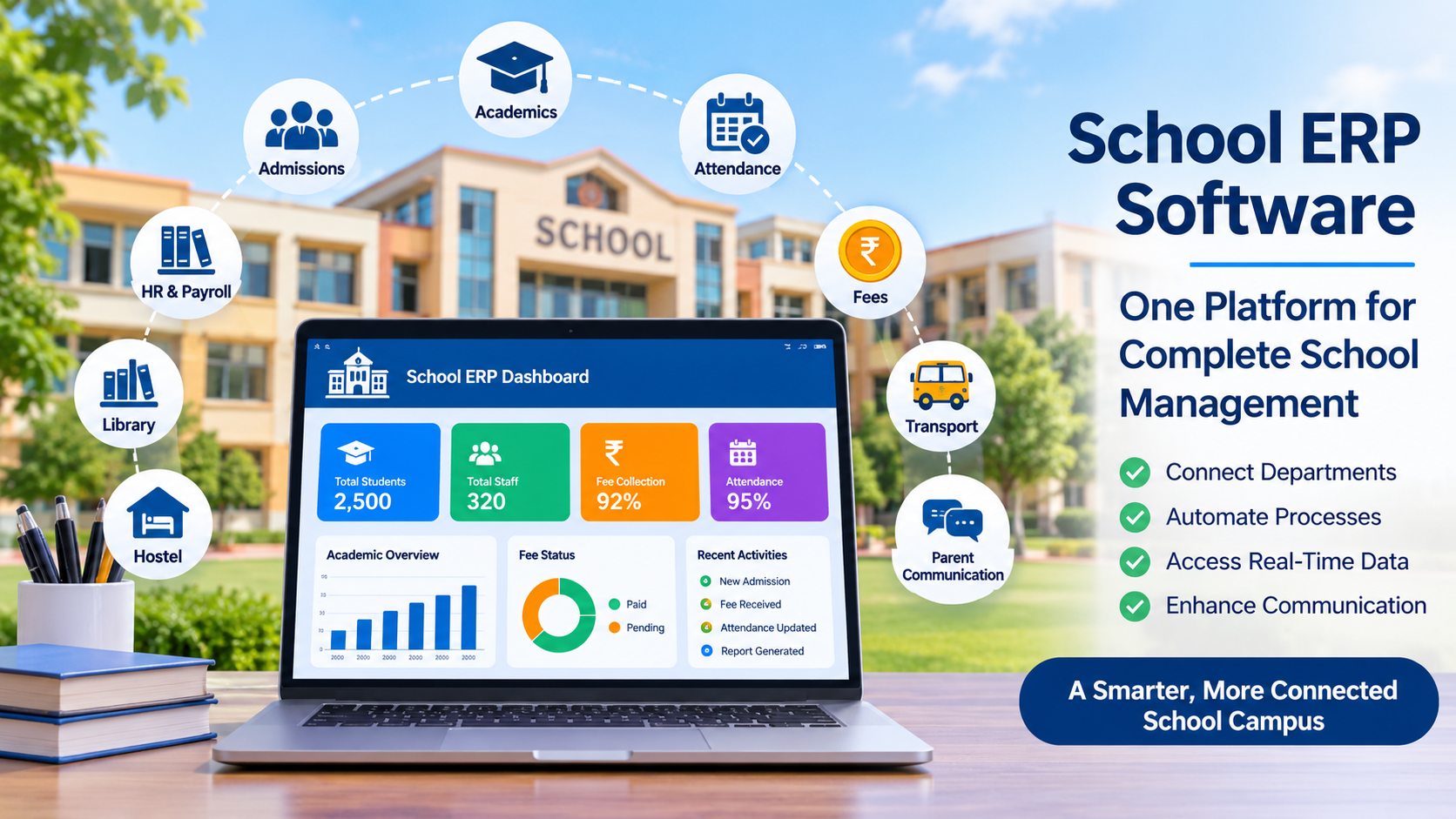

A school functions through several interconnected departments. Admissions teams manage enquiries and registrations, teachers handle attendance and academic activities, accounts departments oversee fee collection, and administrators coordinate staff, transportation, communication, and campus resources.
When these activities operate through separate tools or manual registers, information becomes scattered and coordination takes additional effort. School ERP Software addresses this challenge by bringing essential academic and administrative processes together through a centralized digital platform.
Instead of managing every department independently, schools can use an integrated system to organize information, automate routine activities, and maintain better visibility across their operations.
Why Do Schools Need a Connected Management System?
As schools grow, managing daily operations becomes increasingly complex. More students, additional staff members, multiple departments, and expanding administrative requirements create a greater need for accurate information and coordinated workflows.
Common challenges include:
-
Maintaining student information across different departments.
-
Managing admissions and registrations manually.
-
Tracking attendance and academic performance.
-
Monitoring fee collection and outstanding payments.
-
Coordinating staff records, payroll, and leave.
-
Communicating updates to parents and students.
-
Preparing reports for school management.
A centralized ERP environment helps reduce disconnected processes by allowing authorized users to access relevant information from one system.
8 Ways School ERP Software Connects School Operations
1. Centralize Student Information and Admissions
Student information is used across almost every school department. Admission details, contact information, academic records, attendance, and fee information need to remain consistent.
An integrated ERP platform connects these records and helps administrators manage student information throughout the academic lifecycle. Admission teams can organize enquiries and registrations, while other departments can access relevant student details according to their permissions.
Explore Admission CRM Software to understand how schools can organize admission enquiries and follow-ups.
2. Coordinate Attendance and Academic Activities
Attendance and academic administration require regular coordination between teachers and school administrators.
A connected system helps schools manage student attendance, examination schedules, assessments, timetables, and academic records. Teachers can update relevant information, while administrators can review reports and monitor academic activities.
Schools can also explore Student Attendance Management Software for more focused attendance automation.
3. Simplify Fee Collection and Financial Administration
Financial management involves several recurring tasks, including fee structure configuration, payment tracking, receipt generation, refunds, and outstanding-fee follow-ups.
School ERP Software connects fee-related information with student records and administrative workflows. This helps accounts teams maintain organized payment records and gives management better visibility into collection activities.
The School Fees Management System provides dedicated capabilities for managing these processes.
4. Manage Teachers, Staff, and Payroll
Schools need to coordinate teaching and non-teaching staff, maintain employee records, manage leave requests, and process payroll.
An integrated ERP system helps HR teams organize these responsibilities and reduce repetitive recordkeeping. Connecting staff information with attendance and payroll activities also supports more consistent administrative records.
5. Connect Parents, Students, and Teachers
Communication gaps can create unnecessary follow-ups between schools and families. Parents need timely information about attendance, homework, circulars, examination updates, and fee payments.
A connected School Mobile App gives parents and students access to relevant school updates through mobile devices. Teachers and administrators can use the communication environment to share important announcements and information.
6. Coordinate Transportation and Campus Resources
Transportation, libraries, hostels, inventory, and other campus activities require separate operational attention but are closely connected to overall school administration.
School ERP platforms can bring these functions into a shared management environment. Administrators can coordinate transport information, library activities, hostel records, inventory, and other resources without depending entirely on isolated records.
Schools can also review the School Transport Management System for dedicated transportation workflows.
7. Generate Reports for Better Administrative Decisions
School management needs reliable information to review operational performance. Collecting data manually from different departments can make reporting slow and inconsistent.
An ERP platform provides access to organized records and graphical reports, helping administrators review relevant information across departments. These insights can support decisions about admissions, attendance, fee collection, staff activities, and resource utilization.
8. Support Multiple Departments Through Modular Software
Not every school has identical operational requirements. Some institutions may need advanced transport or hostel management, while others may prioritize admissions, accounting, or academic administration.
A modular ERP approach allows schools to select and activate relevant modules according to their requirements. This makes it easier to align software implementation with existing workflows and future institutional needs.
What Should Schools Evaluate Before Implementing ERP Software?
Selecting an ERP platform requires understanding both current administrative challenges and future operational goals.
Before choosing a solution, school management should evaluate:
-
Module coverage: Does the platform support admissions, academics, attendance, fees, HR, and resource management?
-
Integration capabilities: Can different departments work with connected information?
-
User accessibility: Are separate access permissions available for administrators, teachers, students, and parents?
-
Customization: Can workflows and reports accommodate the school’s requirements?
-
Reporting: Does the system provide useful operational dashboards?
-
Mobile access: Can parents and staff access relevant information through mobile applications?
-
Scalability: Can the solution accommodate additional students, departments, or campuses?
-
Implementation support: Does the provider offer onboarding, training, and ongoing assistance?
A careful evaluation helps schools select a platform that supports practical requirements rather than paying for features they may not use.
How Vidyalaya School ERP Connects Institutional Operations
Vidyalaya provides an integrated School ERP Software solution designed for schools, colleges, universities, and other educational institutions.
Its platform brings together core modules such as admission management, student management, attendance, fee management, timetable, assessments, HR, payroll, accounting, transportation, library, hostel, and inventory management.
It also supports integrations such as biometric attendance, online payments, SMS and email, WhatsApp, vehicle tracking, and mobile applications. Its modular structure allows institutions to select and activate modules according to their operational requirements.
Schools can also explore AI-Powered School Management Software to understand how AI-enabled capabilities can support evolving administrative workflows.
Bring Every School Department Into One Connected System
Effective school administration depends on accurate information and coordination between departments. When admissions, academics, finance, HR, transportation, and communication work through disconnected processes, administrative teams spend more time managing information instead of focusing on institutional priorities.
A centralized School ERP platform provides a structured way to connect these activities. By selecting the right modules and implementing them according to institutional needs, schools can build a more organized digital management environment.
Planning to digitize your school operations? Explore Vidyalaya School ERP and request a product demonstration to understand how an integrated platform can support your institution.