
Time-of-Flight (ToF) Sensor Market: Rising Demand for 3D Sensing Technologies to Accelerate Global Market Growth
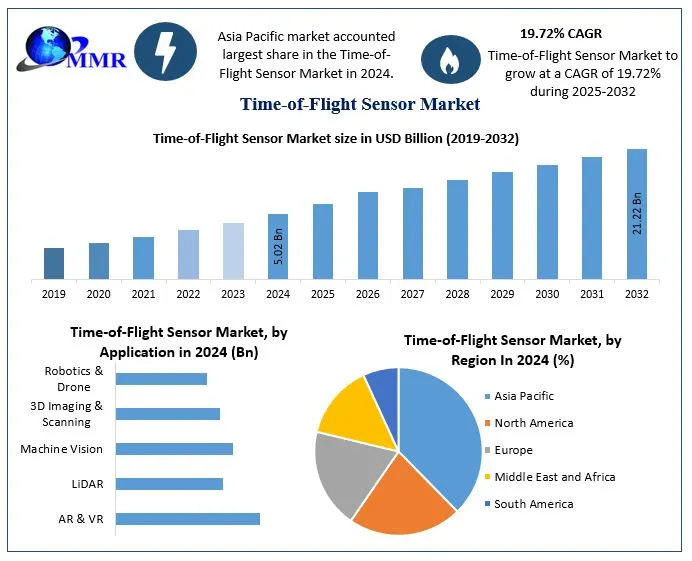
The global Time-of-Flight (ToF) Sensor Market is witnessing significant growth as industries increasingly adopt advanced depth-sensing, 3D imaging, and distance-measurement technologies. The market was valued at USD 5.02 billion in 2024 and is projected to reach approximately USD 21.22 billion by 2032, growing at a CAGR of 19.72% during the forecast period 2025–2032. Increasing applications across consumer electronics, automotive, healthcare, industrial automation, and augmented and virtual reality are creating substantial opportunities for market participants.
* Request Your Free Sample Copy: https://www.maximizemarketresearch.com/request-sample/90154/
Market Estimation, Growth Drivers, and Opportunities
Time-of-Flight sensors measure the distance between an object and a sensor by calculating the time taken by emitted light to travel to the object and return. These sensors are increasingly important in applications requiring accurate depth measurement, object detection, gesture recognition, and 3D environmental mapping. The growing demand for smartphones with advanced camera capabilities, facial recognition systems, autonomous driving technologies, and intelligent industrial equipment is supporting market expansion.
One of the major growth drivers is the increasing adoption of 3D cameras and machine vision systems across aerospace and defense, healthcare, manufacturing, and consumer electronics. The growing implementation of Industry 4.0, robotics, and automated inspection solutions is further increasing demand for reliable depth-sensing technologies. Additionally, advancements in sensor miniaturization, improved accuracy, low-power consumption, and real-time processing are creating new opportunities for manufacturers. The expansion of AR and VR applications, smart devices, and LiDAR-enabled systems is expected to strengthen the market’s long-term growth potential.
United States Market: Latest Trends and Investment Developments
The United States remains an important market for ToF sensor technology due to strong investments in automotive innovation, consumer electronics, robotics, and industrial automation. In 2025, the increasing development of spatial computing, AI-powered devices, autonomous mobility, and advanced driver-assistance systems strengthened demand for accurate 3D sensing solutions. Investments in smart manufacturing and machine vision are also encouraging manufacturers to integrate ToF sensors into automated production and quality-inspection systems. Government support for domestic semiconductor manufacturing through initiatives such as the CHIPS and Science Act continues to strengthen the broader semiconductor ecosystem, creating a supportive environment for sensor innovation and supply-chain investment. These developments are expected to provide opportunities for ToF sensor manufacturers, technology developers, and semiconductor suppliers.
Market Segmentation Analysis
The market is segmented by display resolution, product type, application, and end-user.
By display resolution, the market includes Quarter-QVGA (QQVGA), Half Quarter Video Graphics Array (HQVGA), Quarter Video Graphics Array (QVGA), and Video Graphics Array (VGA). These categories address different requirements for depth resolution, image quality, and sensing performance across applications.
By product type, the market is divided into RF-modulated light sources with phase detectors, range-gated imagers, and Direct ToF imagers. Direct ToF imagers are gaining attention because of their ability to calculate distance directly through light travel-time measurement.
By application, the market includes AR and VR, LiDAR, machine vision, 3D imaging and scanning, and robotics and drones. The AR and VR segment is projected to register the highest CAGR of 20.04% during the forecast period, supported by increasing demand for immersive experiences, spatial awareness, and real-time environment tracking.
By end-user, the market covers automotive, consumer electronics, gaming and entertainment, industrial, healthcare, and other sectors. Consumer electronics is expected to account for the largest market share by 2032, driven by growing smartphone adoption and the integration of ToF sensors into cameras, tablets, PCs, and wearable devices.
Time-of-Flight (ToF) Sensor Market Key Players are :
1. Sony Corporation.
2. Texas Instruments Incorporated
3. STMicroelectronics N.V.
4. AMS AG
5. Infineon Technologies
6. Panasonic Corporation
7. Melexis
8. Broadcom Inc. (Avago)
9. Teledyne Technologies Incorporated
10. pmd Technologies AG
11. Keyence Corporation
12. Sharp Corporation
13. Omron Corporation
14. Terabee
15. Lucid Vision Labs, Inc.
16. Adafruit Industries
17. Renesas Electronics
18. Others
Competitive Analysis: Leading Market Participants
The competitive landscape includes established semiconductor and sensing technology companies focusing on product innovation, strategic partnerships, and research and development.
- Sony Corporation: Sony continues to strengthen its image-sensing portfolio through advanced CMOS image sensors and 3D sensing technologies. Its expertise in sensor architecture and imaging innovation supports applications in smartphones, automotive systems, and industrial equipment.
- Texas Instruments Incorporated: Texas Instruments focuses on advanced sensing, signal processing, and semiconductor solutions. Its investment in efficient integrated circuits and precision measurement technologies supports the broader development of industrial and automotive sensing applications.
- STMicroelectronics N.V.: STMicroelectronics is advancing its imaging and depth-sensing capabilities through its FlightSense direct ToF technology. Improvements in sensing accuracy, compact design, and integration support applications in smartphones, robotics, and industrial automation.
- AMS AG: ams OSRAM has developed innovative direct ToF solutions, including its TMF8801 sensor, designed for accurate distance measurement in compact electronic devices. Its optical sensing expertise supports proximity detection and consumer electronics applications.
- Infineon Technologies: Infineon is strengthening its sensing and semiconductor portfolio through investments in 3D depth-sensing technologies, intelligent systems, and automotive electronics. Its expertise in semiconductor integration supports opportunities across industrial automation and advanced mobility.
Competition among these companies is increasingly focused on smaller sensor modules, improved measurement accuracy, lower power consumption, and enhanced performance under different lighting conditions. These developments are expected to support wider commercial adoption.
Regional Analysis: Key Country Markets
United States: The US market benefits from advanced semiconductor research, automotive technology development, and strong demand for smart consumer devices. Semiconductor manufacturing incentives and investments in automation support the wider sensing ecosystem.
Germany: Germany represents an important European market because of its automotive manufacturing base and Industry 4.0 initiatives. Demand for machine vision, robotics, and advanced driver-assistance technologies supports ToF sensor adoption.
United Kingdom: The UK market is supported by investments in robotics, autonomous systems, healthcare technology, and research into advanced imaging. Its growing technology ecosystem provides opportunities for innovative sensing applications.
France: France benefits from developments in aerospace, defense, automotive engineering, and industrial automation. Government-backed innovation and research initiatives contribute to the adoption of advanced sensing technologies.
Japan: Japan is a major technology and electronics manufacturing hub. Strong capabilities in robotics, automotive electronics, imaging systems, and precision manufacturing support the demand for ToF sensors.
China: China offers significant growth opportunities due to its large consumer electronics manufacturing industry, expanding electric vehicle production, and increasing automation investments. Government initiatives supporting semiconductor development and domestic technology manufacturing further strengthen the market outlook.
Conclusion
The global Time-of-Flight Sensor Market is positioned for substantial expansion as demand for accurate depth measurement, 3D imaging, and intelligent sensing continues to increase. Consumer electronics is expected to remain the leading end-user segment, while AR and VR applications offer strong growth potential. In my view, the major growth opportunities will emerge from automotive safety systems, robotics, industrial automation, spatial computing, and AI-enabled devices. Manufacturers that prioritize sensor miniaturization, cost efficiency, higher accuracy, and low-power technology will be better positioned to capitalize on the expanding global demand through 2032.
About Maximize Market Research
Maximize Market Research Pvt. Ltd. (MMR) is a global market research and consulting firm known for delivering accurate, actionable, and data-driven insights. Our expertise spans diverse industries — including medical devices, pharmaceuticals, technology, automotive, electronics, chemicals, personal care, and consumer goods. We provide services such as market-validated forecasts, competitive intelligence, strategic consulting, and industry impact analysis, helping businesses navigate market complexities and achieve sustainable growth.
Contact Maximize Market Research
MAXIMIZE MARKET RESEARCH PVT. LTD.
2nd Floor, Naval IT Park Phase 3,
Pune-Bangalore Highway, Narhe,
Pune, Maharashtra 411041, India.
📞 +91 9607365656
📧 [email protected]