

Mountain Bike Market: Technological Innovation, E-Mountain Bikes, and Adventure Tourism to Drive Global Growth
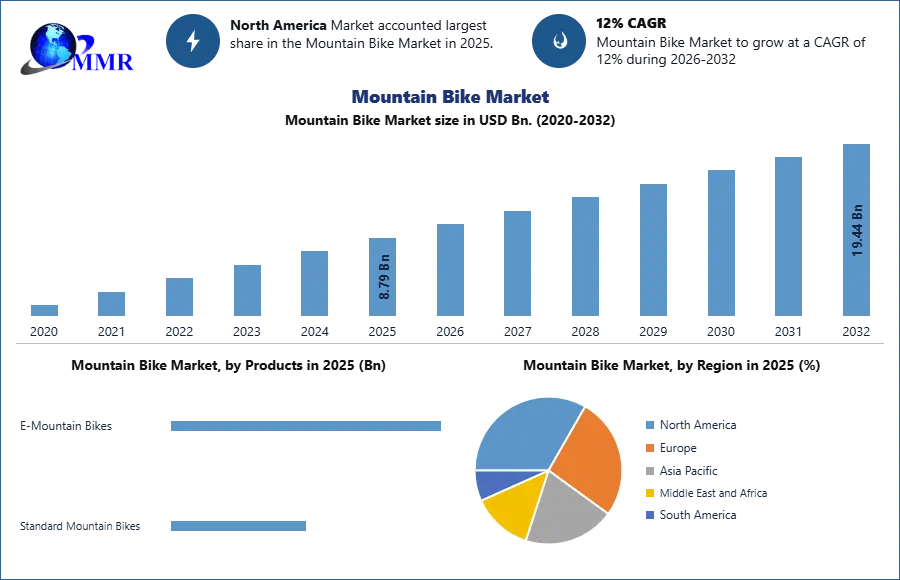
The Global Mountain Bike Market was valued at USD 8.79 billion in 2025 and is expected to reach approximately USD 19.44 billion by 2032, growing at a CAGR of 12% during the forecast period 2026–2032. The market is experiencing strong growth due to increasing interest in outdoor recreational activities, adventure sports, fitness, and sustainable transportation. Mountain bikes are specifically designed for off-road cycling across challenging terrains, including rocky trails, steep slopes, forests, and mountainous landscapes. Growing participation in mountain biking competitions, rising health awareness, and increasing investments in cycling infrastructure are creating significant opportunities for manufacturers.
The major growth drivers include increasing popularity of adventure tourism, expanding cycling communities, and technological advancements in bicycle manufacturing. Manufacturers are focusing on lightweight carbon-fibre frames, advanced suspension systems, improved braking technologies, and durable bicycle components to enhance riding performance. The growing popularity of electric mountain bikes (E-MTBs) is also creating new revenue opportunities by making challenging terrains more accessible to recreational and professional cyclists. Additionally, increasing disposable incomes and the development of dedicated mountain biking trails are supporting market expansion. However, high product prices, maintenance expenses, and limited accessibility to suitable riding infrastructure may restrict adoption in certain regions.
* Gain Competitive Market Advantage: https://www.maximizemarketresearch.com/request-sample/56758/
US Mountain Bike Market: Latest Trends and Investments in 2025
The United States represents a significant market for mountain bikes, supported by established cycling communities, outdoor recreational activities, and growing investments in trail infrastructure. In 2025, technological innovation and sustainability became important industry priorities. Trek Bicycle announced a major sustainability initiative in July 2025, introducing low-emission aluminum sourcing across nearly its entire aluminum bicycle lineup starting in October 2025. The initiative was expected to impact more than one million bicycles annually, highlighting the industry’s transition toward environmentally responsible manufacturing. Additionally, the EXPLORE Act, signed into law in January 2025, introduced provisions for identifying long-distance bicycle trails and opportunities for new trail development across federal recreational lands. These developments are expected to strengthen mountain biking tourism, encourage outdoor participation, and create additional demand for performance-oriented bicycles.
Mountain Bike Market Segmentation Analysis
Based on type, the market is segmented into Cross Country Bikes, All Mountain Bikes, Downhill Bikes, Freeride Bikes, Dirt Jumping Bikes, and Others. Cross Country Bikes held the largest market share because of their popularity among recreational and professional cyclists. Their lightweight construction, endurance-oriented geometry, and suitability for long-distance trail riding make them widely preferred. All Mountain Bikes are also gaining attention because of their ability to handle challenging terrain and technical trails.
By product, the market is divided into E-Mountain Bikes and Standard Mountain Bikes. E-Mountain Bikes are gaining popularity due to electric assistance, improved climbing performance, and accessibility for riders with different fitness levels.
Based on application, the market is categorized into Racing and Leisure. Leisure cycling represents an important demand segment, supported by increasing participation in outdoor activities and adventure tourism, while racing drives demand for high-performance bicycles.
By distribution channel, the market is segmented into Offline and Online. Offline distribution remains important because consumers prefer physical product demonstrations, professional fitting, and expert guidance when purchasing premium mountain bikes. Online channels are expanding through digital retail platforms and direct-to-consumer sales.
Key Players
Trek Bicycle Corporation
Giant Bicycles
Specialized Bicycle Components
Santa Cruz Bicycles
Cannondale
Scott Sports SA
Merida Industry
Canyon Bicycles
Dorel Sports
Shimano Inc
BOSCH
XDS Bikes
BH Bikes
Pivot Cycles
Yeti Cycles
Competitive Analysis: Top Five Mountain Bike Companies
The competitive landscape features established manufacturers focusing on product innovation, lightweight materials, advanced suspension systems, and electric bicycle technologies.
- Trek Bicycle Corporation: Trek strengthened its sustainability strategy in 2025 by announcing its transition to low-emission aluminum across almost its entire aluminum bicycle lineup. This manufacturing initiative supports environmentally responsible bicycle production.
- Giant Bicycles: Giant continues investing in advanced bicycle engineering and lightweight frame technologies. Its 2025 Anthem cross-country mountain bike series introduced an upgraded FlexPoint Pro suspension system and an improved frame design to enhance racing performance.
- Specialized Bicycle Components: Specialized focuses on high-performance mountain bikes, advanced carbon-fibre construction, suspension engineering, and electric mountain bike technologies. Its product development strategy emphasizes improved handling, durability, and rider efficiency.
- Santa Cruz Bicycles: Santa Cruz continues strengthening its premium mountain bike portfolio through carbon-frame engineering, progressive geometry, and advanced suspension technologies. Its Hightower platform demonstrates the company’s focus on improved traction, comfort, and technical trail performance.
- Cannondale: Cannondale focuses on lightweight frame construction, innovative bicycle engineering, and performance-oriented product development. Its advanced frame technologies and suspension solutions support the growing demand for high-performance mountain bikes.
These companies compete through product differentiation, technological development, sustainability initiatives, and expanding international distribution networks. The market report identifies these companies as key competitors but does not provide verified individual global market-share percentages.
Regional Analysis: Key Country Opportunities
United States: North America is expected to hold the largest regional share of the global market. High disposable incomes, organized mountain biking competitions, established cycling communities, and adventure tourism support market growth. Government-supported recreational trail programs also encourage cycling infrastructure development.
United Kingdom: Growing interest in outdoor recreation, cycling tourism, and mountain biking destinations supports demand. Government initiatives promoting active travel and cycling infrastructure further strengthen the broader bicycle industry.
Germany: Germany benefits from a strong cycling culture, advanced bicycle manufacturing capabilities, and increasing adoption of electric mountain bikes. Government-supported cycling infrastructure and sustainable mobility initiatives contribute to market development.
France: France’s established cycling culture, mountain tourism destinations, and international sporting events create opportunities for premium mountain bike manufacturers. Investments in recreational infrastructure and outdoor tourism further support demand.
Japan: Japan’s growing interest in outdoor fitness, recreational cycling, and technologically advanced bicycles supports market development. Lightweight bicycle engineering and electric-assisted cycling solutions offer additional opportunities.
China: China is an important manufacturing hub for bicycle components and finished bicycles. Increasing urban incomes, expanding outdoor recreational activities, domestic manufacturing capabilities, and growing interest in electric bicycles support market expansion.
Conclusion
The global Mountain Bike Market is positioned for substantial growth through 2032, supported by increasing participation in adventure sports, technological innovation, and the growing popularity of electric mountain bikes. In our view, lightweight carbon-fibre materials, advanced suspension technologies, improved battery performance, and sustainable manufacturing will be the major factors influencing future industry development. Manufacturers focusing on affordable E-MTB solutions, premium performance bicycles, and environmentally responsible production are likely to gain significant opportunities. Furthermore, investments in mountain biking trails, adventure tourism, and cycling infrastructure will remain essential to strengthening global market demand.
About Maximize Market Research
Maximize Market Research Pvt. Ltd. (MMR) is a global market research and consulting firm known for delivering accurate, actionable, and data-driven insights. Our expertise spans diverse industries — including medical devices, pharmaceuticals, technology, automotive, electronics, chemicals, personal care, and consumer goods. We provide services such as market-validated forecasts, competitive intelligence, strategic consulting, and industry impact analysis, helping businesses navigate market complexities and achieve sustainable growth.
Contact Maximize Market Research
MAXIMIZE MARKET RESEARCH PVT. LTD.
2nd Floor, Naval IT Park Phase 3,
Pune-Bangalore Highway, Narhe,
Pune, Maharashtra 411041, India.
📞 +91 9607365656
📧 [email protected]



