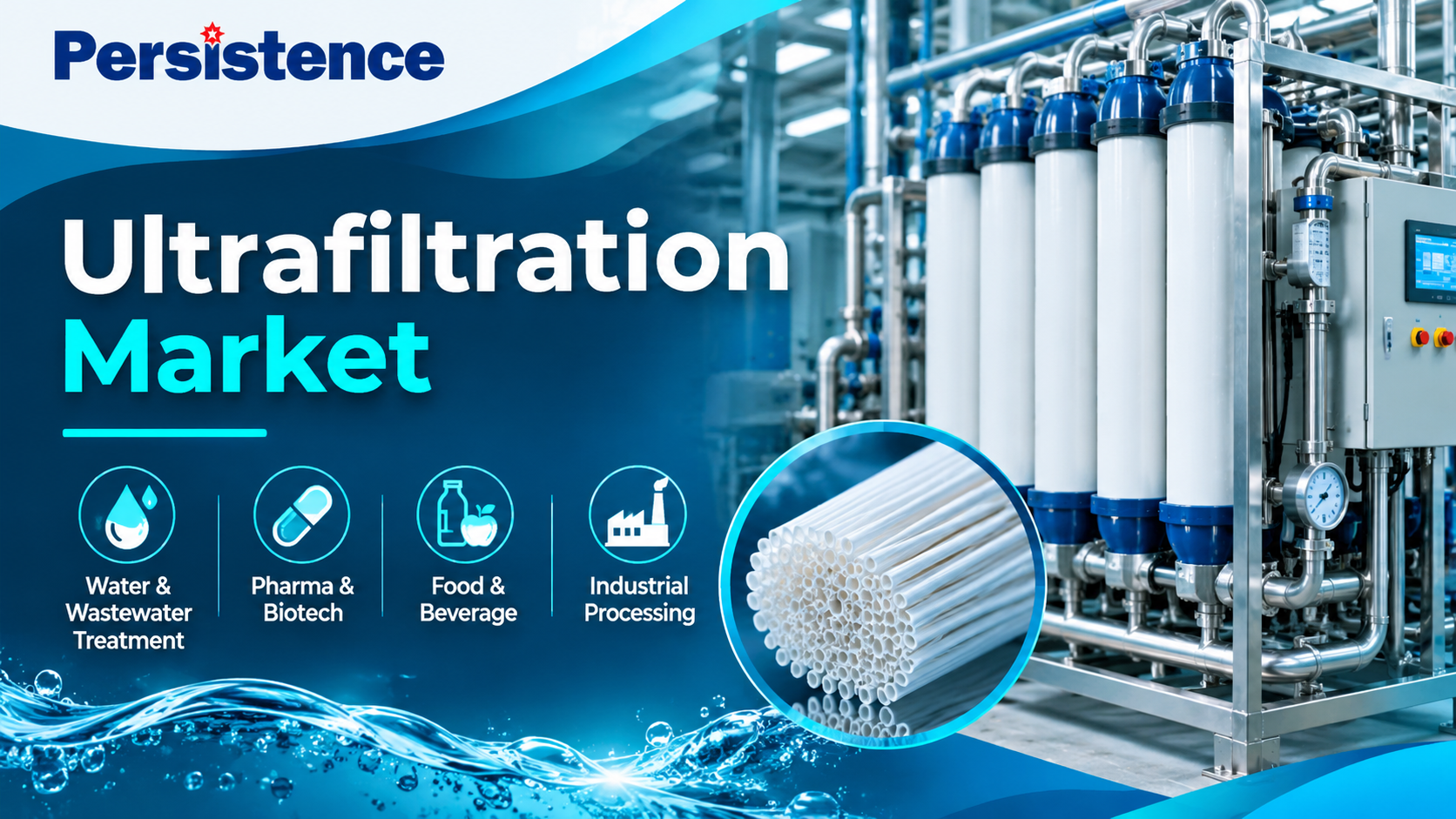

The global ultrafiltration market is expected to reach US$ 3.1 billion in 2026 and expand to US$ 4.5 billion by 2033, registering a CAGR of 5.4% during the forecast period. Increasing demand for clean water, industrial wastewater recycling, and advanced membrane filtration technologies supports market expansion. Ultrafiltration uses semipermeable membranes to remove suspended solids, bacteria, colloids, and macromolecules from liquids, making it valuable for municipal water treatment, industrial processing, and pharmaceutical manufacturing.
Growing concerns about water scarcity and stricter wastewater discharge requirements encourage investment in membrane filtration systems. Polymeric membranes are widely used because of their flexibility, established manufacturing processes, and suitability for diverse applications. Asia Pacific represents a significant growth opportunity, supported by industrialization, urbanization, and water infrastructure investment. However, verified market shares are unavailable to establish the leading membrane segment or geographical region conclusively.
𝐅𝐫𝐞𝐞 𝐒𝐚𝐦𝐩𝐥𝐞 & 𝐂𝐡𝐞𝐜𝐤 𝐭𝐡𝐞 𝐋𝐚𝐭𝐞𝐬𝐭 𝐌𝐚𝐫𝐤𝐞𝐭 𝐀𝐧𝐚𝐥𝐲𝐬𝐢𝐬: https://www.persistencemarketresearch.com/samples/37827
Key Highlights from the Report
- The global ultrafiltration market is projected to reach US$ 4.5 billion by 2033.
- Market revenue is forecast to grow at a CAGR of 5.4% between 2026 and 2033.
- Municipal water treatment remains an important application for ultrafiltration technology.
- Industrial wastewater recycling creates opportunities for advanced membrane systems.
- Polymeric ultrafiltration membranes support diverse separation and purification applications.
- Membrane innovation and water reuse initiatives are shaping future market development.
Ultrafiltration Market Segmentation and Technology Insights
The ultrafiltration market can be segmented by membrane material, module configuration, application, and end-user industry. Membrane materials include polymeric and ceramic alternatives. Polymeric membranes, including polyethersulfone and polyvinylidene fluoride, offer adaptable performance across water treatment applications. Ceramic membranes provide chemical resistance and durability in demanding industrial environments.
Based on module configuration, ultrafiltration systems include hollow fiber, tubular, plate-and-frame, and spiral-wound designs. Hollow fiber membranes offer compact configurations and substantial filtration surface area. Tubular systems can accommodate challenging feed streams, while other configurations address specific operating and maintenance requirements.
Major applications include drinking water purification, wastewater treatment, industrial process water, food and beverage processing, and pharmaceutical filtration. System selection depends on water quality, contaminant characteristics, membrane compatibility, and operating costs.
Regional Insights and Market Expansion
Asia Pacific presents considerable opportunities through expanding industrial activity, municipal water infrastructure development, and growing demand for wastewater reuse. China and India require efficient treatment technologies to support urban populations and industrial facilities.
North America benefits from established water treatment infrastructure and investment in industrial water management. The United States and Canada increasingly emphasize operational efficiency, treatment reliability, and water conservation.
Europe supports membrane technology adoption through environmental requirements and industrial sustainability initiatives. Germany, France, and the United Kingdom represent relevant markets for advanced filtration equipment.
The Middle East offers opportunities through water scarcity management, desalination pretreatment, and industrial water recycling. Latin America and Africa also present longer-term opportunities where water infrastructure investment improves.
Market Drivers Supporting Ultrafiltration Adoption
Increasing freshwater demand is a major factor encouraging investment in efficient water purification technologies. Municipal utilities require dependable filtration solutions capable of reducing particulate contamination and supporting drinking water treatment.
Industrial operators are adopting water recycling strategies to reduce freshwater withdrawals and manage wastewater discharge. Ultrafiltration can serve as a standalone treatment step or complement reverse osmosis and other purification technologies.
Growing requirements for consistent product quality in food processing, biotechnology, and pharmaceutical manufacturing also support demand for specialized membrane separation equipment.
Market Restraints and Operational Challenges
Membrane fouling remains an important operational challenge. Suspended particles, organic substances, and biological deposits can reduce filtration performance, increasing cleaning requirements and operating expenditure.
High initial investment costs may limit adoption among smaller utilities and industrial facilities. Equipment selection also requires technical expertise, suitable pretreatment, and ongoing membrane maintenance.
Chemical compatibility, membrane replacement expenses, and variations in feedwater quality can further influence system performance and investment decisions.
Emerging Opportunities in Membrane Filtration
Water reuse projects create opportunities for ultrafiltration manufacturers offering reliable treatment systems. Industrial facilities increasingly evaluate integrated membrane solutions that improve water recovery and reduce wastewater volumes.
Advancements in membrane materials, surface modification, and automated monitoring may improve filtration performance and maintenance efficiency.
Modular ultrafiltration systems also offer opportunities for decentralized treatment facilities, industrial expansion projects, and locations with limited water infrastructure.
Competitive Landscape and Company Insights
The ultrafiltration industry includes membrane manufacturers, water technology providers, and integrated treatment system suppliers. Competition focuses on membrane durability, filtration efficiency, system reliability, and lifecycle economics.
Key companies associated with ultrafiltration technologies include:
- DuPont
- Toray Industries, Inc.
- Veolia
- Pentair
- Koch Separation Solutions
- Pall Corporation
- Asahi Kasei Corporation
- MANN+HUMMEL
These companies are relevant industry participants rather than a verified market-share ranking.
Recent Developments and Industry Trends
Two notable industry developments involve growing adoption of ultrafiltration in water reuse projects and continued improvements in membrane durability and fouling resistance.
Manufacturers are also emphasizing integrated treatment solutions combining ultrafiltration with complementary purification technologies. Specific recent company announcements require verification against dated official disclosures.
Conclusion and Future Market Outlook
The ultrafiltration market is positioned for sustained expansion through 2033, supported by increasing water treatment requirements, industrial sustainability initiatives, and advances in membrane technology.
Companies delivering reliable filtration performance, efficient maintenance, and cost-effective treatment solutions can benefit from growing demand across municipal, industrial, and specialized purification applications.