
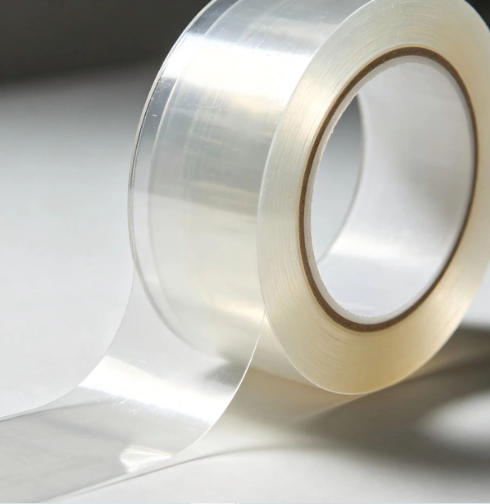

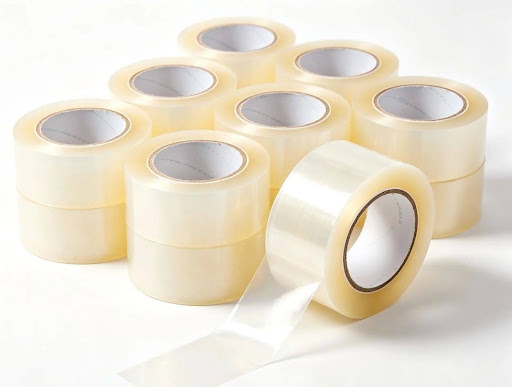
Around a work site, PE tape gets used for three jobs more than any others: sealing, bundling and weatherproofing. It seals the joints in scaffold sheeting and membranes, wraps bundles of battens, pipes and trim so they travel and store as one piece, and closes the tears in tarpaulins and temporary covers before the weather gets in. The reason it holds all three jobs is its backing. Polyethylene ignores rain, stretches instead of snapping, and stays flexible in the cold, so the tape behaves the same wet as dry for the weeks a site asks of it.
It also sticks to the materials a modern site is wrapped in: polythene sheeting, membranes, tarpaulins and its own kind, which makes it the natural partner for a temporary world built from plastic. Sealing is about joints, bundling is about movement, and weatherproofing is about time: a patch only has to last until Friday, but it has to last through weather until Friday. Used with a firm wrap, clean overlaps and edges pressed down properly, PE tape does all three without ceremony, which is why a roll lives permanently in the site box beside the nails.
Sealing sheeting and membranes
The first job is the seam. Sheeting and membranes only work as continuous skins, and every overlap, repair and penetration is a place where the skin is broken. PE tape closes those places: along the laps of a damp proof membrane, around the pipe that passes through it, across the tear a boot made yesterday. Because the tape is the same family of material as the sheet, the two age together instead of arguing, and the seal stays flexible as the building moves. A failed seam is invisible until the damage is done, which is why this humble strip carries so much responsibility. Water is patient, and it only needs the seam to be wrong once.
Bundling the awkward and the long
Sites are full of things that are too long, too many or too awkward to carry politely: battens, beads, conduit, offcuts of pipe, the roll of mesh that wants to unroll itself across the yard. A few turns of tape turn the argument into a parcel. PE tape suits this work because it stretches slightly as it is wound, gripping the bundle tighter the more it is pulled, and its smooth face sheds the mud the bundle will meet on its journey. At the other end it cuts or tears away without leaving the bundle wearing glue, which matters when the bundle is a finished product.
Weatherproofing the temporary world
Half of a building site is temporary: the cabin, the store, the tarpaulin roof over materials, the sheeted opening where a window has not yet arrived. Weather attacks all of it at the joints. This is where a roll of pe tape earns its permanent place in the site box, patching a split tarpaulin before the rain arrives, sealing the edge of a sheeted doorway against driven weather, and wrapping the joint on a temporary downpipe. None of these repairs is expected to last forever. They are expected to last until Friday, through weather, and that is a genuine engineering requirement disguised as a small one. Friday, on a wet site, is a serious design life. It comes in the widths site boxes standardise on, wound for exactly this daily sealing and patching work.
Repairs that buy time honestly
There is a respectable category of repair whose whole purpose is to buy time, and tape is its patron saint. A cracked bucket, a split hose, a torn cement bag shedding its contents across the store: each can be returned to service for the day with two minutes and a roll. The honesty lies in knowing these are truces, not victories. Sites that respect the difference thrive. The tape holds the day together while the proper replacement is ordered, and it asks only that nobody confuses the truce with the peace treaty and leaves it in charge of something structural.
Technique that makes it last
Even the right tape fails when it is applied like an afterthought. Surfaces want to be dry and roughly clean, because tape sticks to the dust instead of the thing, and the dust is not attached to anything. Tension matters: wound firmly, the tape’s stretch works for the joint; waved at it, nothing works. Overlaps should run so that water flows over them rather than into them, the way roof tiles are laid. These are thirty second disciplines, and they separate the seal that survives the month from the one found hanging like bunting after the first storm. Tape rewards the careful out of all proportion to the effort.
The roll that is always in the box
Ask a site manager which materials run out first and the answer is never the glamorous ones. It is tape, ties, blades and gloves: the small consumables that hold the temporary world together. PE tape sits at the top of that list because a site is, until surprisingly late in its life, a construction of sheeting, bundles and repairs, all of it exposed to weather. The roll in the site box is not a detail of the work. In a real sense, on a wet Tuesday in November, it is the work, holding the whole enterprise together one seam at a time. Civilisation, at site scale, is mostly seams that hold.



