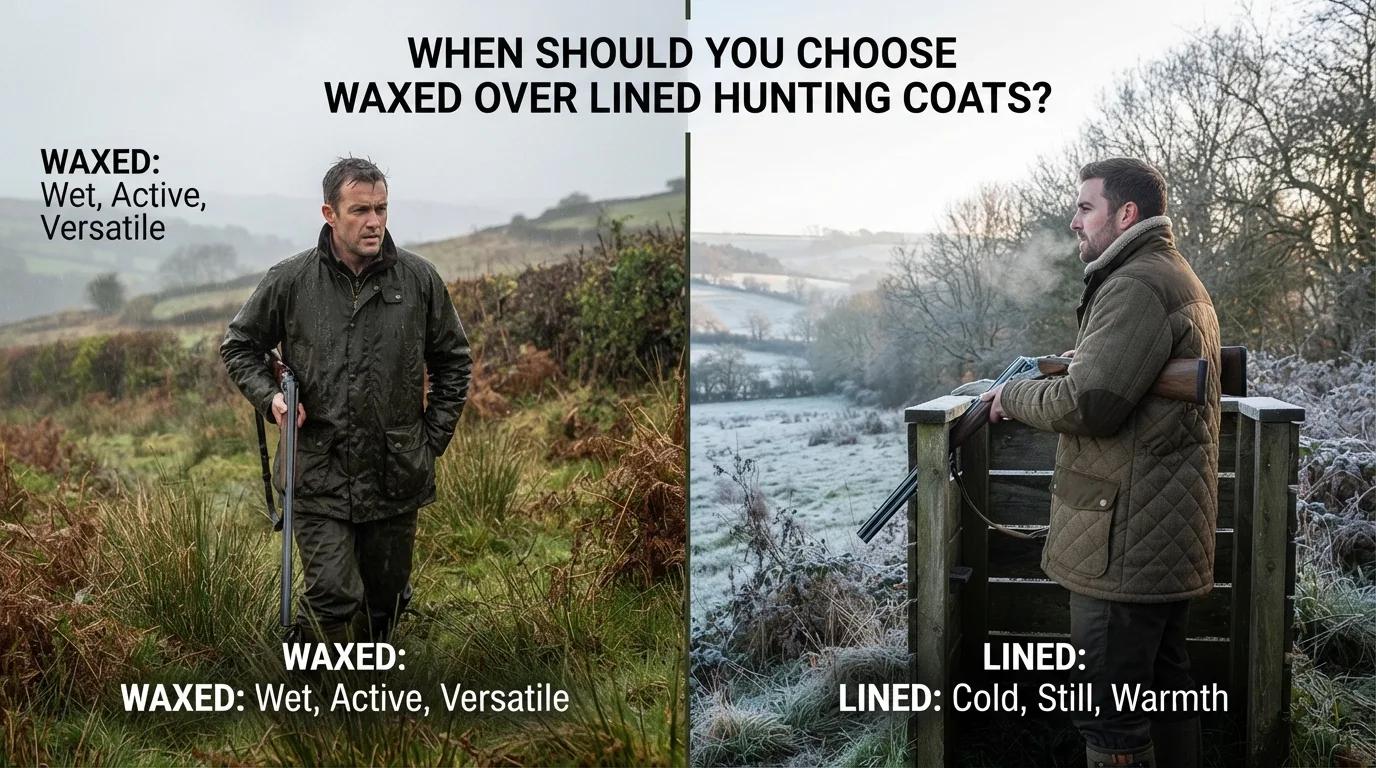

Choosing the right hunting coat is less about fashion and more about matching the garment to the conditions you actually face in the field. For UK hunters, that often means damp mornings, persistent drizzle, cold winds, and long periods of standing still followed by brisk walking across rough ground. In that setting, the decision between waxed and lined coats becomes practical very quickly. A waxed outer layer offers reliable resistance to rain and wind, while a lined coat focuses more on warmth and comfort. If you are comparing options such as a waxed hunting jacket, it helps to understand when that style is the better fit and when a lined alternative makes more sense.
The short answer is that waxed coats suit wet, changeable conditions and active use, while lined coats suit colder weather and longer periods of low activity. But there is more to it than that. Fit, breathability, terrain, season, and how you move during a shoot all influence the best choice. Understanding those factors can help you select a coat that keeps you comfortable without overheating, feeling restricted, or getting soaked through.
Key points
- Waxed coats are best for wet, windy, and unpredictable weather.
- Lined coats are better when warmth is the main priority.
- Waxed fabrics offer solid water resistance, but they are not usually as insulating as lined garments.
- Lined coats can feel too warm during active walking or mild weather.
- The right choice depends on how much time you spend moving versus standing still.
- For UK conditions, versatility and weather resistance often matter more than heavy insulation alone.
What a waxed hunting coat is designed to do
A waxed hunting coat is made from cotton or similar fabric treated with wax to create a water-resistant outer layer. This finish helps rain bead off the surface instead of soaking into the material straight away. That makes waxed coats especially useful in fields, woods, and upland environments where the weather can change quickly and shelter is limited.
These coats are typically valued for their hard-wearing construction and ability to handle mud, brush, and repeated outdoor use. They are often chosen by people who spend time in wet grass, light rain, or strong wind. While they are not the lightest option, they usually provide a good balance between protection and mobility.
Best conditions for waxed coats
- Showery or drizzly weather
- Windy days where a shell layer matters
- Mixed terrain with damp undergrowth
- Active days involving walking, beating, or carrying kit
- Autumn and early winter conditions in the UK
What a lined hunting coat offers
Lined hunting coats are built with insulation inside the garment, often using quilted, fleece, or padded materials. Their main purpose is to trap body heat and keep the wearer warm for longer periods. This can be useful when you are stationary for extended stretches, such as while waiting in a hide or standing on a peg in colder weather.
Compared with waxed coats, lined styles usually feel softer and warmer from the outset. However, that comfort can come with reduced breathability and greater bulk. If you walk hard or work up a sweat, the lining may make you feel too hot or clammy, especially if the weather is only mildly cold.
Best conditions for lined coats
- Cold, dry weather
- Long periods of standing still
- Early mornings with a sharp frost
- Lower activity levels where warmth is essential
- Situations where layering underneath is minimal
When waxed is the better choice
Waxed coats are usually the stronger option when the forecast is uncertain and rain is likely. UK weather rarely stays one thing for long, and a coat that can handle drizzle, gusts, and wet foliage without becoming heavy is useful across a wide range of outings. If you are moving between cover, crossing muddy ground, or spending time outdoors without guaranteed shelter, the weather protection of waxed fabric becomes a major advantage.
They are also sensible when you need a coat that can cope with wear and tear. The outer surface is often robust enough for brambles, fence lines, and repeated use in rough country. For people who want one outer layer that performs well in changeable conditions, waxed is often the more adaptable choice.
Another reason to choose waxed over lined is temperature control. A waxed coat can be worn over lighter layers, allowing you to add or remove insulation underneath as needed. This is useful when the morning starts cold but the day warms up, which is common in the UK.
When lined is the better choice
Lined coats are often the right answer when cold is the main challenge and wet weather is less of a concern. If you are likely to remain still for long periods, insulation matters more than weather resistance alone. A lined coat helps reduce heat loss and can make the difference between staying comfortable and becoming chilled.
They are also useful for people who dislike layering heavily. If you want a coat that provides warmth by itself, a lined option is more straightforward. For shorter outings in dry, cold weather, this can be a practical and comfortable solution.
That said, lined coats can be less flexible in changing conditions. Once you start moving more actively, the insulation may become too much. This is why many experienced outdoor users judge coat choice by activity level rather than temperature alone.
How activity level affects the decision
One of the most important factors is how much movement the day involves. If you are walking steadily, carrying equipment, or covering ground over several hours, waxed coats often make more sense because they protect against wind and rain without trapping too much heat. If your role is mostly static, a lined coat may be more comfortable because it keeps warmth in while your body is not producing much heat of its own.
This distinction matters because people often buy for the coldest possible day, then find the coat too restrictive or too warm in ordinary use. A good hunting coat should support the way you actually hunt, not only the worst weather you imagine.
Fit, layering, and comfort
Waxed coats generally work best when there is room for layering underneath. A base layer and a mid layer can provide the insulation you need, while the coat itself handles wind and light rain. This system gives more control over comfort across different conditions.
Lined coats simplify layering because the insulation is built in. That can be convenient, but it also means there is less adjustability. If the fit is too snug, the coat may reduce movement or make layering difficult. If it is too loose, warmth can be lost.
When trying to decide, think about shoulder movement, sleeve length, and whether you need room for thick knitwear or fleece underneath. A coat that feels fine standing still may feel limiting once you start lifting, crouching, or walking uphill.
Care and maintenance differences
Waxed coats usually need more specific care. The wax finish gradually wears with use and may need reproofing to maintain water resistance. They should also be cleaned carefully, as aggressive washing can damage the treatment. For many users, this extra maintenance is worthwhile because it extends the coat’s useful life and preserves performance.
Lined coats are often easier to care for in day-to-day use, especially if the outer material is synthetic or machine washable. However, once a lining becomes compressed or damp inside, it can take longer to dry and may lose some of its insulating efficiency. In wet climates, drying time is worth considering.
Making the right choice for UK conditions
In the UK, the best coat is often the one that handles a bit of everything. Waxed coats are usually the better choice for rain, wind, and active use in mixed conditions. Lined coats are often better for cold, still, and dry weather. If you regularly hunt in changeable weather, the versatility of waxed outerwear can be more useful than the extra warmth of insulation alone.
For many people, the decision comes down to balance. If your outings are often wet and unpredictable, waxed offers broader usefulness. If your days are consistently cold and you spend long periods stationary, lined may be the more comfortable option. Neither is universally better. The real answer depends on your routine, the season, and how much protection or warmth you need from one garment.
Conclusion
Waxed and lined hunting coats each solve a different problem. Waxed coats are designed to protect against damp, wind, and rough conditions, making them especially useful in changeable weather and during active use. Lined coats are designed to retain heat, which makes them ideal when the cold is the main issue and movement is limited. If you hunt in the UK, where weather can shift quickly and terrain is often wet, waxed coats tend to offer greater flexibility. If warmth is your top priority, a lined coat may be the better fit. The best choice is the one that matches your activity level, climate, and comfort needs.
FAQ
Are waxed hunting coats waterproof?
Waxed coats are water-resistant rather than fully waterproof. They shed rain well and perform strongly in damp conditions, but prolonged heavy rain may eventually get through unless the coat is properly maintained and reproofed.
Do lined coats keep you warmer than waxed coats?
Yes, in most cases. Lined coats are designed to trap heat, so they are usually warmer than waxed coats on their own. Waxed coats rely more on layering underneath for insulation.
Which is better for active walking?
Waxed coats are usually better for active walking because they are less insulating and provide useful protection from wind and rain without overheating as quickly.
Which is better for sitting still outdoors?
Lined coats are generally better for long periods of inactivity because they retain body heat more effectively.
Can I wear layers under a waxed coat?
Yes. In fact, layering is one of the main advantages of waxed coats. You can adjust insulation according to the weather and your level of activity.
Do waxed coats need special care?
They do. The wax finish needs occasional reproofing, and the coat should be cleaned carefully to avoid removing the protective layer.
What is the main advantage of a lined coat?
The main advantage is warmth. A lined coat provides built-in insulation, which is useful in cold weather or when you are not moving much.