
Transforming Business Operations with Generative AI Services in Atlanta
Artificial intelligence is transforming how modern businesses operate, communicate, and make strategic decisions. From automating repetitive tasks to improving customer experiences, AI-powered technologies are helping organizations become more efficient, productive, and competitive. Among these innovations, generative artificial intelligence has emerged as a powerful technology capable of creating content, analyzing information, supporting decision-making, and streamlining complex business processes.
For businesses in Atlanta, adopting generative AI creates opportunities to modernize operations and develop intelligent digital solutions. However, successful implementation requires more than selecting an AI platform. Organizations need a clear strategy, reliable infrastructure, secure data management, and solutions aligned with their long-term objectives.
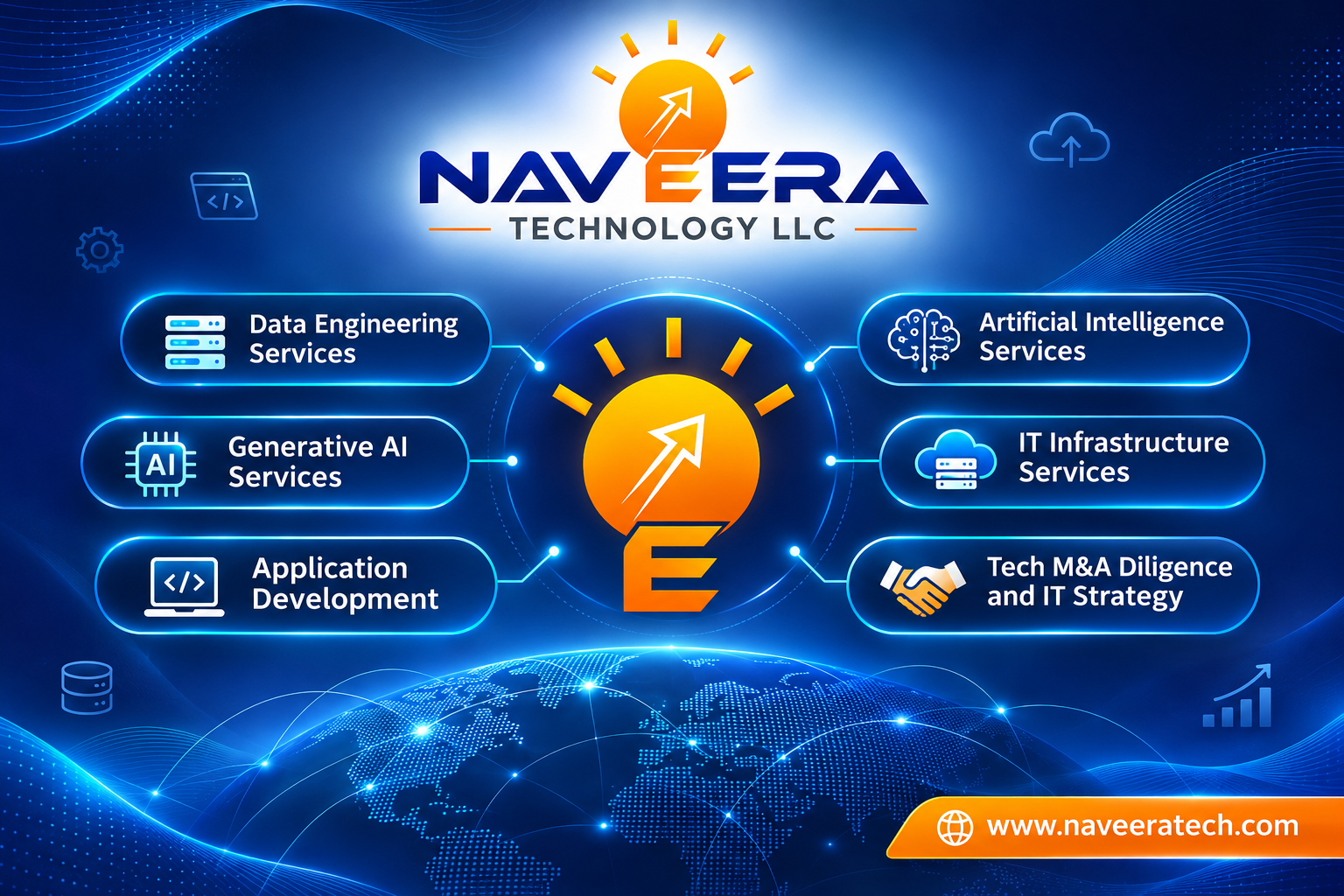
Naveera Technology helps organizations explore these opportunities through enterprise-focused generative AI consulting, development, integration, and managed services. By combining advanced AI technologies with practical business strategies, companies can move beyond experimentation and build intelligent systems that deliver measurable business value.
Understanding Generative AI and Its Business Potential
Generative AI refers to artificial intelligence technologies capable of producing new content, understanding natural language, processing complex information, and generating context-aware responses. Unlike traditional software that follows predefined instructions, generative AI models can interpret requests and produce dynamic outputs based on patterns learned during training and information provided through connected systems.
Businesses increasingly use generative AI for customer support, document processing, knowledge management, software development, marketing operations, and internal workflow automation. These applications can help employees spend less time completing repetitive tasks and more time focusing on strategic responsibilities.
For example, a company may introduce an AI-powered assistant that retrieves information from internal documents, answers employee questions, and prepares business reports. Similarly, customer service teams can use intelligent conversational systems to respond to common inquiries while escalating complicated issues to human representatives.
The real value of generative AI comes from integrating these capabilities into existing business processes rather than treating AI as a separate technology.
Building a Strong AI Strategy with Expert Consulting
Implementing artificial intelligence without proper planning can create unnecessary costs, operational challenges, and security concerns. Businesses must first identify where AI can provide meaningful improvements and determine whether their existing technology infrastructure can support implementation.
Professional GenAI Consulting Services in Atlanta help organizations evaluate their AI readiness, identify valuable use cases, and establish practical implementation roadmaps.
A successful consulting approach begins with understanding the company’s business objectives, operational challenges, existing applications, and data environment. AI specialists can then recommend suitable technologies, development frameworks, and deployment strategies.
Strategic consulting also helps organizations establish measurable performance indicators. These may include reducing manual processing time, improving customer response efficiency, increasing employee productivity, or enhancing access to business information.
Naveera Technology emphasizes aligning AI initiatives with enterprise governance, security requirements, and measurable outcomes. This structured approach helps businesses invest in technologies that support their operational goals while managing risks associated with AI adoption.
Custom Generative AI Development for Modern Enterprises
Every organization has unique workflows, customer requirements, and operational challenges. Although ready-made AI platforms offer valuable capabilities, they may not fully address specialized business processes or industry-specific requirements.
This is where custom generative AI development becomes particularly valuable.
Businesses seeking GenAI Development Services in Atlanta can explore solutions designed around their existing infrastructure, proprietary business data, and specific operational needs.
Custom AI development can involve intelligent document-processing applications, enterprise knowledge assistants, automated reporting platforms, conversational AI tools, and specialized language-model applications.
For example, a financial services organization might need an intelligent system capable of analyzing internal reports and helping employees locate relevant information. A healthcare organization may require an AI-supported administrative assistant that processes approved documentation while maintaining appropriate privacy controls.
Similarly, logistics companies can develop intelligent applications that summarize operational information, identify workflow issues, and support planning activities.
Naveera Technology focuses on developing scalable enterprise AI applications using technologies such as large language models, retrieval-augmented generation, and domain-specific AI solutions. These technologies can help businesses build applications that deliver more relevant responses and operate within established enterprise systems.
Connecting Artificial Intelligence with Existing Business Systems
One of the biggest challenges organizations face during AI adoption is connecting new technologies with their existing software applications and databases.
Many businesses already depend on customer relationship management platforms, enterprise resource planning systems, analytics dashboards, cloud applications, and internal databases. Introducing AI without connecting these systems can create isolated solutions that provide limited operational value.
Professional Generative AI Integration Services help organizations connect intelligent applications with existing digital infrastructure.
Through secure APIs, data pipelines, and enterprise integration frameworks, generative AI can access authorized business information and support workflows across different departments.
For example, integrating an AI assistant with a CRM platform can help sales representatives summarize customer interactions, prepare follow-up communications, and retrieve relevant account information.
Connecting AI to business intelligence platforms may enable managers to ask questions about operational performance using natural language instead of manually searching through multiple reports.
Successful integration also requires careful attention to access permissions, data quality, application compatibility, and system reliability.
By incorporating AI into established workflows, businesses can improve accessibility, reduce unnecessary manual effort, and create a more connected digital environment.
Advancing Business Automation Through Agentic AI
While traditional generative AI primarily responds to individual prompts, agentic AI introduces capabilities for planning and executing connected tasks within defined boundaries.
Agentic AI systems can evaluate objectives, select appropriate tools, retrieve information, and carry out multiple steps toward completing a business process. Depending on the application, these systems may operate independently within approved limits or require human authorization before performing sensitive actions.
Organizations exploring Agentic AI Development Services can develop intelligent workflows that extend beyond basic content generation and conversational assistance.
For instance, an agentic AI application could receive a customer service request, identify the relevant issue, retrieve approved information, prepare a response, and route the case to the appropriate employee when additional assistance is required.
In internal operations, AI agents may help coordinate document reviews, organize incoming information, generate workflow summaries, and initiate predefined business processes.
However, responsible implementation is essential. AI agents should operate with clearly defined permissions, activity monitoring, escalation procedures, and human oversight.
Naveera Technology incorporates governance-focused engineering principles into its generative AI solutions, helping organizations explore intelligent automation while maintaining operational accountability.
Developing Intelligent AI Agents for Business Productivity
AI agents are becoming increasingly relevant for businesses seeking more responsive digital services and improved internal efficiency.
Unlike basic automated chatbots, advanced AI agents can combine language understanding with enterprise data access and connected tools to support complex tasks.
Through professional AI Agent Development Services, businesses can develop purpose-built assistants that address specific operational challenges.
Customer support agents, for example, can help answer common questions, retrieve product information, and guide customers through standard service procedures.
Internal knowledge assistants can help employees locate policies, understand documentation, and access information stored across authorized enterprise systems.
Sales support agents may assist with researching account information, preparing personalized communication drafts, and organizing customer interaction summaries.
AI agents can also support human resources teams by helping employees navigate onboarding resources, internal guidelines, and routine administrative questions.
The effectiveness of these applications depends on several factors, including accurate information retrieval, carefully designed workflows, secure system connections, and continuous performance evaluation.
By developing AI agents around specific business objectives, organizations can introduce practical automation without unnecessarily complicating their existing operations.
Why Security and Responsible AI Governance Matter
Security is a critical consideration when deploying generative AI in enterprise environments.
Businesses frequently manage confidential customer information, proprietary documents, financial records, and sensitive operational data. AI systems interacting with these resources must follow appropriate security policies and access restrictions.
Responsible AI implementation involves establishing data protection practices, model evaluation procedures, monitoring systems, and clear accountability structures.
Organizations should also consider risks such as inaccurate AI-generated responses, unauthorized data exposure, prompt injection, and unintended automated actions.
For businesses operating in regulated industries, additional compliance considerations may apply, including HIPAA, GDPR, CCPA, or other relevant privacy and security requirements.
Naveera Technology emphasizes governance-first architecture, human oversight, secure infrastructure, and ongoing model management as essential elements of enterprise generative AI deployment.
These practices help businesses build greater confidence in AI-supported processes while maintaining appropriate control over important business decisions.
How Generative AI Supports Different Industries
Generative AI offers practical applications across a wide range of industries, although the specific benefits depend on each organization’s objectives and implementation approach.
In healthcare, AI-supported applications can help with administrative documentation, internal knowledge retrieval, and operational coordination while maintaining appropriate safeguards for sensitive information.
Financial services organizations can use intelligent systems to summarize reports, assist with document analysis, and improve access to internal research materials.
Retail and e-commerce businesses may apply generative AI to product content creation, customer communication, personalized shopping assistance, and inventory-related reporting.
Manufacturing companies can explore AI-supported technical documentation, maintenance knowledge systems, employee training resources, and operational information management.
Professional services firms can use intelligent assistants to summarize project documentation, organize research, draft routine communications, and improve collaboration between departments.
Across these industries, generative AI is most effective when implemented with clear performance goals, reliable data, and continued human involvement.
Choosing the Right Generative AI Technology Partner in Atlanta
Selecting an experienced technology partner is an important step toward successful AI adoption.
Businesses should look beyond basic AI development capabilities and consider whether a provider understands enterprise architecture, data engineering, operational security, integration requirements, and long-term application management.
A reliable partner should be able to assess business requirements, recommend appropriate AI technologies, develop customized applications, and provide support after deployment.
Naveera Technology, headquartered in the Atlanta area, offers enterprise-focused generative AI services covering consulting, custom development, system integration, infrastructure, and ongoing operational support.
Its approach includes production-oriented engineering, governance frameworks, model lifecycle management, and continuous improvement.
Instead of focusing exclusively on experimental AI applications, the company emphasizes building solutions that can operate within established enterprise environments.
This combination of strategic planning and technical implementation can help organizations establish a stronger foundation for sustainable AI adoption.
Preparing Your Business for the Future of Artificial Intelligence
Generative AI continues to influence how businesses approach digital transformation. As AI technologies become more capable, organizations will have additional opportunities to improve operations, expand automation, and develop more intelligent customer experiences.
However, achieving long-term value requires a thoughtful implementation strategy.
Companies should begin by identifying practical business challenges, evaluating existing data resources, and selecting AI applications with measurable objectives. Starting with focused use cases allows teams to evaluate performance, address technical limitations, and improve governance before expanding deployment.
Employee training and organizational readiness are equally important. Teams need to understand how AI applications support their responsibilities, when human review is necessary, and how to handle AI-generated information responsibly.
Businesses that combine technical innovation with strong governance and continuous improvement will be better positioned to adapt as artificial intelligence evolves.
Conclusion
Generative AI is creating new opportunities for businesses to automate workflows, improve access to information, strengthen customer experiences, and support informed decision-making.
From strategic consulting and custom application development to enterprise integration and intelligent AI agents, organizations can use these technologies to address real operational challenges.
For businesses in Atlanta and throughout the United States, working with an experienced AI technology partner can simplify the transition from initial planning to production-ready implementation.
Naveera Technology provides generative AI consulting, development, integration, and managed services designed around enterprise requirements, security, scalability, and long-term performance.
By adopting a structured and responsible approach to artificial intelligence, businesses can transform promising AI ideas into practical digital capabilities that support sustainable growth.