
Global Commercial Refrigerator Market
The Global Commercial Refrigerator Market is witnessing steady growth as expanding food retail, hospitality, and food service industries increase the need for reliable refrigeration and temperature-controlled storage. Commercial refrigerators are essential for preserving perishable food products, maintaining freshness, displaying beverages, and supporting the safe storage and distribution of temperature-sensitive goods. These systems are widely used across supermarkets, hypermarkets, restaurants, hotels, catering businesses, convenience stores, and food distribution facilities. Rising consumption of packaged foods and beverages, growth in organized retail, and expanding e-commerce operations are creating new opportunities for commercial refrigeration manufacturers worldwide.
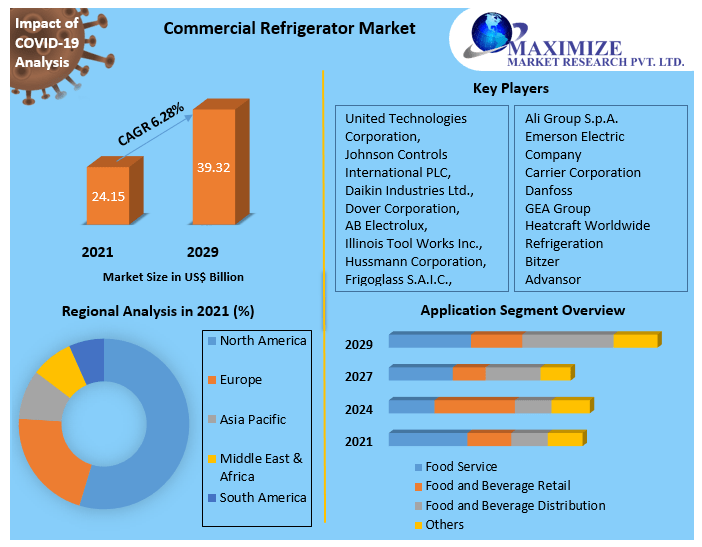
The Global Commercial Refrigerator Market is expected to reach USD 39.32 billion by 2029, registering a CAGR of 6.28% during the forecast period from 2021 to 2029. Increasing demand for ready-to-eat food, chilled beverages, frozen products, and processed food is encouraging businesses to invest in advanced refrigeration equipment. Manufacturers are also focusing on energy-efficient designs, improved cooling performance, environmentally friendly refrigerants, and technologies that reduce operating costs.
Commercial refrigerators play an important role in maintaining product quality throughout storage, display, and transportation. Supermarkets and retail outlets use refrigerated display cases and beverage coolers to preserve products while making them accessible to customers. Restaurants and hotels depend on walk-in coolers, freezers, and undercounter refrigeration units to maintain ingredients and support kitchen operations. Food distributors also require specialized refrigeration equipment to preserve temperature-sensitive products across the supply chain. The expansion of organized retail and food service industries is further supporting market growth.
* Access Exclusive Industry Data: https://www.maximizemarketresearch.com/request-sample/36726/
Market Growth Drivers
- Expansion of organized retail: The increasing number of supermarkets, hypermarkets, and convenience stores is driving demand for commercial refrigeration systems used for food preservation, product display, and beverage cooling.
- Rising consumption of packaged food and beverages: Growing demand for ready-to-eat meals, frozen products, dairy items, and chilled beverages is encouraging food retailers and service providers to expand refrigeration capacity.
- Growth of the food service industry: Expansion of restaurants, hotels, catering businesses, cafés, and quick-service outlets is increasing the need for reliable commercial refrigerators and freezers.
- Increasing demand for cold-chain infrastructure: Food producers, distributors, and retailers require temperature-controlled storage and transportation solutions to maintain product freshness and reduce spoilage.
- Expansion of e-commerce and online grocery delivery: The growth of online food retail is increasing the importance of refrigeration across storage facilities, fulfillment centers, and distribution networks.
- Technological advancements: Improvements in cooling systems, compressor technologies, temperature controls, and energy-efficient designs are encouraging businesses to upgrade existing refrigeration equipment.
- Growing focus on energy efficiency: Rising electricity costs and environmental concerns are motivating commercial operators to adopt refrigeration systems that reduce energy consumption and operating expenses.
Key Market Segments
The Commercial Refrigerator Market can be segmented based on type, application, end user, and region. By type, the market includes walk-in coolers, display cases, beverage refrigerators, ice-making machinery, transportation refrigerator equipment, and other equipment. Walk-in coolers include packaged units, remote condensing units, and remote plants. Display cases are categorized into plug-in and remote cases, while beverage refrigeration includes beverage cooling and dispensing units, drinking fountains, beer dispensing units, soda fountain equipment, and others.
Based on application, the market is divided into food service, food and beverage retail, food and beverage distribution, and others. By end user, it includes supermarkets, hotels, restaurants and catering businesses, hypermarkets, convenience stores, e-commerce businesses, and others.
Walk-in coolers are important equipment for commercial establishments that require substantial refrigerated storage capacity. They are widely used in food service operations, supermarkets, hotels, and food distribution facilities. Display cases also represent an important product category because they allow retailers to preserve and merchandise chilled and frozen products while improving product visibility. Beverage refrigerators support the storage and presentation of bottled drinks, while ice-making machinery serves restaurants, hotels, and other commercial establishments.
By application, food service and food and beverage retail are important demand areas. Restaurants, catering businesses, and hospitality establishments require dependable refrigeration to preserve ingredients and maintain food quality. Retail outlets depend on display refrigerators and freezers to store dairy products, packaged foods, beverages, and frozen items. Food and beverage distribution also requires specialized refrigeration equipment to support temperature-controlled handling and storage.
Commercial Refrigerator Market Key players:
• United Technologies Corporation,
• Johnson Controls International PLC,
• Daikin Industries Ltd.,
• Dover Corporation,
• AB Electrolux,
• Illinois Tool Works Inc.,
• Hussmann Corporation,
• Frigoglass S.A.I.C.,
• AHT Cooling Systems GmbH,
• Ali Group S.p.A.
• Emerson Electric Company
• Carrier Corporation
Emerging Trends
- Shift toward environmentally friendly refrigerants: Manufacturers are increasingly exploring natural and lower-global-warming-potential refrigerants to reduce the environmental impact of commercial refrigeration systems.
- Development of energy-efficient refrigeration: Advanced compressors, inverter technology, improved insulation, and optimized cooling systems are helping businesses reduce electricity consumption.
- Growth of smart refrigeration systems: Digital temperature monitoring, connected controls, and remote diagnostics are improving equipment management and operational visibility.
- Increasing adoption of advanced display cases: Retailers are investing in modern refrigerated display solutions that improve product visibility, maintain consistent temperatures, and support merchandising requirements.
- Expansion of modular refrigeration solutions: Flexible refrigeration equipment is gaining attention among businesses seeking scalable storage and cooling capacity.
- Focus on cold-chain efficiency: Food retailers and distributors are prioritizing dependable refrigeration systems to minimize product losses and maintain quality during storage and transportation.
- Integration of automation and monitoring: Automated temperature controls and equipment monitoring technologies are helping commercial operators improve maintenance planning and refrigeration performance.
Recent Developments
- Voltas Limited: In March 2026, Voltas showcased its next-generation energy-efficient commercial refrigeration portfolio at AAHAR 2026. The company introduced an eco-friendly refrigerant range across its visi-cooler models and upgraded glass-top chest freezers with energy-efficient internal LED lighting.
- Hoshizaki Corporation: In November 2025, Hoshizaki announced plans to expand its product portfolio using low-environmental-impact natural refrigerants. The initiative included converting 66 models across four product lines, with upgraded products scheduled for successive launches from December 2025.
- Panasonic Heating & Cooling Solutions: In October 2025, Panasonic announced the European availability of its iCORE range of CO₂ condensing units, expanding its commercial refrigeration portfolio based on natural refrigerant technology.
- Epta: In July 2025, Epta introduced UNIT, a beverage cooler designed around circular refrigeration principles. The product incorporates isobutane refrigerant, recycled plastic, and biodegradable cork insulation, with the company highlighting its recyclability.
- Danfoss India: In July 2025, Danfoss India introduced NeoCharge at Seafood Expo Bharat 2025. The industrial refrigeration solution was designed to increase cold-room capacity and reduce energy costs without increasing refrigerant use.
Regional Outlook
Asia-Pacific held the largest share of the Commercial Refrigerator Market in 2021 and is expected to witness the fastest growth during the forecast period. China and India are important contributors to regional expansion. Rising disposable incomes, urbanization, and the growing middle-class population are increasing consumption of frozen, processed, and imported food products. The expansion of supermarkets, food service establishments, and the seafood industry is further increasing demand for commercial refrigeration equipment used in storage, preservation, and transportation.
North America represents an important market supported by established food retail networks, developed hospitality infrastructure, and demand for advanced refrigeration technologies. Supermarkets, restaurants, convenience stores, and food distribution businesses require reliable cooling equipment to maintain product quality and support large-scale operations. The adoption of energy-efficient systems and environmentally friendly refrigerants is also creating opportunities for manufacturers.
Europe continues to offer growth opportunities through its established food and beverage industry, organized retail infrastructure, and increasing emphasis on energy efficiency. Demand for modern display cases, walk-in coolers, beverage refrigerators, and sustainable refrigeration technologies is supporting market development across the region.
Latin America is witnessing opportunities as organized retail, food service, and food distribution networks expand. Increasing demand for packaged food and beverages is encouraging commercial establishments to invest in improved refrigeration and storage facilities.
The Middle East and Africa are also creating opportunities through the development of hospitality, retail, tourism, and food distribution infrastructure. The need to preserve perishable products under challenging climatic conditions is supporting demand for dependable commercial refrigeration equipment.
Conclusion
The Global Commercial Refrigerator Market is evolving as food retail, hospitality, and distribution businesses increasingly depend on efficient refrigeration systems to preserve perishable products and maintain food quality. Growth in organized retail, packaged food consumption, e-commerce, and food service operations is supporting demand across walk-in coolers, display cases, beverage refrigerators, ice-making machinery, and transportation refrigeration equipment. At the same time, energy-efficient designs, natural refrigerants, smart monitoring, and advanced cooling technologies are reshaping product development. Continued investment in cold-chain infrastructure and commercial food operations is expected to create significant opportunities for refrigeration manufacturers through 2029.
About Maximize Market Research
Maximize Market Research Pvt. Ltd. (MMR) is a global market research and consulting firm known for delivering accurate, actionable, and data-driven insights. Our expertise spans diverse industries — including medical devices, pharmaceuticals, technology, automotive, electronics, chemicals, personal care, and consumer goods. We provide services such as market-validated forecasts, competitive intelligence, strategic consulting, and industry impact analysis, helping businesses navigate market complexities and achieve sustainable growth.
Contact Maximize Market Research
MAXIMIZE MARKET RESEARCH PVT. LTD.
2nd Floor, Naval IT Park Phase 3,
Pune-Bangalore Highway, Narhe,
Pune, Maharashtra 411041, India.
📞 +91 9607365656
📧 [email protected]