Physical Address
304 North Cardinal St.
Dorchester Center, MA 02124
Physical Address
304 North Cardinal St.
Dorchester Center, MA 02124

The Airline Ancillary Services Market is becoming an increasingly important part of the global aviation industry’s revenue strategy. Ancillary services include optional products and services purchased in addition to the base airfare, such as checked baggage, seat selection, onboard meals, priority boarding, lounge access, travel insurance, Wi-Fi, loyalty programs, hotel bookings, and car rentals.
The market is evolving as airlines seek to increase revenue per passenger while offering flexible fare structures. In 2025, global airline ancillary revenue was projected to reach $157 billion, compared with $148.4 billion in 2024. Ancillary revenue represented about 15.7% of total airline revenue, highlighting its growing strategic importance.
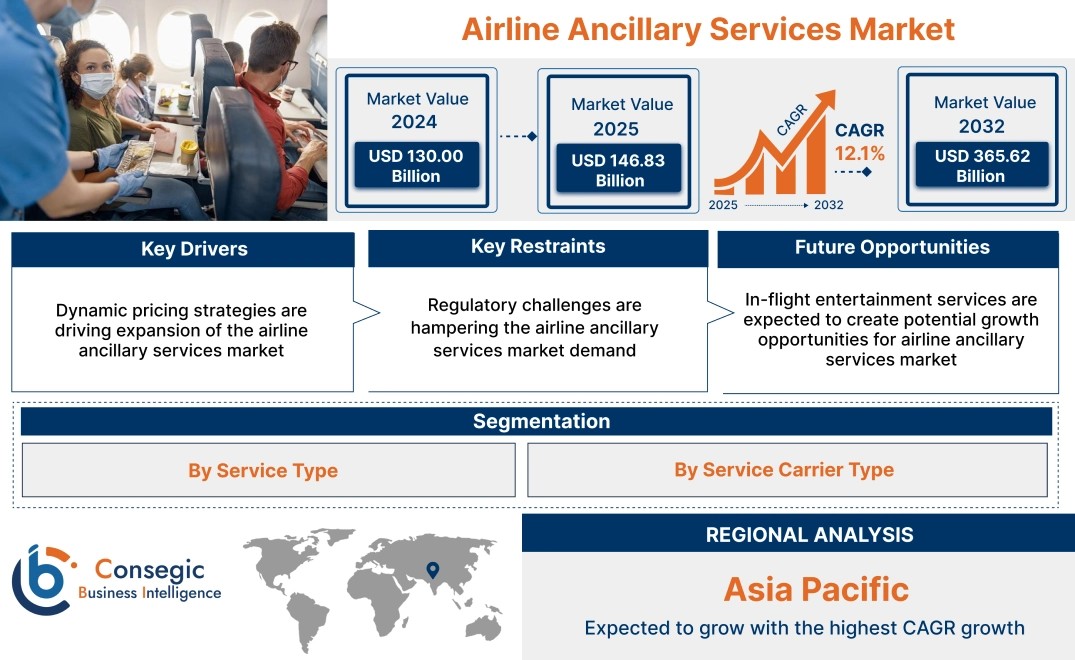
Airline Ancillary Services Market Size is estimated to reach over USD 365.62 Billion by 2032 from a value of USD 130.00 Billion in 2024 and is projected to grow by USD 146.83 Billion in 2025, growing at a CAGR of 12.1% from 2025 to 2032.
The market covers a broad ecosystem of airline retailing and passenger-focused services. Low-cost carriers have traditionally relied heavily on ancillary income, but full-service airlines are increasingly adopting similar strategies.
Key applications include:
Strong passenger demand remains an important foundation for market expansion. IATA reported that global passenger demand increased 5.3% in 2025, while the passenger load factor reached a record 83.6%.
Several factors are supporting the expansion of ancillary services.
Growth in air passenger traffic: More passengers create a larger customer base for optional purchases. International passenger demand increased 7.1% in 2025, according to IATA.
Unbundled airfare models: Basic and economy fares increasingly separate the core transportation service from optional features. This gives passengers greater choice while creating additional revenue opportunities for airlines.
Digital transformation: Mobile applications, airline websites, digital wallets, and connected booking platforms allow passengers to purchase services before and during travel.
Personalization: Airlines are using customer data analytics and machine learning to understand preferences and present more relevant offers.
Partnership-based revenue: Airlines increasingly generate commissions through hotels, car rentals, travel insurance, loyalty programs, and financial partnerships.
Personalization is becoming a major trend across airline retailing. Artificial Intelligence (AI) and Machine Learning (ML) can analyze customer behavior, travel history, booking patterns, and preferences to support targeted offers.
Automation is also improving the passenger experience. Digital check-in, automated baggage services, mobile boarding passes, and self-service airport technologies reduce friction while creating additional opportunities for service upgrades.
Other important trends include:
Cloud technologies and data analytics are also becoming central to airline retail platforms. These technologies enable airlines to manage customer information and ancillary transactions across multiple digital channels.
Technology is changing how airlines design, sell, and manage ancillary products. Modern airline retailing platforms can connect booking systems, customer relationship management, loyalty programs, payment systems, and airport operations.
AI can support demand forecasting and personalized recommendations, while automation can streamline transaction processing and customer service. Predictive analytics can also help airlines identify purchasing patterns and optimize service availability.
IoT integration may further improve connected airport and aircraft services. Smart devices and connected systems can support baggage tracking, passenger notifications, and operational monitoring.
Industry 4.0 concepts are also influencing aviation service infrastructure. Smart manufacturing, robotics, data analytics, and predictive maintenance can improve the wider aviation ecosystem, even though these technologies are not themselves ancillary products.
Sustainability is another emerging consideration. Airlines and technology providers are exploring green technologies, digital documentation, reduced paper use, sustainable onboard products, and more efficient airport processes.
North America represents a mature market with extensive adoption of unbundled fares, loyalty programs, seat selection, baggage services, and co-branded financial products. Established digital infrastructure and high passenger spending support continued innovation.
Europe has strong demand for low-cost airline services, making ancillary revenue particularly important. Airlines are expanding digital retailing, seat upgrades, priority services, and travel partnerships. Sustainability considerations are also increasingly influencing passenger purchasing behavior.
Asia-Pacific offers substantial long-term potential because of expanding aviation networks, growing middle-class populations, and increasing international travel. IATA reported that Asia-Pacific accounted for approximately 34.5% of global airline RPKs in 2025.
Latin American airlines are increasingly adopting digital booking systems and ancillary products. Growth in regional connectivity, tourism, and low-cost aviation creates opportunities for baggage, seat, priority, and travel-related services.
The Middle East benefits from its position as a major international aviation hub, while African markets offer longer-term opportunities through improving connectivity and expanding passenger networks. Digital payment adoption and airport modernization could support ancillary service growth.
Investment opportunities are emerging across airline retail technology, personalization, digital payments, loyalty platforms, and travel marketplaces.
High-potential areas include:
Emerging markets may offer additional opportunities as airline networks expand and passengers become more comfortable purchasing travel services digitally.
Competition is increasingly centered on customer experience, digital capabilities, personalization, and the breadth of optional services.
Airlines and technology providers are investing in product launches, partnerships, digital platforms, loyalty ecosystems, and integrated travel marketplaces. Collaboration between airlines, airports, payment providers, hotels, car rental companies, and technology firms can expand the range of services available to passengers.
Research and development is also focused on AI, automation, cloud technologies, data analytics, and customer-centric retailing.
The Airline Ancillary Services Market is expected to continue evolving as airlines place greater emphasis on revenue diversification and personalized passenger experiences.
Through 2034, AI-driven recommendations, machine learning, digital payments, cloud technologies, loyalty integration, and automated customer engagement are likely to become increasingly important. Airlines may move beyond traditional baggage and seat fees toward broader travel ecosystems combining flights, accommodation, mobility, insurance, entertainment, and other services.
Sustainability could also influence product development. Green technologies, digital documentation, sustainable onboard products, and circular economy principles may become more relevant to airline retail strategies.
The competitive focus is therefore likely to shift from simply adding more fees toward creating relevant, convenient, and personalized optional services. Airlines that effectively combine data analytics, digital transformation, automation, and customer experience could identify new revenue opportunities while giving passengers greater control over their travel choices.
Overall, the Airline Ancillary Services Market is moving toward a more digitally connected and personalized model. Rising passenger demand, technology adoption, airline retail innovation, and expanding travel ecosystems are expected to support long-term market development through 2034.
The Airline Ancillary Services Market covers optional products and services that passengers purchase beyond the base airfare. These include baggage, seat selection, priority boarding, onboard meals, Wi-Fi, lounge access, travel insurance, loyalty products, and commissions from hotels and car rentals.
Major growth factors include rising passenger traffic, unbundled airline fares, digital booking platforms, personalized offers, loyalty programs, and increasing adoption of ancillary products by both low-cost and full-service airlines. AI, machine learning, automation, and data analytics are also improving how airlines identify and sell relevant services.
North America is a mature market for airline ancillary services because of widespread adoption of unbundled fares, loyalty programs, digital payments, and optional passenger services. However, Asia-Pacific represents a major long-term growth opportunity because of its large passenger base and expanding aviation networks.
Major trends include AI-powered personalization, dynamic pricing, digital loyalty platforms, mobile-first retailing, automated customer engagement, integrated travel marketplaces, digital payments, and sustainable passenger services. Airlines are increasingly using data analytics and cloud technologies to deliver more targeted ancillary offers.
By 2034, opportunities are expected across AI-based personalization, digital payment systems, loyalty platforms, connected passenger services, sustainable products, dynamic pricing, and integrated travel marketplaces. Emerging aviation markets may also provide opportunities as passenger traffic, digital adoption, and airline connectivity continue to expand.
About Us
At Consegic Business Intelligence Pvt. Ltd., we empower organizations with actionable market intelligence, strategic insights, and data-driven research solutions that support informed business decision-making. Our comprehensive market research reports provide in-depth analysis of industry trends, competitive landscapes, emerging opportunities, and future growth prospects across diverse sectors.
Contact Us
Consegic Business Intelligence Pvt. Ltd.
Website: www.consegicbusinessintelligence.com
Email: sales@consegicbusinessintelligence.com
Phone: +1-833-313-3130




