Physical Address
304 North Cardinal St.
Dorchester Center, MA 02124
Physical Address
304 North Cardinal St.
Dorchester Center, MA 02124

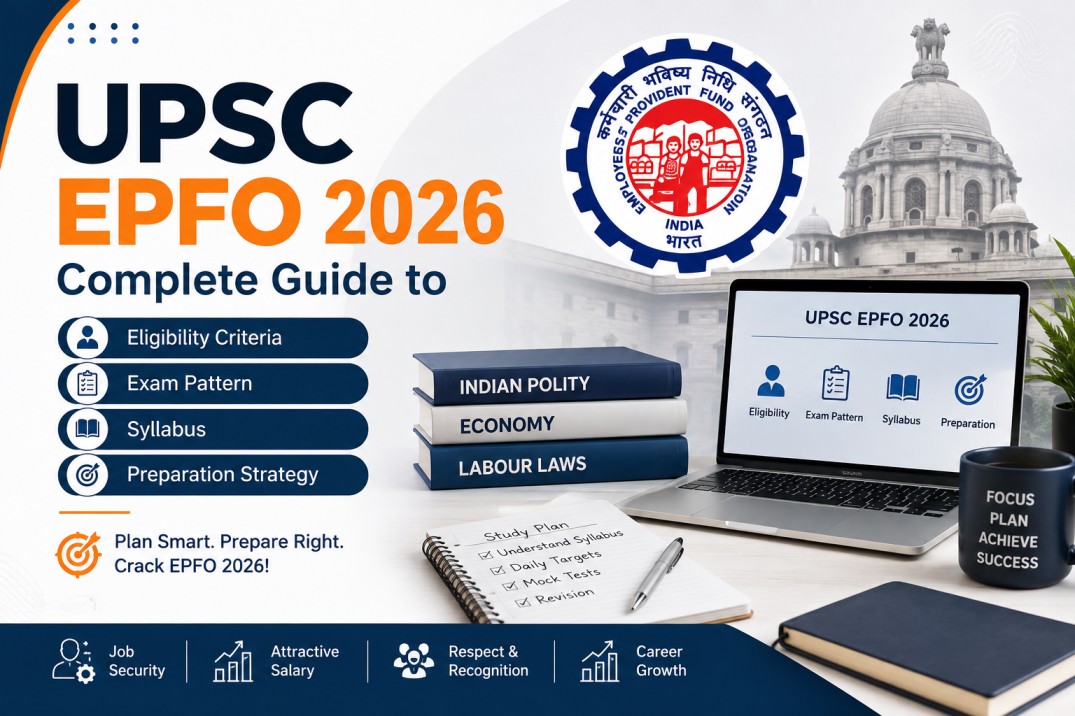
Government jobs continue to attract lakhs of aspirants across India. Among the popular opportunities, the Employees’ Provident Fund Organisation (EPFO) recruitment conducted through the Union Public Service Commission (UPSC) is an important career option for graduates who want to work in the field of social security and labour administration.
The UPSC EPFO 2026 examination is expected to attract candidates looking for a stable and respected government career. However, candidates should always check the official UPSC website for the latest notification because eligibility conditions, vacancies, dates, and examination details can change.
This guide explains the expected eligibility requirements, exam pattern, syllabus, preparation approach, and important tips in simple language.
The UPSC EPFO recruitment is conducted for posts in the Employees’ Provident Fund Organisation. EPFO works under the Ministry of Labour and Employment, Government of India, and plays an important role in managing social security schemes for employees.
The recruitment process may include positions such as Enforcement Officer/Accounts Officer (EO/AO) and other posts depending on the official recruitment notification.
For UPSC EPFO 2026, candidates should not rely only on information available on coaching websites or social media. The official UPSC notification will provide the final details about posts, vacancies, eligibility, examination dates, syllabus, and selection procedure.
As of August 2026, UPSC’s official examination notification page does not list a current EPFO 2026 examination notification. Therefore, aspirants should wait for the official announcement before treating any expected date or vacancy figure as confirmed.
Before starting preparation, candidates should understand the basic eligibility requirements. The final conditions will depend on the official notification.
For EPFO recruitment, candidates generally need a recognised university degree for graduate-level posts such as Enforcement Officer/Accounts Officer.
Candidates should make sure that their degree meets the requirements mentioned in the official notification.
If you are in the final year of graduation, carefully check the notification before applying because the rules regarding qualification completion can vary.
The maximum age limit depends on the post and the recruitment notification. There may also be age relaxations for eligible categories according to Government of India rules.
Candidates should check the official notification for:
Do not assume that the age limit from an earlier recruitment cycle will remain unchanged.
Candidates must satisfy the nationality requirements specified by UPSC and the Government of India for the particular post.
The official notification should always be treated as the final source for eligibility requirements.
Understanding the examination pattern helps candidates plan their studies effectively.
The recruitment test for EPFO posts has traditionally been objective in nature, with questions covering areas such as general awareness, English, reasoning, quantitative aptitude, labour and social security-related topics, and other subjects mentioned in the recruitment notification.
However, candidates should check the official notification for the exact UPSC EPFO 2026 examination scheme.
Depending on the final syllabus, candidates should prepare areas such as:
The exact subjects, marks, duration, and negative-marking rules should be confirmed from the official notification.
The syllabus is one of the most important parts of preparation. Instead of studying everything available online, candidates should create their preparation plan around the official syllabus.
Read about important national and international developments. Give special attention to topics related to:
Daily current affairs revision can help you build confidence in this section.
Focus on the Constitution of India and important political institutions.
Important areas include:
This is an important area for EPFO aspirants because the job is closely connected with labour administration and social security.
Candidates should understand basic concepts related to:
Do not simply memorise laws. Try to understand their purpose and practical application.
English preparation should focus on understanding and correct usage.
Important topics can include:
Regular reading can naturally improve vocabulary and comprehension skills.
Candidates should practise basic mathematical and logical concepts regularly.
Important topics may include:
Regular practice is more useful than studying these topics only once.
A good preparation plan should be practical and consistent. You do not need to study for extremely long hours every day. Instead, focus on quality study time.
Start by reading the official syllabus carefully. Divide the subjects into strong, average, and weak areas.
This will help you understand where you need more practice.
Make a weekly plan instead of creating an unrealistic daily schedule.
For example, you can divide your preparation into:
Adjust the timetable according to your available time.
Current affairs should not be left for the last few weeks.
Read reliable news sources and make short notes. Focus on important government schemes, economic developments, labour-related updates, social security developments, and major national events.
Previous year questions help you understand the difficulty level and question style.
After completing a topic, solve relevant questions. Analyse your mistakes instead of simply checking your score.
Mock tests can improve both accuracy and speed.
Start with topic-wise tests and gradually move to full-length tests. After every test, identify:
This analysis can make your preparation more effective.
Many candidates work hard but do not get the expected result because their preparation lacks direction.
Avoid these common mistakes:
Jumping between different subjects can waste valuable time. Follow a clear study schedule.
Reading a topic once is not enough. Revise important information regularly.
Current affairs are important, but candidates should also build a strong foundation in static subjects.
Some students wait until the last month before attempting mock tests. Start earlier so you have enough time to improve your speed and accuracy.
Collecting many study materials can create confusion. Choose limited, reliable resources and revise them properly.
Time management is especially important for working professionals and college students preparing alongside their regular responsibilities.
Set small daily targets. For example, instead of deciding to “finish the entire polity syllabus,” set a target such as completing one specific topic and solving 30 questions.
Use weekends for longer revision sessions and mock tests.
Keep one notebook for important facts, formulas, difficult concepts, and mistakes. Revise this notebook regularly.
A balanced approach can make preparation easier. Start with the basics, gradually increase question practice, and use mock tests to measure progress.
Follow these simple steps:
Remember that consistency matters more than studying for long hours occasionally.
Revision helps you retain information for a longer period. This is particularly useful for subjects containing facts, concepts, laws, schemes, and current affairs.
Follow a simple revision cycle:
This approach can help improve both memory and confidence.
Preparing for a competitive government examination requires patience, discipline, and the right direction. The UPSC EPFO 2026 examination can be a valuable opportunity for candidates who want to build a career in government service and social security administration.
Do not depend on rumours about vacancies, exam dates, or eligibility. Always verify important information through official UPSC sources before making application or preparation decisions. UPSC regularly publishes examination notifications, calendars, recruitment information, admit cards, results, and other updates through its official website.
For aspirants who want structured guidance, regular practice, and focused preparation, VyasaIAS can help you build a more organised approach to competitive examination preparation.
A focused UPSC EPFO preparation strategy can help you study the right subjects, practise effectively, manage your time, and track your progress. Start with the basics, follow a realistic timetable, revise regularly, and keep improving through practice tests.
Most importantly, stay consistent. Success in a competitive examination is not achieved in one day. Small and regular efforts can take you closer to your goal.




