Physical Address
304 North Cardinal St.
Dorchester Center, MA 02124
Physical Address
304 North Cardinal St.
Dorchester Center, MA 02124

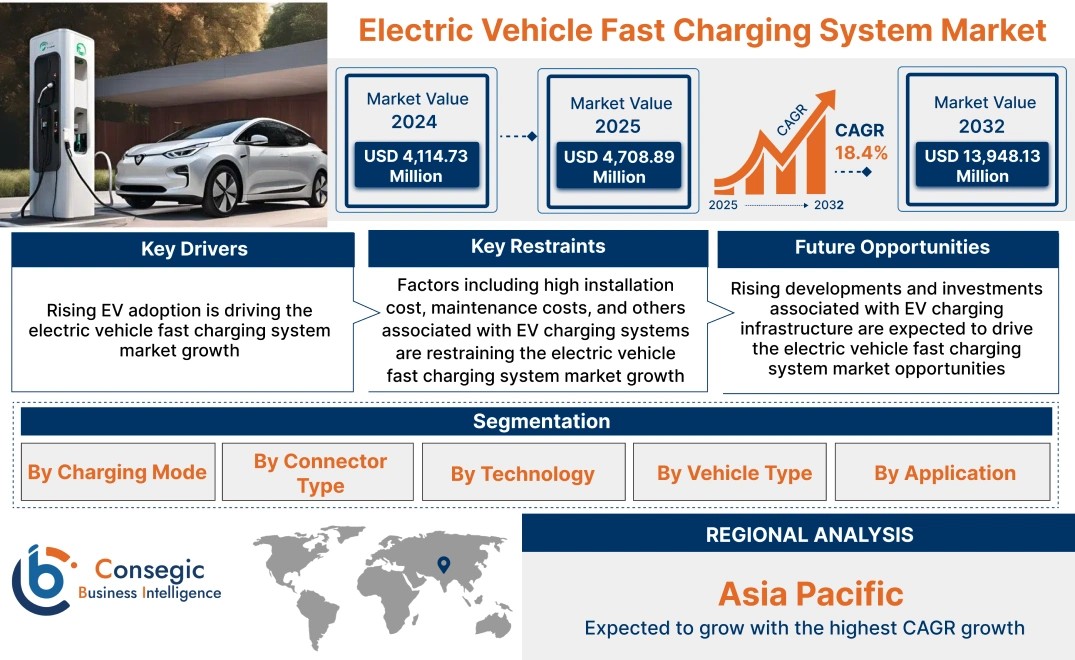
The rapid adoption of electric vehicles (EVs) is increasing the need for charging infrastructure that can deliver more energy in less time. Fast charging systems are becoming particularly important for highway travel, commercial fleets, urban charging hubs, workplaces, and locations where drivers cannot rely on overnight charging. This is creating strong opportunities across the Electric Vehicle Fast Charging System Market.
In 2025, the global stock of public charging points exceeded 7 million after growing by more than 33% during the year. The average speed of public charging also increased as fast and ultra-fast chargers expanded. At the same time, advances in batteries, power electronics, and higher-voltage architectures are enabling significantly faster charging.
The Electric Vehicle Fast Charging System Market covers charging equipment, power electronics, software, connectivity platforms, charging cables, connectors, and related infrastructure designed to rapidly recharge electric vehicles.
Fast-charging systems are generally used across:
The market serves passenger EVs, commercial vehicles, buses, trucks, fleet operators, charging network providers, and other mobility businesses.
Fast charging is becoming increasingly important because charging availability can influence EV adoption, particularly for drivers without convenient home charging. The IEA reports that fast and ultra-fast public charging deployment accelerated in 2025, while next-generation systems increasingly move beyond 250 kW.
Rising EV adoption is the fundamental driver. Global electric car sales exceeded 20 million units in 2025, with EVs accounting for approximately one in four cars sold worldwide. As the installed EV fleet grows, charging infrastructure must expand accordingly.
Shorter charging times are another major factor. Consumers and fleet operators increasingly prefer charging solutions that minimize vehicle downtime. Higher-voltage battery systems and improved power electronics are supporting this transition.
Government initiatives are also encouraging charging infrastructure development through financial incentives, highway programs, charging targets, and regulatory frameworks.
Commercial fleet electrification creates additional demand. Delivery vehicles, buses, taxis, and logistics fleets often require rapid turnaround, making high-power charging particularly valuable.
Infrastructure development is expanding the market beyond traditional urban charging locations. Highway corridors, transport hubs, retail centers, and fleet depots are becoming important deployment areas.
The market is increasingly shifting toward smart and connected charging. Artificial Intelligence (AI) and Machine Learning (ML) can support demand forecasting, charger utilization analysis, fault detection, and intelligent energy management.
Automation is simplifying charging operations, payment processing, remote monitoring, and system diagnostics. Digital Transformation is also connecting charging infrastructure with mobile applications, navigation platforms, fleet management systems, and energy networks.
Major trends include:
The IEA notes that 1,000-volt EV models emerged in 2025 and that ultra-fast charging developments continued into 2026, including charging technologies designed to deliver very high power.
Power electronics are central to fast charging. Silicon carbide and other advanced semiconductor technologies can support higher efficiency and improved thermal performance, while advanced cooling systems help manage the heat generated during high-power charging.
Battery innovation is equally important. Higher-voltage architectures, improved cell chemistry, and new battery pack designs are allowing vehicles to accept greater charging power. According to the IEA, more than 30 new high-voltage electric car models were released globally in 2025, with the majority introduced by Chinese manufacturers.
Data Analytics can help charging operators understand usage patterns and optimize station performance. Predictive Maintenance can identify equipment problems before they cause prolonged outages.
IoT Integration enables chargers to communicate with vehicles, cloud platforms, energy systems, and operator networks. Smart Manufacturing, Robotics, and Industry 4.0 practices are also improving the production and testing of charging hardware.
North America is supported by EV adoption, highway charging development, fleet electrification, and infrastructure investment. The United States recorded strong growth in fast and ultra-fast charging points in 2025. Investment opportunities include highway charging, commercial fleets, grid-connected systems, and charging network software.
Europe has strong demand for fast charging because of its dense cross-border transportation network and emphasis on alternative-fuel infrastructure. EU regulations are supporting the deployment of high-power charging stations along major transport corridors. Opportunities include ultra-fast highway chargers, smart charging, renewable integration, and fleet infrastructure.
Asia-Pacific represents a major growth center, led particularly by China. China accounted for more than 65% of global public charging points at the end of 2025 and experienced significant growth in fast and ultra-fast chargers. India, Japan, South Korea, and other markets also offer long-term opportunities.
EV adoption and charging infrastructure are expanding from a relatively smaller base. Brazil, Mexico, Chile, and other markets are developing public charging networks. Investment opportunities include urban fast-charging hubs, fleet electrification, and highway corridors.
Growing interest in electric mobility, smart cities, and sustainable transportation is supporting charging infrastructure development. High-income markets can provide opportunities for premium fast-charging networks, while developing markets may focus on scalable and cost-efficient systems.
Investment opportunities are emerging across both charging hardware and digital services. High-growth areas include:
Vehicle-to-grid technology may create another investment avenue. Smart and bidirectional charging can help shift electricity demand and potentially provide grid services.
Sustainability is also influencing infrastructure design. Green Technologies, renewable energy, battery storage, energy-efficient power electronics, and Circular Economy practices can help reduce the environmental impact of charging infrastructure.
Competition is increasingly focused on charging speed, reliability, energy efficiency, software capabilities, interoperability, and total operating cost. Market participants are investing in new charging architectures, partnerships, product launches, network expansion, and research activities.
Strategic collaborations between vehicle manufacturers, charging operators, utilities, technology providers, and energy companies are becoming increasingly relevant. Companies are also developing modular systems that can be upgraded as vehicle charging capabilities improve.
The Electric Vehicle Fast Charging System Market is expected to move toward faster, smarter, and more integrated infrastructure through 2034. Charging systems will increasingly combine high-power electronics, advanced cooling, cloud connectivity, AI-driven energy management, and bidirectional charging.
The IEA projects that more than 10 million public fast and ultra-fast chargers could be deployed globally by 2035 under its Current Policies Scenario, illustrating the scale of infrastructure expansion expected over the coming decade.
Future charging networks are likely to become closely integrated with renewable energy, stationary storage, electricity grids, fleet-management platforms, and connected vehicles. AI, Data Analytics, Automation, and Predictive Maintenance can improve utilization and reliability.
At the same time, grid capacity, installation costs, interoperability, battery temperature, and equipment reliability will remain important challenges. The long-term market opportunity will therefore depend not only on installing more chargers but also on building efficient, reliable, scalable, and intelligent charging ecosystems.
The Electric Vehicle Fast Charging System Market includes hardware, software, power electronics, connectors, charging cables, and digital platforms used to rapidly recharge electric vehicles. These systems are deployed at public charging stations, highways, fleet facilities, commercial locations, and other sites where reducing charging time is important.
Major growth drivers include increasing EV adoption, demand for shorter charging times, government charging infrastructure programs, fleet electrification, highway development, battery improvements, and advances in power electronics. Growing consumer expectations for convenient charging and increasing investment in public charging networks are also supporting market expansion.
Asia-Pacific, particularly China, currently represents the largest public charging infrastructure market. China accounted for more than 65% of global public charging points at the end of 2025. Europe and North America are also important markets, while India and other emerging economies offer significant future growth potential.
Major trends include ultra-fast charging, higher-voltage EV architectures, megawatt-scale systems, AI-enabled energy management, smart charging, cloud connectivity, vehicle-to-grid technology, and renewable-powered charging. Advanced power electronics and battery technologies are also helping increase charging speeds while improving system efficiency.
Opportunities are expected in ultra-fast highway charging, commercial fleet infrastructure, megawatt charging, smart charging software, energy storage, renewable-powered stations, and vehicle-to-grid systems. Charging operators and technology providers can also benefit from expanding EV fleets and the growing integration of charging networks with digital energy-management platforms.
About Us
At Consegic Business Intelligence Pvt. Ltd., we empower organizations with actionable market intelligence, strategic insights, and data-driven research solutions that support informed business decision-making. Our comprehensive market research reports provide in-depth analysis of industry trends, competitive landscapes, emerging opportunities, and future growth prospects across diverse sectors.
Contact Us
Consegic Business Intelligence Pvt. Ltd.
Website: www.consegicbusinessintelligence.com
Email: sales@consegicbusinessintelligence.com
Phone: +1-833-313-3130