Physical Address
304 North Cardinal St.
Dorchester Center, MA 02124
Physical Address
304 North Cardinal St.
Dorchester Center, MA 02124

The Electric Car Rental Market is gaining momentum as electric vehicles (EVs) move from a niche transportation option toward mainstream mobility. Rising EV availability, expanding charging networks, environmental awareness, and changing travel preferences are encouraging rental companies to add battery-electric vehicles to their fleets. In 2025, global electric car sales exceeded 20 million, representing about one-quarter of new car sales, creating a larger vehicle base for rental and shared-mobility applications.
Rental services also provide consumers with an opportunity to experience EV technology without purchasing a vehicle. This makes electric rentals relevant for tourists, business travelers, urban residents, corporate fleets, and customers considering future EV ownership.
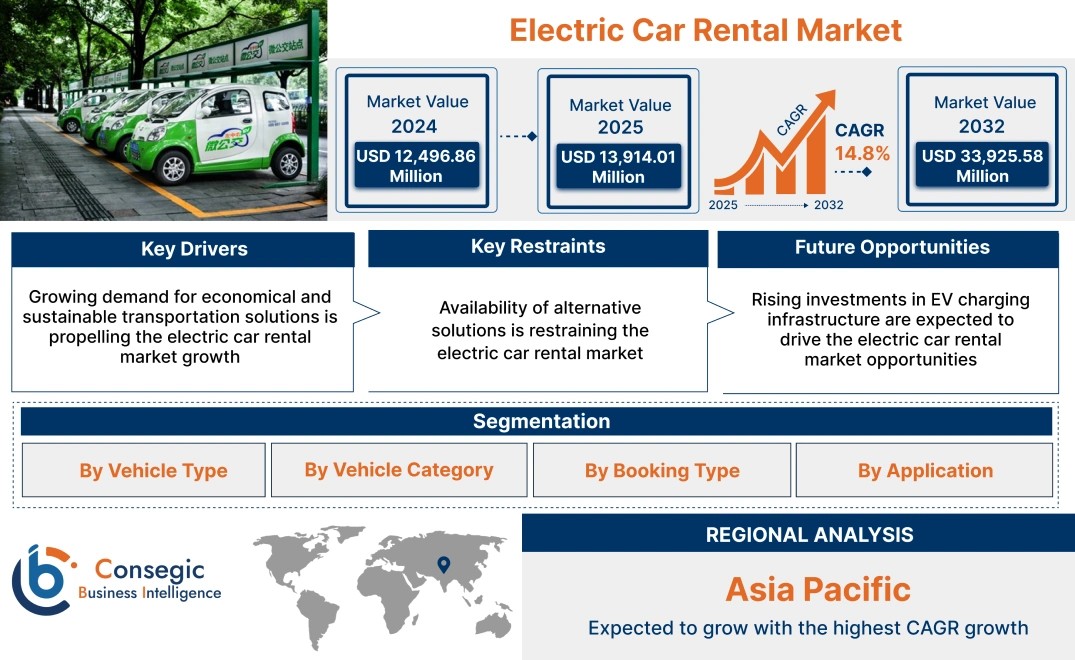
Electric Car Rental Market size is estimated to reach over USD 33,925.58 Million by 2032 from a value of USD 12,496.86 Million in 2024 and is projected to grow by USD 13,914.01 Million in 2025, growing at a CAGR of 14.8% from 2025 to 2032.
The market includes rental services offering battery electric vehicles through traditional car-rental companies, mobility platforms, airport rental operations, corporate mobility programs, and peer-to-peer vehicle-sharing services.
Key applications include:
The growth outlook is closely connected to EV adoption and charging infrastructure. The International Energy Agency expects global EV deployment to continue increasing significantly through 2035, although growth rates will vary according to policies, charging availability, vehicle prices, and regional market conditions.
Several factors are supporting the expansion of the Electric Car Rental Market.
Growing EV adoption: More electric models are becoming available across vehicle categories. The IEA estimates that nearly 1,000 electric car models were available globally in 2025, representing around 40% of all available car models.
Lower operating considerations: EVs generally have fewer moving powertrain components than conventional vehicles. Rental operators can evaluate potential maintenance and operating-cost advantages as fleet utilization increases.
Consumer trial experience: Renting an EV allows customers to understand charging, driving range, regenerative braking, and digital vehicle features before committing to ownership.
Charging infrastructure: Public and high-speed charging expansion remains fundamental. Convenient charging at airports, hotels, highways, shopping centers, and rental depots can make EV rentals more practical.
Energy and fuel-price volatility: Changes in conventional fuel prices can influence rental preferences. In the United States, EV rental bookings increased during a period of higher gasoline prices in 2026, highlighting how short-term mobility demand can respond to operating-cost pressures.
The market is increasingly influenced by Artificial Intelligence (AI), Machine Learning (ML), automation, and digital transformation.
AI-based demand forecasting can help rental operators predict which locations will require additional EVs. Machine Learning can analyze booking behavior, seasonal travel patterns, charging requirements, and vehicle utilization.
Other important trends include:
Sustainability is also becoming more important. Rental operators can incorporate renewable electricity, energy-efficient facilities, battery lifecycle management, and Circular Economy practices into fleet operations.
Technology is changing how electric rental fleets are purchased, managed, maintained, and deployed.
Cloud Technologies allow rental companies to centralize reservation, fleet, charging, and customer information. IoT Integration enables connected vehicles and charging equipment to transmit operational data.
Predictive Maintenance can identify potential battery, charging, tire, or electronic-system issues before they become major problems. Automation can also improve vehicle allocation, charging coordination, cleaning schedules, and fleet availability.
At the manufacturing level, Advanced Materials, lightweight components, improved battery systems, and more efficient electric drivetrains can influence the range and operating characteristics of rental vehicles.
Smart Manufacturing and Industry 4.0 technologies further support the production of connected EVs and charging equipment. Robotics and automated inspection can improve manufacturing consistency while data analytics can support product development.
North America: The region benefits from established rental networks, strong tourism activity, and expanding EV availability. The United States is particularly important for airport and leisure rentals. However, charging coverage, vehicle utilization, and fleet economics remain important considerations.
Europe: Europe has strong potential due to EV adoption, environmental regulations, tourism, and established cross-border mobility. Countries with dense charging infrastructure can provide favorable conditions for electric rental fleets.
Asia-Pacific: China represents a major EV market, while India, Southeast Asia, South Korea, Japan, and other economies are expanding electric mobility. Growing tourism, urbanization, and EV manufacturing capabilities create opportunities for rental businesses.
Latin America: EV rental adoption is developing from a smaller base. Tourism centers and major cities can provide early opportunities, particularly where charging infrastructure and EV availability are improving.
Middle East & Africa: Adoption varies significantly between countries. Tourism hubs, premium mobility services, and sustainability-focused urban developments offer opportunities, while charging availability and electricity infrastructure can constrain expansion.
Investment potential exists across both vehicle fleets and supporting infrastructure. High-growth opportunities may include:
Emerging markets could become particularly important as EV prices decline and more affordable models enter international markets.
Competition is shifting beyond simply adding electric vehicles to rental fleets. Companies are increasingly focusing on digital booking, fleet optimization, charging partnerships, customer education, and integrated mobility services.
Partnerships between rental operators, automakers, charging providers, airports, hotels, and technology companies can improve the customer experience. Product launches, fleet expansions, software investments, acquisitions, and charging-network agreements are likely to remain important competitive strategies.
The Electric Car Rental Market is expected to evolve alongside the broader electrification of transportation. By 2034, rental companies are likely to operate more diverse electric fleets, including compact cars, SUVs, premium vehicles, and potentially newer electric commercial models.
Future technologies may include AI-powered fleet allocation, automated charging, vehicle-to-grid applications, advanced battery analytics, connected mobility platforms, and more sophisticated customer personalization.
However, growth will not be uniform. Charging availability, electricity costs, battery degradation, resale values, insurance, fleet financing, and consumer familiarity will influence adoption. Markets that combine strong EV demand with reliable charging infrastructure are likely to see faster development.
Overall, the Electric Car Rental Market is moving toward a more connected, data-driven, and sustainability-oriented mobility model. As EV ownership expands and digital rental platforms mature, electric vehicles are positioned to become a more familiar part of short-term transportation and shared mobility through 2034.
The Electric Car Rental Market refers to rental and short-term mobility services that provide battery-electric vehicles to customers. It includes airport rentals, tourism services, corporate mobility, urban rentals, subscriptions, and peer-to-peer platforms. Market development depends on EV availability, charging infrastructure, consumer demand, operating economics, and government policies.
Major growth factors include rising EV adoption, expanding charging infrastructure, environmental awareness, increasing electric vehicle availability, digital rental platforms, and consumer interest in experiencing EVs before purchasing. Higher fuel-price volatility and corporate sustainability objectives can also encourage rental operators and customers to consider electric vehicles.
Market leadership varies by definition and segment, but Asia-Pacific has a major strategic advantage because of China’s large EV market and manufacturing ecosystem. Europe also has strong potential because of EV adoption, tourism, and charging infrastructure, while North America remains important for large-scale rental and airport mobility services.
Important trends include AI-powered fleet management, mobile reservations, connected vehicles, smart charging, predictive maintenance, data analytics, EV subscriptions, corporate mobility, and charging partnerships. Rental companies are also increasingly examining sustainability, renewable energy, battery lifecycle management, and digital transformation to improve fleet efficiency.
Opportunities are expected in airport EV rentals, tourism mobility, corporate fleets, premium EV services, charging infrastructure, subscription models, fleet-management software, and peer-to-peer platforms. AI, IoT, predictive analytics, smart charging, and battery-management technologies could create additional opportunities as electric rental fleets become larger and more connected.
About Us
At Consegic Business Intelligence Pvt. Ltd., we empower organizations with actionable market intelligence, strategic insights, and data-driven research solutions that support informed business decision-making. Our comprehensive market research reports provide in-depth analysis of industry trends, competitive landscapes, emerging opportunities, and future growth prospects across diverse sectors.
Contact Us
Consegic Business Intelligence Pvt. Ltd.
Website: www.consegicbusinessintelligence.com
Email: sales@consegicbusinessintelligence.com
Phone: +1-833-313-3130




