Physical Address
304 North Cardinal St.
Dorchester Center, MA 02124
Physical Address
304 North Cardinal St.
Dorchester Center, MA 02124

The transition toward electric mobility is increasing demand for technologies that make EV charging faster, safer, and more efficient. One of the most important components within an electric vehicle is the on-board charger (OBC), which converts alternating current (AC) from a charging source into direct current (DC) suitable for the vehicle’s battery.
The Electric Vehicle On-Board Charger Market is developing alongside rising electric vehicle adoption, improvements in charging infrastructure, and advances in power electronics. Automakers and component manufacturers are focusing on compact designs, higher power density, improved thermal management, bidirectional charging, and greater energy efficiency. These developments are positioning OBC technology as an important part of the broader EV charging ecosystem.
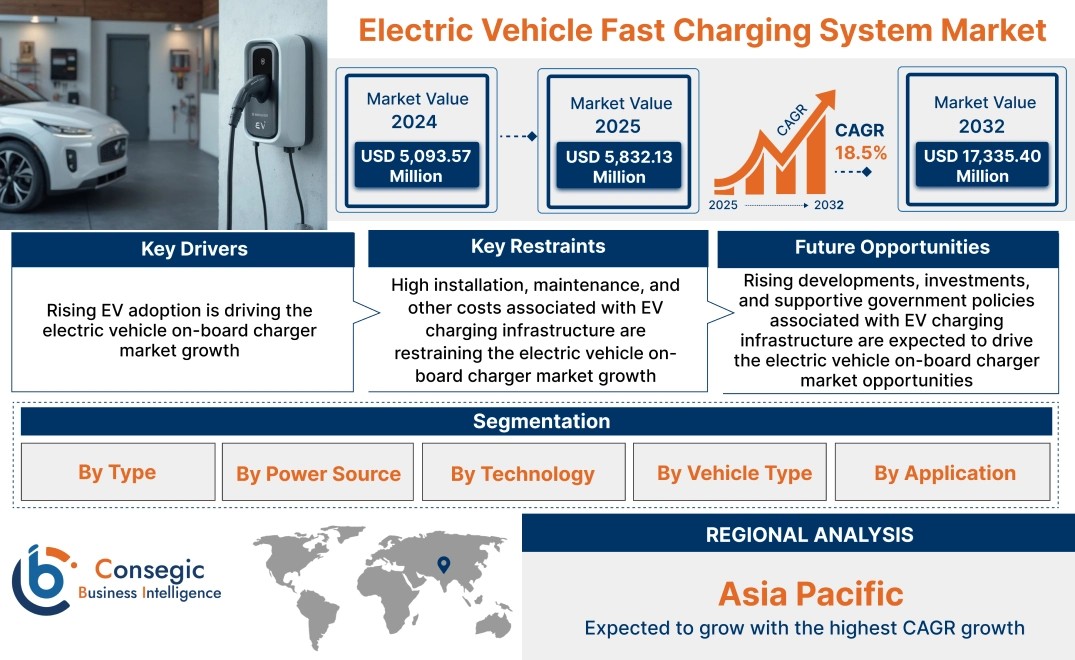
Electric Vehicle On-Board Charger Market size is estimated to reach over USD 17,335.40 Million by 2032 from a value of USD 5,093.57 Million in 2024 and is projected to grow by USD 5,832.13 Million in 2025, growing at a CAGR of 18.5% from 2025 to 2032.
An on-board charger is an electronic power-conversion system installed inside an electric or plug-in hybrid vehicle. It manages AC charging and regulates the electricity supplied to the battery according to the vehicle’s charging requirements.
The market includes OBC systems used across:
The market’s growth is closely connected to EV production, charging standards, battery technology, and consumer expectations for convenient charging. Higher charging power and improved efficiency are becoming increasingly important as EV manufacturers seek to reduce charging times without significantly increasing vehicle weight or system complexity.
Rising EV adoption is the primary demand driver. As more electric and plug-in hybrid vehicles enter global markets, demand for integrated charging electronics increases accordingly.
Charging infrastructure expansion is another important factor. Although DC fast chargers can bypass the vehicle’s OBC for direct battery charging, AC charging remains important for homes, workplaces, parking facilities, and other everyday charging locations.
Advancements in power electronics are improving OBC performance. Silicon carbide (SiC) and gallium nitride (GaN) technologies can support higher switching frequencies, efficiency, and power density in suitable applications.
Government initiatives and emissions targets are also supporting electric mobility investment. Incentives for EV manufacturing, charging infrastructure, and low-emission transportation can indirectly create opportunities for OBC suppliers.
The increasing electrification of commercial vehicles and fleets further expands potential demand because fleet operators require reliable and efficient charging systems.
One major trend is the development of high-power, compact OBC systems. Manufacturers are working to increase charging capability while reducing size, weight, and heat generation.
Bidirectional charging is another emerging area. Vehicle-to-Grid (V2G), Vehicle-to-Home (V2H), and Vehicle-to-Load (V2L) technologies allow compatible vehicles to send stored electricity back to buildings, electrical grids, or external equipment.
Artificial Intelligence (AI) and Machine Learning (ML) can also contribute to smarter charging management. Data-driven systems can help optimize charging schedules, identify abnormal operating conditions, and improve battery-related energy management.
Other important trends include:
The technology landscape is evolving through improvements in semiconductors, power modules, thermal systems, control software, and electronic architecture.
Silicon carbide semiconductors are attracting attention because of their ability to support efficient power conversion at high voltages and temperatures. These technologies can contribute to smaller and lighter OBC designs when appropriately engineered.
Advanced thermal management is equally important. As charging power increases, controlling heat becomes essential for maintaining reliability and component life. Manufacturers are therefore investigating improved cooling structures, packaging methods, and thermal interface materials.
Smart Manufacturing is influencing OBC production through automation, robotics, and digital quality-control systems. Industry 4.0 technologies can monitor production parameters and identify deviations during manufacturing.
Cloud Technologies and Data Analytics can support supply-chain monitoring and product lifecycle management. Predictive Maintenance can also help manufacturers monitor production equipment and reduce unexpected downtime.
North America: EV adoption, charging infrastructure investment, and increasing interest in high-voltage vehicle platforms are supporting demand. The region also has a growing ecosystem of automotive technology and semiconductor suppliers.
Europe: Strict emissions regulations and electrification targets continue to influence automotive development. European manufacturers are focusing on efficient charging architectures, high-voltage systems, and integrated vehicle electronics.
Asia-Pacific: Asia-Pacific represents a major production and consumption center for electric vehicles. Expanding EV manufacturing capacity, battery production, charging infrastructure, and electronics supply chains create substantial opportunities for OBC technologies.
Latin America: EV adoption is developing at different rates across countries. Urban electrification, fleet applications, and infrastructure investment can support gradual growth in OBC demand.
Middle East & Africa: EV deployment remains comparatively developing in many markets, but investment in sustainable transportation, premium EVs, public charging infrastructure, and smart-city projects can create long-term opportunities.
Investment potential is emerging across both OBC hardware and related technologies.
Key opportunity areas include:
Emerging markets can also provide opportunities as EV manufacturing and charging infrastructure expand. Suppliers that develop scalable systems compatible with different vehicle platforms may be better positioned to address diverse market requirements.
Sustainability is another investment consideration. More efficient power conversion can reduce energy losses during charging, while recyclable materials and longer component lifecycles can contribute to circular-economy objectives.
Competition in the market is focused on charging efficiency, power density, reliability, thermal performance, system integration, cost, and compatibility with evolving EV architectures.
Companies are investing in research and development to introduce compact OBC platforms, higher-voltage systems, bidirectional charging capabilities, and improved power semiconductor technologies.
Partnerships between automotive manufacturers, semiconductor suppliers, charging companies, and electronics specialists can accelerate product development. Capacity expansions and localized manufacturing may also become important as EV supply chains mature.
Product launches are increasingly centered on modular architectures that can be adapted to different vehicle platforms and charging requirements.
The Electric Vehicle On-Board Charger Market is expected to evolve alongside changes in EV architectures, battery systems, charging infrastructure, and power electronics. Higher charging power, improved efficiency, smaller form factors, and greater system integration are likely to remain central development priorities.
By 2034, bidirectional charging could become more widely integrated into suitable EV platforms, enabling vehicles to participate in energy-management applications. AI-assisted charging optimization and advanced Data Analytics may further improve charging efficiency and battery utilization.
The adoption of advanced semiconductor materials, improved thermal systems, and smart power-management technologies could also enable more compact OBC designs. At the manufacturing level, automation, Industry 4.0, and digital quality systems are likely to improve production efficiency.
Sustainability will remain an important consideration, with manufacturers increasingly evaluating energy efficiency, material selection, recyclability, and lifecycle performance. Overall, continued EV adoption and technological innovation should create long-term opportunities across the OBC ecosystem.
The Electric Vehicle On-Board Charger Market covers charging systems installed inside electric and plug-in hybrid vehicles. An OBC converts AC electricity from compatible charging sources into DC power for the vehicle battery while managing charging voltage, current, safety, and energy flow.
The main drivers include rising EV adoption, expansion of AC charging infrastructure, advancements in power electronics, higher charging-power requirements, government electrification initiatives, and growing demand for efficient vehicle charging. Bidirectional charging and high-voltage EV platforms are also creating new technology opportunities.
Asia-Pacific is a major region because of its large EV manufacturing base, extensive electronics supply chains, expanding battery production, and growing charging infrastructure. Europe and North America also represent important markets due to vehicle electrification policies and investments in advanced automotive technologies.
Key trends include high-power and compact OBC designs, bidirectional charging, Silicon Carbide and Gallium Nitride semiconductors, improved thermal management, smart charging, IoT connectivity, AI-based energy optimization, and integration with higher-voltage EV architectures.
Opportunities are expected in high-power OBCs, bidirectional charging, advanced semiconductors, thermal-management systems, commercial EV applications, smart charging software, and integrated power-conversion platforms. Localized manufacturing and energy-management applications may also create additional opportunities as EV adoption expands.
About Us
At Consegic Business Intelligence Pvt. Ltd., we empower organizations with actionable market intelligence, strategic insights, and data-driven research solutions that support informed business decision-making. Our comprehensive market research reports provide in-depth analysis of industry trends, competitive landscapes, emerging opportunities, and future growth prospects across diverse sectors.
Contact Us
Consegic Business Intelligence Pvt. Ltd.
Website: www.consegicbusinessintelligence.com
Email: sales@consegicbusinessintelligence.com
Phone: +1-833-313-3130




