Physical Address
304 North Cardinal St.
Dorchester Center, MA 02124
Physical Address
304 North Cardinal St.
Dorchester Center, MA 02124

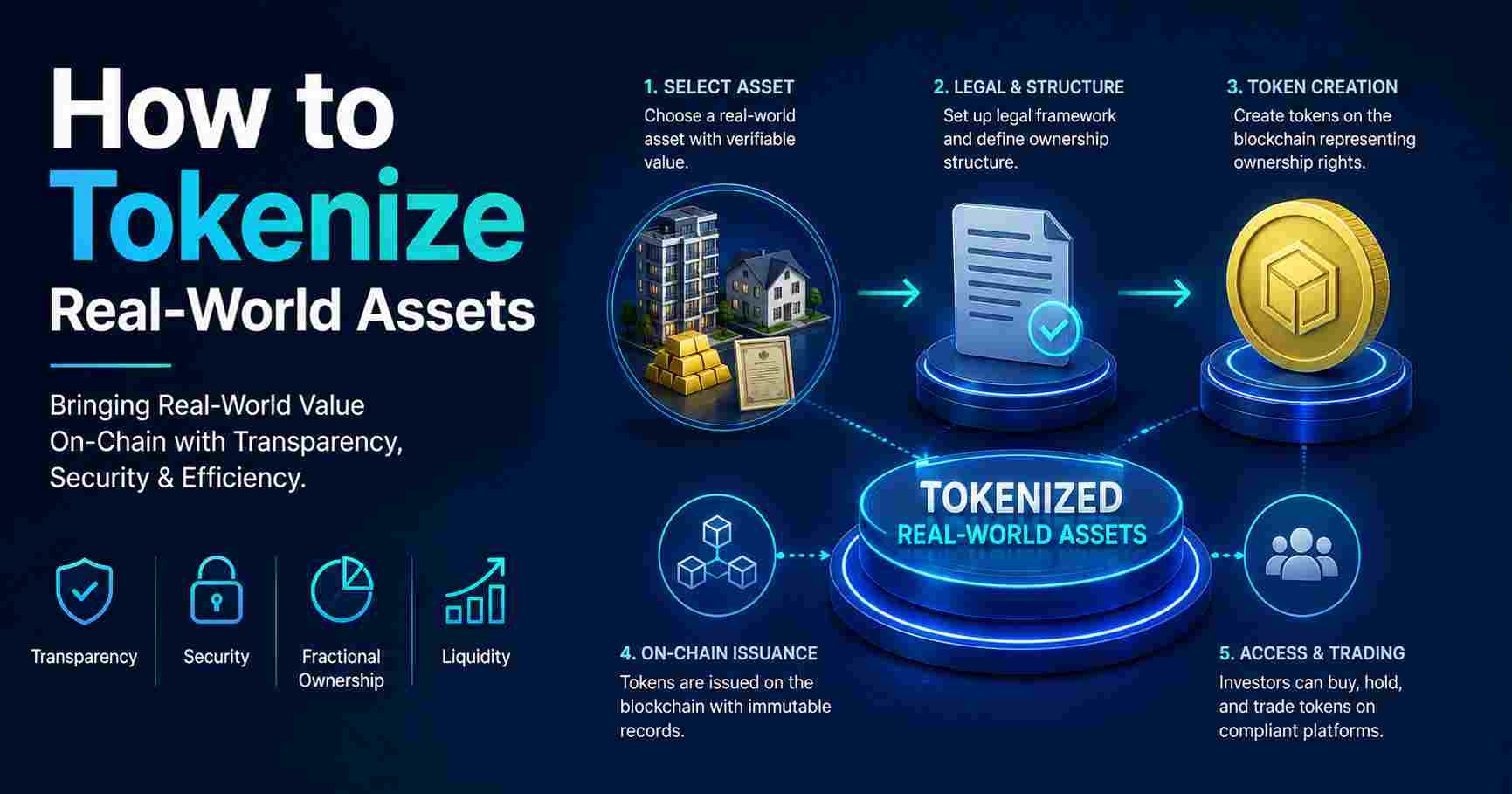
Real-world asset (RWA) tokenization is emerging as one of the most practical applications of blockchain technology. Instead of representing value only through traditional paperwork, databases, or financial intermediaries, tokenization creates digital tokens that represent ownership rights or claims linked to physical or financial assets. These assets can include real estate, precious metals, private credit, bonds, artwork, commodities, infrastructure, and other forms of traditionally illiquid value.
The concept is gaining attention because blockchain can combine asset records with programmable rules governing how those assets are transferred. The Bank for International Settlements (BIS) describes tokenization as recording claims on real or financial assets on a programmable platform, potentially integrating asset transfer, settlement, and related processes more efficiently.
However, tokenization is not simply a matter of creating a blockchain token. The real challenge is establishing a legally enforceable connection between the digital token and the underlying asset. Successful RWA projects therefore require a combination of legal structuring, asset verification, blockchain infrastructure, smart contracts, compliance, custody, and an appropriate marketplace.
RWA tokenization is the process of converting ownership rights, economic interests, or claims associated with a real-world asset into blockchain-based digital tokens. Depending on the structure, one token might represent a fractional ownership interest in a property, a claim on a debt instrument, a quantity of gold, or another legally defined economic right.
For example, consider a commercial property valued at $10 million. Instead of requiring one investor to purchase the entire property, a properly structured tokenization model could divide the economic interest into 100,000 digital tokens. Each token could represent a defined fractional interest or claim, subject to the legal structure governing the asset.
This does not mean that blockchain itself changes the property’s legal ownership automatically. The legal entity, trust, special purpose vehicle, custodian, or other structure holding the asset must establish how token ownership corresponds to rights in the underlying asset.
This distinction is important because the blockchain records the digital representation, while legal agreements determine what that representation actually means.
A successful tokenization project generally follows several interconnected stages. The exact process differs according to the asset class and jurisdiction, but the following framework provides a practical foundation.
The first step is determining which asset should be tokenized and whether tokenization makes economic and legal sense.
Real estate is a common candidate because properties can be expensive and relatively illiquid. Other potential assets include government or corporate bonds, private credit, commodities, artwork, carbon credits, infrastructure projects, and investment funds.
The asset should be evaluated for ownership status, valuation, income potential, liquidity, existing liabilities, documentation, and transfer restrictions. Independent valuation and due diligence are particularly important because tokenization does not eliminate the risks associated with the underlying asset.
This is arguably the most important stage of RWA tokenization.
A project must determine what the token represents and how investors obtain enforceable rights. Depending on the jurisdiction and asset, a special purpose vehicle (SPV), trust, fund, company, or other legal entity may hold the underlying asset.
The project must also address securities laws, investor eligibility, KYC and AML requirements, taxation, custody, transfer restrictions, reporting obligations, and redemption procedures.
BIS research emphasizes that tokenization introduces legal, governance, economic, and technical challenges that cannot be solved through technology alone.
Before tokens are issued, the underlying asset needs to be independently verified.
For a property, this can involve title verification, property valuation, ownership records, inspection, insurance, debt checks, and financial analysis. For commodities, verification may involve quantity, quality, storage, and custody records.
This stage creates confidence that the digital representation is backed by a real and identifiable asset. Without reliable verification, tokenization can simply create digital claims without sufficient assurance regarding the underlying value.
The next step is deciding how the asset will be divided and what rights each token provides.
Token design may define:
For example, a tokenized rental property could distribute a proportion of rental income to eligible token holders. A tokenized bond could represent entitlement to principal and interest according to defined terms.
The objective is to make the token’s economic and legal characteristics clear rather than creating a token merely for speculative trading.
Smart contracts provide the programmable infrastructure behind the tokenization platform. They can control token issuance, transfers, investor permissions, distributions, compliance rules, and other predefined actions.
The BIS has highlighted programmability as one of tokenization’s important advantages because rules governing transactions can be integrated with the asset itself. This can support automated processes and potentially reduce reconciliation and settlement friction.
Because smart contracts can control valuable assets and investor rights, security testing and independent auditing are essential before deployment.
An RWA platform must continuously connect blockchain records with information about the underlying asset.
This may involve custodians, property managers, valuation providers, auditors, financial institutions, or blockchain oracles. For example, a token representing a rental property may require off-chain information about rental income, expenses, property valuation, and ownership.
This creates an important technical consideration: blockchain may make token transactions transparent, but it cannot independently verify whether an off-chain property, commodity, or financial claim actually exists. Reliable data providers and governance mechanisms therefore remain essential.
Once the legal, technical, and asset infrastructure is ready, tokens can be issued through a compliant platform.
The platform may include investor onboarding, KYC verification, wallet management, token purchases, portfolio dashboards, reporting, distributions, secondary transfers, and redemption functionality.
The distribution model should reflect the applicable regulations. Not every token can or should be freely traded by anyone. Some tokenized assets may need permissioned transfers or restrictions based on investor location and eligibility.
The strongest argument for tokenization is not simply that assets become “digital.” Its value comes from reducing friction and creating new ways to structure ownership and transactions.
Tokenization can divide large assets into smaller investment units. This can lower the capital requirement for participating in certain opportunities, although actual accessibility depends on regulation and the project’s legal structure.
Real estate demonstrates this particularly well. A property worth millions of dollars can potentially be divided into smaller interests, allowing investors to gain exposure without purchasing an entire property.
Blockchain-based records can provide a shared and auditable history of token transactions. When combined with appropriate disclosures and off-chain verification, this can improve visibility into ownership and transaction activity.
However, transparency should not be confused with automatic truth. Blockchain records are transparent, but the quality of the information entering the system still depends on trusted data sources.
Traditional asset transactions can involve multiple intermediaries, reconciliations, paperwork, and settlement processes. Programmable tokenized systems can automate parts of these workflows.
BIS research identifies faster and potentially cheaper transactions, atomic settlement, and programmable financial arrangements among the potential advantages of tokenization.
Tokenization can create digital markets for assets that have historically been difficult to trade. However, creating tokens does not automatically create liquidity. There must be buyers, sellers, suitable market infrastructure, regulatory permission, and mechanisms for valuation and settlement.
Recent BIS research on tokenized real estate found that trading activity can respond to liquidity shocks, while also noting that liquidity benefits can depend on platform features such as buyback mechanisms and therefore involve additional risks.
Real estate remains one of the most visible use cases. Investors can potentially obtain fractional exposure to residential, commercial, hospitality, or industrial properties, while property owners can explore alternative capital-raising structures.
Financial assets are another important category. Bonds, private credit, investment funds, and other securities can be represented on programmable platforms, potentially simplifying issuance, settlement, reporting, and transfer processes.
Commodities such as gold and other physical resources can also be tokenized when custody and verification systems provide reliable evidence that the tokens correspond to specific underlying assets.
Tokenization is additionally being explored for infrastructure, art, collectibles, carbon-related assets, and trade finance. The broader idea is to identify markets where traditional processes create significant costs, fragmentation, or liquidity constraints and determine whether programmable digital infrastructure can meaningfully improve them.
Despite its potential, RWA tokenization is not a shortcut around traditional finance.
Regulatory uncertainty remains one of the biggest challenges. The legal classification of tokens can vary depending on the asset, jurisdiction, rights attached to the token, and method of distribution.
There are also technology risks. Smart contract vulnerabilities, private-key loss, oracle failures, cybersecurity incidents, interoperability problems, and operational mistakes can affect tokenized assets.
Another major challenge is the liquidity gap between the token and its underlying asset. A token may trade continuously while the underlying real estate or private credit instrument cannot be sold quickly. The Financial Stability Board has specifically highlighted liquidity and maturity mismatches, operational vulnerabilities, leverage, valuation risks, and interconnectedness as areas that deserve attention as tokenization scales.
Consequently, businesses should approach tokenization as a financial infrastructure project rather than simply a blockchain development project.
The long-term opportunity for tokenization lies in combining digital ownership records, programmable transactions, compliant financial infrastructure, and real-world assets into a connected ecosystem.
The BIS has argued that tokenization could eventually integrate asset records, transaction rules, and settlement into programmable financial infrastructure. The most successful projects are therefore likely to be those that solve genuine market problems rather than simply putting existing assets on-chain.
For businesses considering an RWA initiative, the priority should be identifying a clear economic purpose, establishing enforceable ownership rights, choosing an appropriate blockchain architecture, designing compliant token economics, and creating reliable mechanisms for custody, valuation, reporting, and secondary transfers.
RWA tokenization has the potential to make traditionally illiquid assets more accessible, programmable, transparent, and efficient, but its success depends on much more than blockchain technology. Legal compliance, asset verification, smart contract security, investor protection, custody, and liquidity must work together to create a trustworthy ecosystem. As tokenization continues to develop, businesses that combine strong financial structures with secure blockchain infrastructure will be better positioned to benefit from this emerging market. Blockchain App Factory provides best services for businesses looking to develop secure and scalable RWA tokenization platforms, with solutions designed around token creation, smart contracts, blockchain integration, and broader tokenization requirements.
RWA tokenization is the process of representing ownership rights or claims associated with real-world assets as digital tokens on a blockchain or programmable platform.
Real estate, bonds, private credit, commodities, artwork, investment funds, infrastructure, and other assets with clearly defined ownership or economic rights can potentially be tokenized.
Not necessarily. The token’s legal rights depend on the project’s legal structure, agreements, and applicable regulations.
Businesses may use RWA tokenization services to structure, develop, and deploy blockchain-based systems for issuing, managing, transferring, and tracking tokenized assets.
An RWA tokenization solution is a technology and infrastructure system that can support asset token creation, smart contracts, compliance workflows, investor management, transactions, and asset-related data management.