Physical Address
304 North Cardinal St.
Dorchester Center, MA 02124
Physical Address
304 North Cardinal St.
Dorchester Center, MA 02124

The Dual Fuel Engine Market is gaining importance as industries look for powertrain technologies that can combine operational reliability with greater fuel flexibility and lower emissions. A dual fuel engine can operate using two different fuels, commonly a gaseous fuel such as natural gas together with diesel or another liquid fuel. This flexibility allows operators to use alternative fuels while retaining a liquid-fuel backup when gas availability or operating conditions change.
The technology is particularly relevant to marine transportation, power generation, heavy-duty equipment, oil and gas operations, and industrial applications. Interest is increasing as industries respond to fuel-cost volatility, emissions regulations, energy-security concerns, and the transition toward lower-carbon fuels.
Current development is moving beyond conventional natural-gas and diesel combinations. Engine manufacturers and research organizations are evaluating methane, biomethane, hydrogen, methanol, ammonia, and other alternative fuels alongside advanced combustion and digital control technologies.
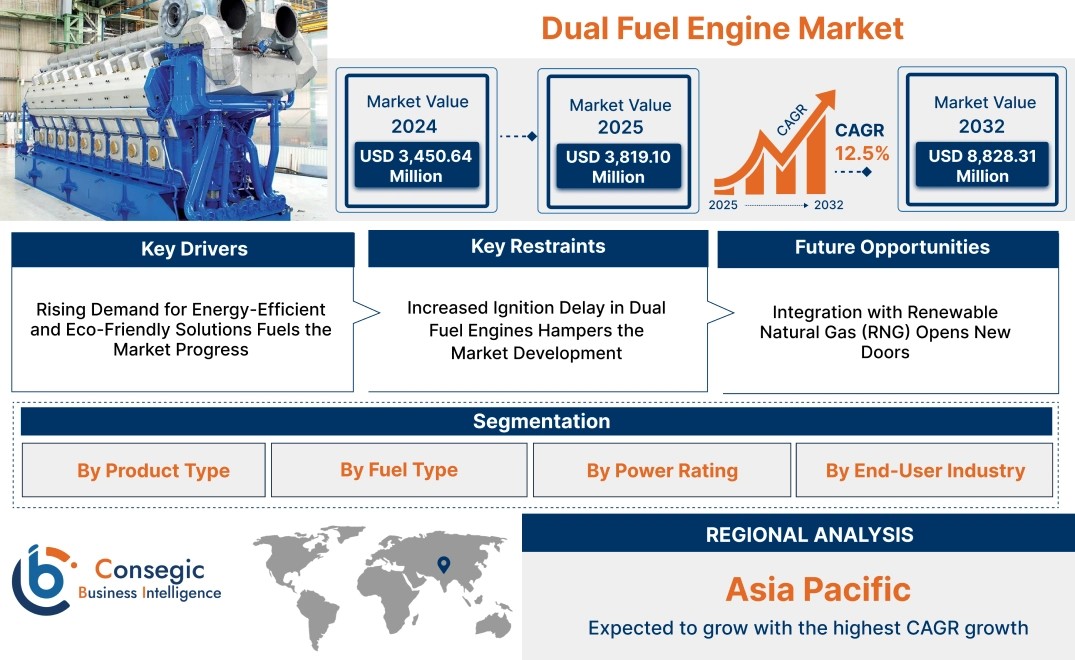
Dual Fuel Engine Market size is estimated to reach over USD 8,828.31 Million by 2032 from a value of USD 3,450.64 Million in 2024 and is projected to grow by USD 3,819.10 Million in 2025, growing at a CAGR of 12.5% from 2025 to 2032.
The Dual Fuel Engine Market includes engines, fuel systems, controls, and related technologies designed to operate with two fuel sources. Depending on the engine architecture, the system can switch between fuels or use both fuels during combustion.
Major applications include:
Marine applications are particularly important because dual-fuel engines can help vessels transition toward lower-carbon fuels while maintaining operational flexibility. The International Maritime Organization’s 2023 greenhouse-gas strategy targets net-zero GHG emissions from international shipping by or around 2050, creating pressure for cleaner propulsion technologies.
Emissions reduction is a major growth driver. Natural-gas-based dual-fuel engines can reduce certain emissions compared with conventional diesel-only operation, although actual environmental performance depends on engine design, fuel quality, operating conditions, and methane emissions.
Fuel flexibility is another important advantage. Operators can use gas when it is economically or operationally attractive and rely on liquid fuel when gas infrastructure is unavailable.
The maritime sector is creating significant demand. According to DNV, more than 1,100 alternative-fuelled vessels were in operation or on order by the beginning of 2025, while LNG remained the dominant alternative fuel by number of vessels.
Power generation also offers opportunities. Gas-based and dual-fuel engines can support distributed generation, microgrids, industrial facilities, and backup power systems.
Government policies, environmental regulations, fuel infrastructure investment, and growing demand for reliable energy are further encouraging the adoption of flexible engine technologies.
The transition toward lower-carbon fuels is reshaping dual-fuel technology. Hydrogen-ready engines are receiving increasing attention because hydrogen can potentially serve as a low-carbon fuel when produced using low-emission energy.
Engine manufacturers are also developing systems capable of using methanol, ammonia, biomethane, and other alternative fuels. These technologies can provide different pathways toward lower greenhouse-gas emissions depending on fuel availability and lifecycle emissions.
Digitalization is another major trend. Artificial Intelligence (AI) and Machine Learning (ML) can analyze engine operating data to optimize combustion, identify abnormal conditions, and improve fuel efficiency.
Automation and IoT integration can connect engines with centralized monitoring platforms. Cloud technologies allow operators to analyze engine performance across multiple assets, while predictive maintenance systems can identify potential component problems before unplanned downtime occurs.
Sustainability is also influencing engine design. Manufacturers are evaluating lower-emission combustion systems, recyclable components, and longer service intervals as part of broader circular economy strategies.
Modern dual-fuel engines rely on sophisticated fuel-injection systems, electronic controls, sensors, turbocharging, exhaust treatment, and combustion-management technologies.
Electronic engine control systems can adjust fuel ratios and combustion parameters according to load, speed, temperature, and fuel availability. Advanced sensors provide real-time information that can help maintain efficient engine operation.
For marine applications, fuel systems are increasingly being designed to accommodate LNG and other alternative fuels. Research and development is also progressing toward hydrogen and ammonia combustion.
Industry 4.0 is influencing engine manufacturing through Smart Manufacturing, automation, robotics, digital twins, and real-time data analytics. These technologies can improve manufacturing precision and quality control.
Advanced materials can help improve durability under high-temperature and high-pressure conditions. Improved coatings and component designs may also extend service life and reduce maintenance requirements.
North America: North America benefits from extensive natural-gas infrastructure, large industrial operations, power-generation demand, and significant oil and gas activity. The region offers opportunities for dual-fuel engines in distributed generation, heavy equipment, marine applications, and backup power.
Europe: Europe is a major center for low-emission marine propulsion and alternative-fuel technology. Strict environmental policies and investments in cleaner fuels are encouraging research into LNG, methanol, hydrogen, and ammonia-compatible engines.
Asia-Pacific: Asia-Pacific represents a major opportunity because of its large maritime industry, manufacturing base, power-generation requirements, and expanding industrial activity. China, Japan, South Korea, India, and Southeast Asian economies are investing in alternative-fuel infrastructure and cleaner propulsion systems.
Latin America: Oil and gas production, maritime activity, distributed power generation, and industrial development can support demand. Natural-gas availability in several markets may create opportunities for dual-fuel applications.
Middle East & Africa: Energy production, marine transportation, industrial facilities, and remote power requirements are important demand areas. Natural-gas resources and investments in alternative fuels could support regional adoption.
Investment opportunities are emerging across engine manufacturing, fuel-injection technology, gas-storage systems, control electronics, alternative-fuel infrastructure, and engine conversion services.
High-growth areas include:
Companies can also explore retrofit solutions that allow existing diesel engines to operate with alternative fuels. Such systems can potentially reduce replacement costs while extending the useful life of industrial equipment.
Competition in the Dual Fuel Engine Market focuses on fuel efficiency, emissions performance, reliability, power density, fuel flexibility, and lifecycle costs.
Engine manufacturers are investing in new combustion architectures, alternative-fuel capabilities, electronic controls, and digital monitoring. Partnerships between engine developers, fuel suppliers, shipbuilders, utilities, and technology providers can accelerate commercialization.
Product launches increasingly focus on engines that can operate with multiple lower-carbon fuels. Research investments are also targeting hydrogen combustion, ammonia, methanol, biomethane, and improved methane-emission control.
Capacity expansions and manufacturing modernization are supporting the production of larger and more technologically advanced engine platforms.
The Dual Fuel Engine Market is expected to evolve as transportation, energy, and industrial sectors pursue greater fuel flexibility and lower emissions. Natural-gas dual-fuel systems are likely to remain important in applications where gas infrastructure is established, while hydrogen, methanol, ammonia, and renewable gases may gradually expand the technology’s fuel portfolio.
Digital technologies will play a growing role. AI-assisted combustion optimization, predictive maintenance, digital twins, cloud-based monitoring, and automated diagnostics can improve engine efficiency and reliability.
The long-term direction will depend heavily on fuel availability, infrastructure development, lifecycle emissions, regulatory requirements, and the economics of alternative fuels. Engines capable of adapting to multiple fuels may offer operators a way to manage this transition more flexibly.
Overall, the Dual Fuel Engine Market has significant potential through 2034 as marine, industrial, power-generation, and heavy-duty applications seek practical pathways toward lower-emission operations while maintaining reliability and fuel flexibility.
The Dual Fuel Engine Market covers engines designed to operate using two different fuels, such as natural gas and diesel. These systems combine fuel flexibility with conventional engine reliability and are used across marine propulsion, power generation, industrial operations, oil and gas, mining, and heavy-duty applications.
Major drivers include emissions-reduction requirements, fuel-price volatility, natural-gas availability, energy-security concerns, marine decarbonization, and demand for flexible power generation. Advances in electronic controls and alternative fuels such as hydrogen, methanol, ammonia, and biomethane are also supporting market development.
Europe and Asia-Pacific are particularly important for marine dual-fuel engine development because of their shipbuilding industries, alternative-fuel investments, and environmental regulations. North America also represents a major market due to its natural-gas infrastructure, industrial base, power-generation requirements, and oil and gas activities.
Key trends include LNG dual-fuel systems, hydrogen-ready engines, methanol and ammonia compatibility, advanced electronic controls, AI-based engine optimization, predictive maintenance, digital twins, IoT monitoring, and lower-emission combustion technologies. Manufacturers are increasingly developing engines designed to accommodate multiple fuel pathways.
Opportunities are expected in hydrogen-ready engines, alternative-fuel marine propulsion, distributed power generation, engine retrofit systems, digital monitoring, fuel-management technologies, and predictive maintenance. Demand may also increase for engines capable of using renewable fuels such as biomethane as industries pursue lower lifecycle emissions.
About Us
At Consegic Business Intelligence Pvt. Ltd., we empower organizations with actionable market intelligence, strategic insights, and data-driven research solutions that support informed business decision-making. Our comprehensive market research reports provide in-depth analysis of industry trends, competitive landscapes, emerging opportunities, and future growth prospects across diverse sectors.
Contact Us
Consegic Business Intelligence Pvt. Ltd.
Website: www.consegicbusinessintelligence.com
Email: sales@consegicbusinessintelligence.com
Phone: +1-833-313-3130