Physical Address
304 North Cardinal St.
Dorchester Center, MA 02124
Physical Address
304 North Cardinal St.
Dorchester Center, MA 02124

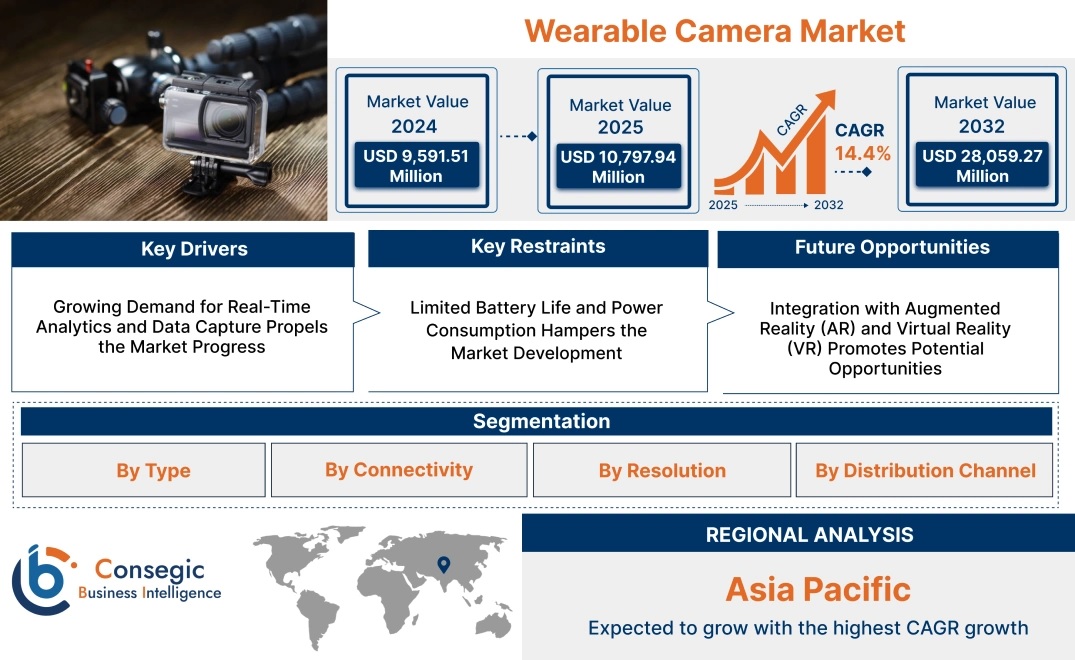
The Wearable Camera Market is evolving as compact imaging devices become increasingly useful across security, sports, healthcare, industrial operations, and consumer applications. Wearable cameras can be attached to the body, head, clothing, equipment, or other accessories to capture hands-free video and audio from the user’s perspective.
The technology has moved beyond action sports and personal recording. Body-worn cameras are increasingly used by law-enforcement agencies for documentation, evidence collection, transparency, and incident review. The U.S. Department of Justice, for example, has established body-worn-camera policies for federal law-enforcement operations.
At the same time, improvements in image stabilization, wireless connectivity, cloud storage, battery technology, Artificial Intelligence (AI), Machine Learning (ML), and real-time analytics are expanding the potential applications of wearable imaging devices.
The Wearable Camera Market includes camera devices designed to be worn or mounted on a person or personal equipment. Major product categories include head-mounted, body-mounted, and ear-mounted or smart-glass-integrated cameras.
Key applications include:
According to Grand View Research, the global wearable camera market was valued at USD 8.0 billion in 2022 and is projected to reach USD 22.8 billion by 2030, representing a 14.4% CAGR from 2023 to 2030.
The market’s development is being supported by demand for hands-free recording, improved connectivity, social-media content creation, public-safety applications, and enterprise documentation.
One of the strongest drivers is the growing demand for hands-free video recording. Wearable cameras allow users to record activities without holding a conventional camera or smartphone.
Sports and adventure activities remain important applications. Skiing, cycling, hiking, motorsports, climbing, and water sports can benefit from lightweight cameras capable of capturing first-person footage.
Security is another major growth area. Body-worn cameras can create audiovisual records of interactions and incidents. The U.S. Department of Justice has highlighted their role in transparency and accountability, while its guidance also emphasizes recording protocols, data storage, access, retention, and release policies.
Industrial applications are also expanding. Workers can use wearable cameras for remote assistance, training, inspections, maintenance documentation, and workplace safety.
The increasing availability of high-speed networks and cloud infrastructure further supports connected wearable camera systems.
Artificial Intelligence and Machine Learning are becoming important technologies for wearable video systems. AI can potentially assist with video classification, object detection, speech transcription, incident identification, and automated content organization.
Digital Transformation is also changing enterprise applications. Instead of simply recording video locally, modern systems can connect cameras to cloud-based platforms for storage, review, collaboration, and evidence management.
IoT Integration can connect wearable cameras with other devices, sensors, access-control systems, location technologies, and enterprise software.
In industrial environments, wearable cameras can support Industry 4.0 initiatives by providing visual information from the workplace. Technicians can share live video with remote specialists, potentially reducing the need for physical travel.
Another trend is the development of smaller and lighter devices. Improvements in sensors, processors, batteries, wireless connectivity, and Advanced Materials are enabling manufacturers to create more comfortable wearable systems.
Sustainability is also gaining attention through longer product lifecycles, energy-efficient components, repairability, and responsible electronics recycling.
Modern wearable cameras increasingly combine high-resolution imaging, digital stabilization, microphones, GPS, wireless connectivity, and cloud integration.
Image stabilization is particularly important for sports and industrial applications where users are moving continuously. Low-light performance and wide-angle imaging can also improve the usability of recorded footage.
Cloud Technologies are becoming increasingly important for enterprise and security deployments. A U.S. Department of Justice privacy assessment, for example, describes a body-worn-camera program using cloud-based evidence storage and management for audio, video, and metadata.
Data Analytics can help organizations organize large volumes of recorded material. AI-powered transcription and search capabilities may further reduce the time required to locate relevant portions of video.
Wearable cameras can also support remote assistance. A worker can stream video to an expert who provides instructions without being physically present.
Automation and Robotics provide another emerging opportunity. Wearable and machine-mounted cameras can supply visual information for automated inspection, safety monitoring, and operational analysis.
North America: North America remains a major market because of strong adoption across security, law enforcement, sports, enterprise, and consumer applications. Grand View Research reported that North America held a 42.7% revenue share in 2022.
Europe: Demand is supported by public safety, industrial digitization, healthcare applications, sports, and workplace documentation. Data protection and privacy requirements remain important considerations for wearable-camera deployments.
Asia-Pacific: The region offers significant growth potential because of expanding consumer electronics markets, rising disposable incomes, manufacturing activity, sports participation, and technology adoption. Grand View Research projected Asia-Pacific to register a 23.9% CAGR during 2023–2030 in its market analysis.
Latin America: Security applications, tourism, adventure sports, industrial operations, and content creation are creating opportunities for wearable imaging technologies.
Middle East & Africa: Security modernization, industrial development, tourism, infrastructure projects, and emergency-response applications could support adoption over the long term.
Investment opportunities are emerging across hardware, software, connectivity, and data-management solutions.
High-potential areas include:
The enterprise segment offers opportunities beyond camera hardware. Software for video storage, search, transcription, security, analytics, and evidence management can become an important part of the broader ecosystem.
Emerging markets also provide opportunities as organizations modernize security infrastructure and industries adopt digital workplace technologies.
Competition in the Wearable Camera Market focuses on image quality, battery life, durability, connectivity, storage, stabilization, device size, software integration, and data security.
Manufacturers are developing smaller cameras with better sensors, improved stabilization, wireless connectivity, and longer operating times.
Product launches increasingly combine cameras with AI capabilities, cloud platforms, mobile applications, GPS, and enterprise-management tools.
Partnerships between camera manufacturers, software providers, law-enforcement technology companies, cloud platforms, and industrial technology firms can accelerate product development.
Research and development is also focused on advanced imaging sensors, AI processing, energy-efficient hardware, ruggedized designs, and privacy-conscious data-management technologies.
The Wearable Camera Market is positioned for continued development as cameras become smaller, smarter, and more connected. Consumer demand for first-person content will remain important, while enterprise applications could provide another major source of long-term growth.
Through 2034, AI-enabled video analysis, real-time connectivity, cloud-based evidence management, and automated transcription are likely to become increasingly important. Machine Learning could improve the ability of systems to organize and analyze large amounts of video data.
Industrial users may increasingly deploy wearable cameras for remote inspections, worker training, predictive maintenance support, and safety documentation. In healthcare, wearable imaging could assist selected documentation and remote-care workflows where appropriate.
However, privacy, cybersecurity, consent, data retention, and responsible AI use will remain critical considerations. Organizations adopting wearable cameras will need clear policies governing when recording occurs, who can access footage, how long information is retained, and how sensitive data is protected. DOJ guidance specifically identifies these policy considerations for body-worn-camera programs.
Overall, the Wearable Camera Market is expected to evolve from a primarily recording-focused industry toward a broader connected imaging ecosystem involving AI, cloud computing, Data Analytics, IoT Integration, automation, and smart technologies.
The Wearable Camera Market covers cameras designed to be worn or attached to a person’s body, head, clothing, equipment, or wearable devices. These cameras provide hands-free video and audio recording for sports, security, healthcare, industrial operations, content creation, emergency response, and other applications.
Key growth factors include demand for hands-free recording, increasing body-worn-camera adoption, sports and adventure activities, enterprise digitization, improvements in camera technology, cloud connectivity, AI-based video analytics, and growing demand for visual documentation across security and industrial environments.
North America was the leading regional market in Grand View Research’s 2022 analysis, accounting for 42.7% of revenue. Strong security adoption, established technology providers, consumer demand, sports participation, and enterprise applications contributed to regional leadership. Asia-Pacific is expected to experience strong growth as technology adoption expands.
Major trends include AI-powered video analytics, cloud connectivity, body-worn security cameras, smart glasses, improved image stabilization, higher-resolution sensors, remote assistance, IoT integration, automated transcription, GPS connectivity, and smaller, lighter camera designs. Enterprise applications are increasingly moving beyond basic recording toward connected video management.
Opportunities are expected in body-worn security systems, industrial cameras, smart glasses, AI video analytics, cloud evidence management, remote assistance, automated inspection, healthcare applications, and sports cameras. Advances in AI, Machine Learning, edge computing, wireless connectivity, and battery technology could further expand wearable-camera applications.
About Us
At Consegic Business Intelligence Pvt. Ltd., we empower organizations with actionable market intelligence, strategic insights, and data-driven research solutions that support informed business decision-making. Our comprehensive market research reports provide in-depth analysis of industry trends, competitive landscapes, emerging opportunities, and future growth prospects across diverse sectors.
Contact Us
Consegic Business Intelligence Pvt. Ltd.
Website: www.consegicbusinessintelligence.com
Email: sales@consegicbusinessintelligence.com
Phone: +1-833-313-3130




