Physical Address
304 North Cardinal St.
Dorchester Center, MA 02124
Physical Address
304 North Cardinal St.
Dorchester Center, MA 02124

The electronics industry is moving toward thinner, lighter, flexible, and more integrated devices. This transition is increasing interest in technologies that can place electronic functions directly onto flexible or unconventional surfaces. The Printed Electronics Market is gaining importance as manufacturers use printing techniques to produce conductive tracks, sensors, displays, antennas, and other electronic components at scale.
Printed electronics combines materials science, electronics engineering, and advanced manufacturing. Conductive inks, semiconducting materials, dielectric materials, and specialized substrates enable electronic circuits to be printed onto surfaces such as plastic films, glass, paper, and textiles. The technology is finding applications across consumer electronics, healthcare, automotive, packaging, energy, and industrial systems.
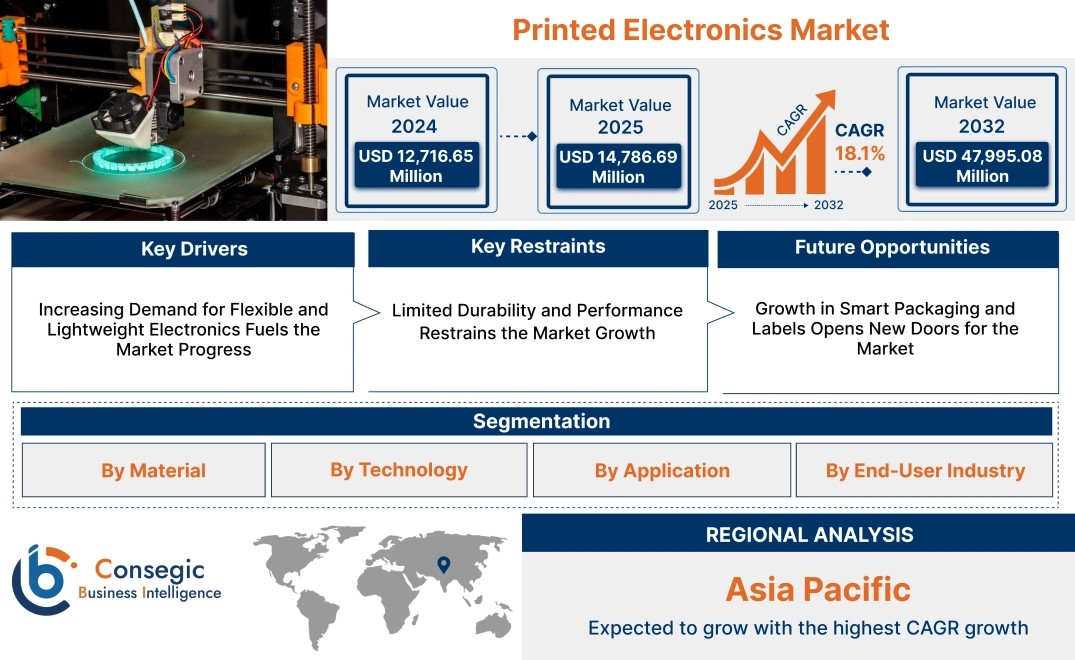
Printed Electronics Market size is estimated to reach over USD 47,995.08 Million by 2032 from a value of USD 12,716.65 Million in 2024 and is projected to grow by USD 14,786.69 Million in 2025, growing at a CAGR of 18.1% from 2025 to 2032.
The Printed Electronics Market includes materials, printing equipment, components, and solutions used to manufacture electronic functions through printing processes.
Major applications include:
Market growth is supported by demand for flexible electronics, miniaturized components, smart packaging, connected products, and cost-efficient manufacturing. The technology also supports high-volume production while reducing the need for conventional rigid circuit structures in selected applications.
Several factors are strengthening demand across the industry.
Growth of flexible electronics: Flexible displays, wearable devices, electronic textiles, and bendable sensors require manufacturing approaches capable of working with flexible substrates.
Expansion of IoT Integration: Connected devices increasingly require low-cost sensors, antennas, identification technologies, and electronic interfaces. Printed electronics can provide these functions across a wide range of products.
Demand for lightweight components: Automotive, aerospace, consumer electronics, and wearable-device manufacturers are seeking lighter electronic structures. Printed circuits and sensors can support this requirement.
Advancements in materials: Conductive inks based on silver, copper, carbon, and other materials are improving performance and expanding application possibilities.
Manufacturing efficiency: Printing techniques can enable additive production and reduce material waste in specific manufacturing processes. This aligns with increasing interest in Sustainability and efficient resource utilization.
The industry is moving toward smarter and more integrated electronic systems. Artificial Intelligence (AI) and Machine Learning (ML) are increasingly relevant to sensor-driven applications, where printed sensors can generate data for real-time analysis.
Digital Transformation is also increasing demand for intelligent labels, connected packaging, flexible human-machine interfaces, and industrial sensing.
Important trends include:
Industry 4.0 is influencing production environments through Automation, Robotics, Data Analytics, and Smart Manufacturing. These technologies can improve process monitoring, quality control, and production consistency.
Technology development is focused on improving conductivity, flexibility, durability, print resolution, scalability, and compatibility with different substrates.
Screen printing, inkjet printing, gravure printing, flexographic printing, and other techniques are being adapted for different applications. Inkjet printing, for example, can support digitally controlled deposition, while high-volume printing methods can be suitable for large-scale production.
Advanced Materials remain central to innovation. Researchers are developing improved conductive inks, nanomaterials, organic semiconductors, dielectric materials, transparent conductors, and functional coatings.
Cloud Technologies and Data Analytics can support manufacturing monitoring and quality management. Predictive Maintenance may also become increasingly relevant as production equipment becomes connected and generates operational data.
Sustainability is another major development area. Manufacturers are exploring recyclable substrates, water-based inks, lower-temperature processing, and material-efficient production methods to support Green Technologies and Circular Economy objectives.
North America benefits from strong investment in advanced electronics, healthcare technology, aerospace, automotive systems, and semiconductor-related innovation. Research institutions and technology companies are developing flexible sensors, wearable electronics, and printed components for specialized applications.
Europe has strong opportunities in automotive electronics, industrial automation, healthcare, smart packaging, and sustainable manufacturing. Environmental priorities are encouraging research into recyclable materials and energy-efficient printed electronic production.
Asia-Pacific represents a major growth region due to its extensive electronics manufacturing ecosystem. China, Japan, South Korea, Taiwan, and other markets are investing in displays, consumer electronics, sensors, automotive systems, and advanced manufacturing technologies.
Demand is developing around smart packaging, identification systems, consumer electronics, and industrial applications. Expanding digital infrastructure and manufacturing capabilities can create opportunities for printed electronic components.
The region presents emerging opportunities in smart infrastructure, healthcare technology, logistics, energy systems, and connected products. Investment in digital transformation and industrial modernization may support future adoption.
Investment opportunities are emerging across materials, manufacturing equipment, components, and specialized applications.
High-potential areas include:
Companies developing scalable manufacturing technologies and high-performance materials may benefit as printed electronics move from specialized applications toward broader commercial deployment.
Competition is centered on material performance, production scalability, printing precision, durability, and cost efficiency. Industry participants are investing in research and development to improve conductive inks, substrates, printing equipment, and electronic integration.
Competitive strategies include partnerships between materials companies and electronics manufacturers, technology licensing, product launches, manufacturing capacity expansions, and research collaborations.
Smart Manufacturing is becoming increasingly important as manufacturers seek automated inspection, process optimization, Robotics integration, and real-time production monitoring.
The Printed Electronics Market is positioned for continued technological development through 2034 as electronics become increasingly flexible, connected, lightweight, and embedded into everyday products.
Future opportunities are expected in smart healthcare, automotive sensing, wearable devices, connected packaging, flexible displays, electronic textiles, and industrial IoT applications. AI and ML can add value by interpreting data generated from distributed printed sensors, while Cloud Technologies can support connected monitoring platforms.
Manufacturing improvements will remain critical. Better printing resolution, faster production, improved material compatibility, and automated quality inspection can help expand commercial applications.
Over the longer term, printed electronics could become an important manufacturing approach for applications where conventional electronics are too rigid, expensive, heavy, or complex. Sustainability, Advanced Materials, Digital Transformation, and Industry 4.0 will continue shaping the industry’s evolution.
The Printed Electronics Market covers technologies, materials, equipment, and electronic components manufactured using printing processes. These technologies can produce conductive tracks, sensors, antennas, displays, and other functions on flexible or conventional substrates. Major applications include wearable devices, smart packaging, automotive systems, healthcare sensors, RFID, and connected products.
Key growth drivers include rising demand for flexible electronics, IoT devices, wearable technology, smart packaging, lightweight components, and connected sensors. Advances in conductive inks, printing technologies, flexible substrates, and automated manufacturing are also improving product performance and expanding the range of commercial applications.
Asia-Pacific is a major region for printed electronics because of its extensive electronics manufacturing ecosystem and strong presence in displays, consumer electronics, automotive components, and advanced manufacturing. North America and Europe also represent important markets due to research activity, healthcare innovation, automotive technology, and investment in sustainable electronics.
Major trends include flexible and stretchable electronics, smart packaging, printed sensors, electronic textiles, wearable healthcare devices, flexible displays, and IoT-connected components. AI, Machine Learning, Advanced Materials, and sustainable conductive inks are also influencing product development and manufacturing strategies.
By 2034, opportunities are expected across flexible sensors, smart packaging, wearable healthcare devices, automotive electronics, electronic textiles, printed energy systems, and connected products. Advances in materials, printing precision, automation, and sustainable manufacturing could help printed electronics enter additional high-volume applications.
About Us
At Consegic Business Intelligence Pvt. Ltd., we empower organizations with actionable market intelligence, strategic insights, and data-driven research solutions that support informed business decision-making. Our comprehensive market research reports provide in-depth analysis of industry trends, competitive landscapes, emerging opportunities, and future growth prospects across diverse sectors.
Contact Us
Consegic Business Intelligence Pvt. Ltd.
Website: www.consegicbusinessintelligence.com
Email: sales@consegicbusinessintelligence.com
Phone: +1-833-313-3130




