Physical Address
304 North Cardinal St.
Dorchester Center, MA 02124
Physical Address
304 North Cardinal St.
Dorchester Center, MA 02124

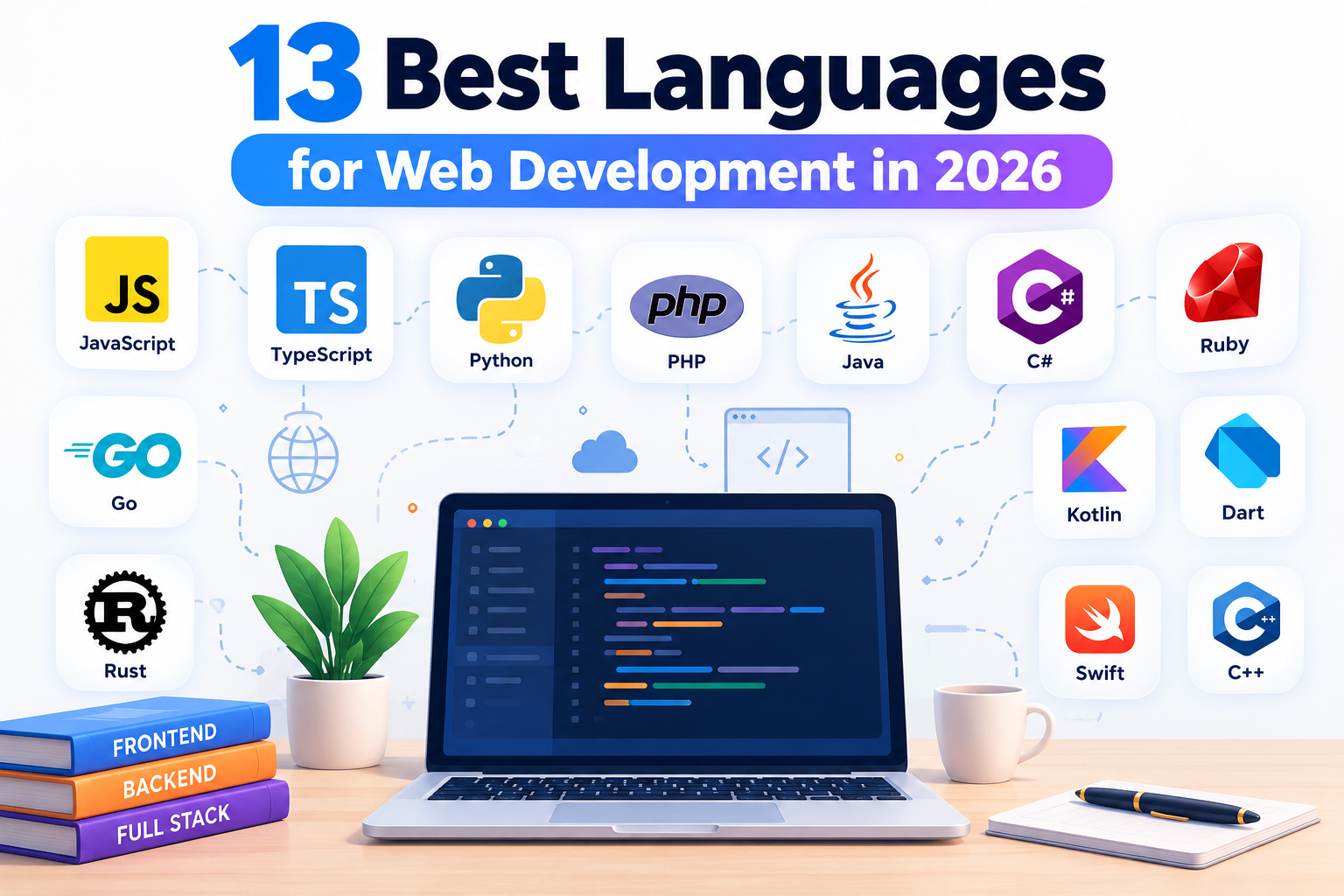
Web development has changed a lot over the years. Today, developers have many programming languages to choose from, and each language has its own strengths.
Some languages are mainly used for frontend development, while others are better suited for backend systems, APIs, enterprise applications, or performance-focused projects.
So, instead of asking which programming language is the best, it is more useful to ask which one is suitable for a particular project.
Here are 13 popular languages worth considering for web development in 2025.
JavaScript remains one of the most widely used languages for web development. It allows developers to create interactive features that run directly in a web browser.
With technologies such as Node.js, JavaScript can also be used for backend development.
Best suited for: Frontend development, backend applications, interactive websites and web apps.
TypeScript builds on JavaScript by adding static typing and other features that can make large projects easier to manage.
It is commonly used in modern web applications where code structure and maintainability are important.
Best suited for: Large frontend applications, backend development and full-stack projects.
Python is popular because its syntax is relatively easy to understand. Frameworks such as Django and Flask allow developers to build websites, APIs and backend applications.
Python can also be useful when a web project involves automation, data processing or machine learning.
Best suited for: Backend development, APIs, automation and data-driven applications.
PHP continues to have an important role in website development. It is widely used in content management systems and server-side applications.
WordPress is one of the biggest examples of a platform built around PHP.
Best suited for: Websites, CMS platforms, WordPress and server-side development.
Java has been used for web and enterprise software development for many years.
Its large ecosystem and strong support for scalable applications make it a common choice for enterprise-level backend systems.
Best suited for: Enterprise applications, backend systems and large-scale platforms.
C# is closely connected with Microsoft’s .NET ecosystem. Developers can use it to create APIs, web applications and enterprise software.
It is particularly useful for organizations already working with Microsoft technologies.
Best suited for: Backend development, APIs and enterprise applications.
Ruby became well known in web development through the Ruby on Rails framework.
Rails focuses on developer productivity and provides many features needed for building web applications.
Best suited for: Rapid web application development and startups.
Go, also known as Golang, was designed with simplicity, speed and concurrency in mind.
It is increasingly used for backend services, APIs, cloud applications and microservices.
Best suited for: APIs, cloud applications, microservices and backend systems.
Rust is known for performance and memory safety. Although it can take more time to learn than some other programming languages, it can be valuable for projects where performance and reliability are important.
Best suited for: High-performance applications, backend services and systems development.
Kotlin is widely known for Android development, but it can also be used for backend web applications.
Because it runs on the Java Virtual Machine, it can work well in environments that already use Java technologies.
Best suited for: Backend applications and JVM-based projects.
Dart is strongly associated with Flutter, Google’s UI toolkit for building applications across different platforms.
It can also be used to build web applications through Flutter.
Best suited for: Cross-platform application development and Flutter projects.
Swift is primarily associated with Apple’s platforms, but it can also be used for server-side development.
For web projects connected closely with Apple’s ecosystem, Swift can be an interesting option.
Best suited for: Apple-focused projects and selected backend applications.
C++ is not normally the first choice for building standard websites. However, its performance makes it useful for certain specialized applications.
It is more commonly found in performance-critical software and systems development.
Best suited for: Performance-focused applications and systems-level development.
There is no single programming language that works best for every website.
Your choice should depend on the type of project, existing technology stack, development team and long-term requirements.
For example:
|
Project Type |
Languages to Consider |
|
Frontend websites |
JavaScript, TypeScript |
|
WordPress websites |
PHP |
|
Backend applications |
Python, JavaScript, Java, C# |
|
Enterprise applications |
Java, C# |
|
APIs and microservices |
Go, Python, JavaScript |
|
High-performance applications |
Rust, C++ |
|
Cross-platform applications |
Dart |
Choosing the right technology is only one part of building a successful website. The development approach, website structure, performance and long-term maintenance also matter. If you are planning a professional website, a web development company can help you choose an approach based on your business goals and project requirements.
Which Language Should Beginners Learn?
Someone completely new to web development does not need to learn all 13 languages.
A practical starting point is HTML and CSS, followed by JavaScript.
After getting comfortable with the basics, a developer can decide whether to move toward frontend development, backend development or full-stack development.
Those interested in WordPress development may want to learn PHP, while someone interested in backend development could explore Python, JavaScript, Java, C# or Go.
The best programming language depends on what you want to build.
JavaScript and TypeScript are strong choices for modern web applications, PHP remains highly relevant for WordPress and many websites, while Python, Java, C#, Go and other languages have their own areas of strength.
Rather than trying to learn everything at once, it is better to choose one language based on your career goal or project requirements and build practical projects with it.
That experience is often more valuable than simply knowing the names of many programming languages.
Frequently Asked Questions
There is no single best language for every project. JavaScript and TypeScript are strong choices for modern web applications, while Python, PHP, Java and C# are widely used for backend development. The right choice depends on the type of website or application you want to build.
JavaScript is a practical starting point for beginners interested in web development because it can be used for frontend development and, with technologies such as Node.js, backend development as well.
Yes. JavaScript remains an important part of modern web development and is used across frontend, backend and full-stack development. TypeScript also builds on the JavaScript ecosystem and is widely used in larger projects.
Not necessarily. Python is popular for backend development, APIs, automation and data-related applications, while JavaScript is especially important for frontend development. The better option depends on the project and your career goals.
Yes. PHP continues to be widely used for websites and content management systems, including WordPress. It remains a practical language for developers working with PHP-based websites and platforms.
Python, JavaScript, Java, C#, PHP and Go can all be used for backend development. The choice depends on factors such as application requirements, scalability, existing infrastructure and developer expertise.
If your main goal is web development, JavaScript is a strong first choice because it is directly used in browsers. Python can be a better starting point if you are more interested in backend development, automation, data or AI-related applications.
JavaScript or TypeScript can be a practical choice for full-stack development because they can be used on both the frontend and backend. Other combinations, such as Python with JavaScript, are also common.
TypeScript is not necessarily better for every project. It adds features such as static typing that can make larger applications easier to maintain. JavaScript can be simpler for smaller projects and beginners.
PHP is the primary programming language associated with WordPress development. Developers working with WordPress themes, plugins and custom functionality can benefit from learning PHP along with HTML, CSS and JavaScript.
The answer depends on your background, but Python is often considered beginner-friendly because of its readable syntax. For someone specifically learning web development, JavaScript is also a practical starting point.
You do not need to learn many languages at once. It is usually better to become comfortable with one language and build real projects before adding another. Your required languages will depend on whether you focus on frontend, backend, WordPress or full-stack development.
JavaScript and TypeScript have broad applications across frontend and full-stack development. Python, Java, C#, PHP and Go also have strong use cases. Instead of choosing a language only because it is popular, consider the types of jobs and projects you want to work on.
Yes. Businesses continue to need websites, web applications, eCommerce platforms, APIs and digital products. However, developers increasingly need to understand frameworks, databases, APIs, cloud platforms, security and modern development workflows alongside programming languages.
For a general web development career, a practical path is HTML and CSS first, followed by JavaScript. After learning the fundamentals, you can specialize in frontend, backend or full-stack development and add languages or frameworks based on that direction.




