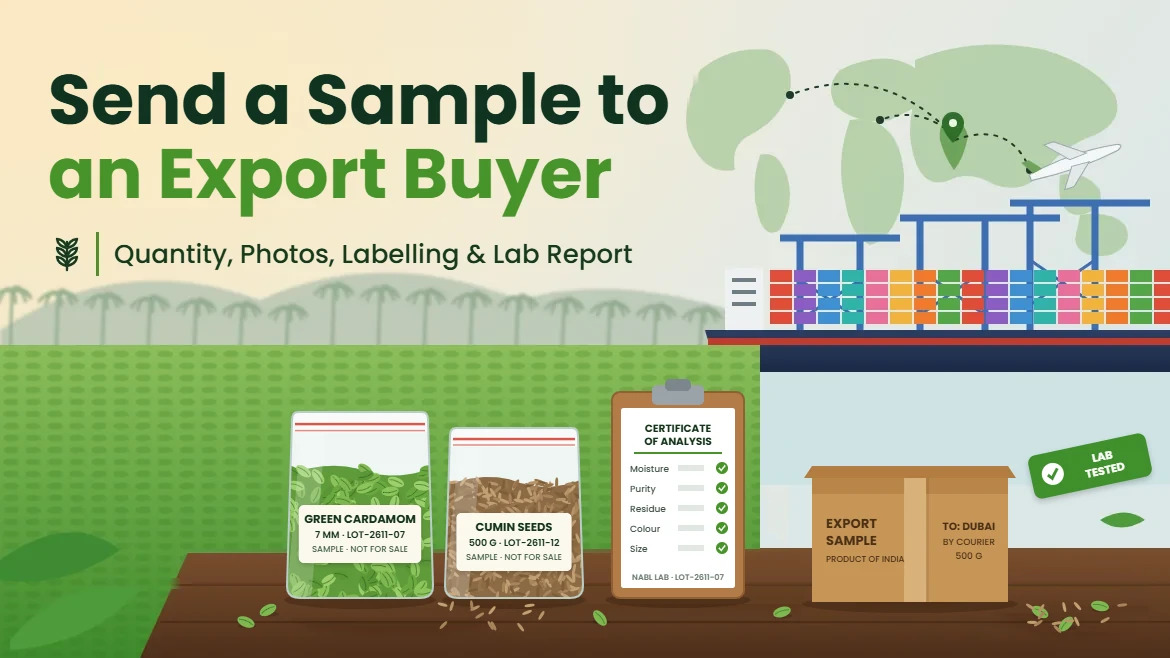

15 Export Sample Mistakes Indian Exporters Must Avoid to Win Global Buyers
A high-quality agricultural product does not always guarantee a successful export order. Many Indian farmers, FPOs, spice traders, rice millers, and agricultural suppliers lose international business opportunities because of avoidable mistakes during sample preparation.
International buyers often compare products from multiple suppliers before making purchasing decisions. An incorrectly labelled pouch, inconsistent product quality, incomplete laboratory report, or delayed sample shipment can create doubts about a supplier’s reliability.
Preparing a professional export sample requires attention to product selection, quality control, packaging, documentation, transportation, and buyer communication.
In this guide, we examine 15 common export sample mistakes and practical solutions that can help Indian agricultural exporters reduce buyer rejection and improve their chances of securing commercial orders.
Originally published at: D&S International – How to Send a Sample to an Export Buyer: Quantity, Photos, Labelling & Lab Report
1. Sending Samples Without Understanding Buyer Requirements
One of the most common mistakes new agricultural exporters make is preparing samples before understanding what the international buyer actually needs.
An importer requesting cumin seeds may require a particular purity level, while a cardamom buyer may need a specific pod size. A rice importer may have detailed requirements concerning grain length, processing type, and cooking performance.
Sending a product without confirming these specifications can result in immediate rejection, even when the product itself is of good quality.
How to Avoid This Mistake
Before preparing the sample, confirm:
-
Product variety and commercial grade
-
Required quality specifications
-
Sample quantity
-
Intended product application
-
Laboratory testing requirements
-
Expected commercial order volume
-
Sample delivery deadline
Obtain written confirmation wherever possible.
A short discussion before sample preparation can prevent unnecessary courier expenses and improve the relevance of the buyer’s evaluation.
2. Hand-Picking Premium Products Instead of Representative Samples
Some agricultural suppliers manually select the most attractive spice pods, cleanest grains, or best-looking fruits to impress international buyers.
Although this approach may generate initial interest, it creates unrealistic expectations about the quality of future commercial shipments.
If a buyer receives a container of agricultural products that does not match the approved sample, the exporter may face:
-
Commercial shipment rejection
-
Quality complaints
-
Payment disputes
-
Compensation claims
-
Loss of future orders
-
Damage to business reputation
How to Avoid This Mistake
Collect samples using appropriate sampling procedures from the actual commercial lot.
For dry agricultural commodities, this may involve collecting smaller portions from different locations within the selected stock.
Maintain clear batch identification and ensure that the offered commercial inventory reflects the sample approved by the buyer.
International business relationships depend on consistency rather than an artificially impressive first sample.
3. Sending the Wrong Sample Quantity
Sending too little material may prevent the buyer from conducting proper evaluation. Sending excessive quantities can unnecessarily increase transportation and packaging costs.
Different agricultural products require different sample sizes depending on their intended evaluation.
| Agricultural Product | Indicative Sample Quantity |
|---|---|
| Green Cardamom | 250–500 g per grade |
| Cumin Seeds | 500 g–1 kg |
| Turmeric | 250–500 g |
| Coriander Seeds | 500 g–1 kg |
| Basmati Rice | 1–2 kg per variety |
| Chickpeas | 500 g–1 kg |
| Fresh Onions | 2–5 kg |
| Pomegranate | Approximately 3–5 kg |
These quantities are practical examples, not mandatory international export standards.
How to Avoid This Mistake
Ask whether the importer needs the sample for visual inspection, laboratory analysis, cooking trials, processing assessment, or retail evaluation.
Confirm laboratory sample requirements separately when necessary.
Prepare enough material to support the agreed evaluation without creating unnecessary shipping expenses.
4. Mixing Different Product Grades in One Package
International buyers often request multiple grades of the same agricultural product for comparison.
For example, a cardamom importer may request 6 mm, 7 mm, and 8 mm samples. Similarly, a rice buyer may request different varieties or processing types.
Mixing these products in one unmarked package makes accurate evaluation difficult.
How to Avoid This Mistake
Pack every commercial grade or product variety separately.
Each sample should have:
-
Individual packaging
-
Clear product identification
-
Commercial grade
-
Net sample weight
-
Batch number
-
Corresponding quality specifications
When sending multiple samples, include a simple product comparison sheet explaining the differences between them.
This helps international buyers identify which product is most suitable for their purchasing requirements.
5. Using Poor-Quality or Misleading Product Photographs
Product photographs often influence a buyer’s decision before a physical sample is requested.
Blurry images, poor lighting, excessive filters, and photographs of unrelated inventory can reduce supplier credibility.
Misleading photographs also create problems when the actual sample differs significantly from the product originally presented.
How to Avoid This Mistake
Prepare accurate photographs using suitable natural lighting and a neutral background.
Include:
-
Close-up product images
-
Representative stock photographs
-
Product size comparisons
-
Commercial packaging photographs
-
Short product videos when useful
Avoid artificial colour enhancement, especially for green cardamom, turmeric, and fresh produce.
The photographs should accurately reflect the commercial product available for supply.
6. Ignoring Moisture Content and Storage Conditions
Moisture management is particularly important when preparing export samples of spices, rice, and other dry agricultural commodities.
Poor storage conditions may contribute to mould growth, aroma deterioration, insect infestation, discolouration, and reduced commercial quality.
A sample that was acceptable during procurement may deteriorate before it reaches the international buyer.
How to Avoid This Mistake
Check the product’s moisture condition before sample preparation.
Use suitable storage facilities and packaging materials appropriate to the commodity.
Monitor relevant storage conditions and avoid exposing dry agricultural products to unnecessary environmental moisture.
For cardamom suppliers, this detailed guide on green cardamom storage after harvest explains important post-harvest practices for maintaining product quality.
Proper storage is not simply a warehouse activity. It directly influences the quality of samples and future commercial shipments.
7. Using Inappropriate Export Sample Packaging
Agricultural samples may travel through multiple courier facilities, warehouses, airports, and customs inspection points before reaching the importer.
Inadequate packaging can result in leakage, contamination, crushing, moisture exposure, and physical damage.
For example, fresh fruits require different transportation arrangements from powdered spices or dry rice.
How to Avoid This Mistake
Select packaging according to product characteristics.
| Product Category | Recommended Packaging Approach |
|---|---|
| Whole Spices | Secure, moisture-resistant food-grade pouches |
| Powdered Spices | Properly sealed, leak-resistant food-grade packaging |
| Rice and Pulses | Durable sealed bags with protective outer cartons |
| Fresh Onions | Suitable ventilated packaging |
| Pomegranate | Protective ventilated cartons with cushioning |
Use appropriate outer protection to prevent excessive movement and physical damage during transportation.
For fresh agricultural products, confirm transit duration, handling conditions, and temperature requirements with the transportation provider.
Professional packaging helps ensure that buyers evaluate the product rather than damage caused during shipment.
8. Sending Samples Without Proper Labels
An international importer may receive agricultural samples from several suppliers within a short period.
Unlabelled packages make it difficult to identify products, compare grades, and connect samples with commercial quotations or laboratory reports.
This can create unnecessary confusion during buyer evaluation.
How to Avoid This Mistake
Prepare a readable sample identification label containing relevant product details.
Example Export Sample Label
| Label Information | Example |
|---|---|
| Product Name | Whole Cumin Seeds |
| Commercial Grade | As per agreed specification |
| Country of Origin | India |
| Batch Number | CUM-2026-037 |
| Net Weight | 500 g |
| Packing Date | November 2026 |
| Supplier | Exporter’s Company Name |
| Shipment Purpose | Sample – Not for Sale |
The details above are illustrative.
Replace them with accurate information corresponding to the actual shipment.
Additional destination-specific labelling requirements may also apply.
Ensure that the sample label, product specification sheet, laboratory report, and shipping documents contain consistent identification details.
9. Providing Outdated or Unrelated Laboratory Reports
Laboratory reports are intended to support product quality and food safety assessments.
However, some suppliers present old test reports from previous crop seasons or unrelated commercial batches.
This creates uncertainty about whether the physical sample actually meets the reported quality parameters.
How to Avoid This Mistake
Arrange relevant laboratory testing for the identified commercial lot when required.
Depending on the commodity and buyer specifications, testing may include:
-
Moisture content
-
Physical purity
-
Pesticide residues
-
Heavy metals
-
Microbiological contamination
-
Aflatoxins
-
Product-specific quality parameters
The Certificate of Analysis should contain suitable sample identification and analytical information.
Indian spice suppliers can consult the Spices Board India Quality Evaluation Laboratory for information about analytical testing facilities and spice quality evaluation services.
Before sharing laboratory documentation, ensure that the report corresponds to the actual batch being offered.
10. Ignoring Destination-Country Food Safety Requirements
Food safety and agricultural import requirements differ between international markets.
A product that satisfies one buyer’s specifications may not necessarily meet the regulatory requirements of another country.
Ignoring pesticide residue limits, contaminant requirements, agricultural quarantine rules, or other applicable conditions can create clearance problems.
How to Avoid This Mistake
Before dispatching agricultural samples:
-
Identify the final destination country.
-
Confirm the applicable product-specific import requirements.
-
Check relevant Maximum Residue Limits (MRLs).
-
Determine whether laboratory testing is required.
-
Confirm applicable food safety documentation.
-
Check whether agricultural quarantine certificates or import permissions are necessary.
-
Coordinate with the international importer.
Do not assume that agricultural samples are automatically exempt from import restrictions because they are small or provided free of charge.
The exact requirements should be verified before every shipment where relevant conditions differ.
11. Preparing Incorrect or Incomplete Export Documentation
Documentation errors can cause unnecessary customs queries, clearance delays, additional charges, and shipment rejection.
New exporters sometimes assume that a small sample shipment does not require accurate product information or supporting documentation.
However, international shipments must satisfy the applicable export and import procedures.
How to Avoid This Mistake
Prepare the documents required for the specific shipment.
These may include:
| Document | Purpose |
|---|---|
| Sample Invoice | Identifies the product, quantity and declared value |
| Packing List | Describes package contents and shipment weight |
| Exporter Identification | Provides applicable business and exporter details |
| Courier Declaration | Supports the relevant customs clearance process |
| Certificate of Analysis | Provides relevant analytical results |
| Phytosanitary Certificate | Supports agricultural clearance where required |
| Product Specification Sheet | Describes agreed product quality characteristics |
The exact documentation depends on the product, destination, shipment classification, and transportation arrangements.
Exporters unfamiliar with international trade procedures can explore this detailed guide on how to export food products from India to understand the broader food export process.
Confirm documentation requirements with the authorised courier and overseas importer before dispatch.
12. Declaring Free Samples Incorrectly for Customs Purposes
A common misconception is that a free sample can always be declared with zero customs value.
The fact that an importer is not paying for the product does not automatically eliminate customs valuation requirements.
Vague descriptions and inaccurate declarations may lead to additional inspections or clearance problems.
How to Avoid This Mistake
Use accurate and specific product descriptions.
Instead of writing only:
-
Food sample
-
Agricultural product
-
General merchandise
-
Spice sample
Provide a clear description such as:
Whole Indian cumin seeds, 500 grams, agricultural sample for buyer quality evaluation, not for retail sale.
Declare the appropriate customs value according to applicable requirements, clearly distinguishing it from the amount charged to the buyer.
Confirm the relevant product classification and declaration procedure with the authorised courier.
Never use misleading descriptions or artificial valuations to avoid legitimate import controls or duties.
13. Choosing a Courier Based Only on the Lowest Price
International transportation costs can be a significant consideration when sending agricultural samples.
However, selecting the cheapest courier without checking its product acceptance and clearance capabilities may result in greater expenses later.
The courier may not accept certain food products, agricultural commodities, untreated seeds, or fresh produce.
How to Avoid This Mistake
Compare transportation providers based on:
-
Acceptance of agricultural products
-
Destination-country delivery coverage
-
Estimated transit duration
-
Customs clearance assistance
-
Tracking facilities
-
Food shipment experience
-
Special handling capabilities
-
Additional transportation and clearance charges
Fresh fruits and vegetables may require specialised transportation arrangements.
For high-value spice samples, reliable handling and accurate delivery information may also be more important than minor differences in courier charges.
Choose a transportation method that protects product quality and supports the buyer’s evaluation deadline.
14. Failing to Maintain a Counter Sample and Batch Records
When an exporter sends the only available sample to an overseas buyer, future quality comparisons may become difficult.
If the buyer approves the sample and later raises concerns about commercial shipment quality, the supplier may have limited reference material available.
Incomplete batch records also make it difficult to connect the approved sample with the actual product lot.
How to Avoid This Mistake
Where practical, retain a representative counter sample from the same commercial lot.
Maintain records containing:
-
Product name and variety
-
Commercial grade
-
Batch number
-
Procurement date
-
Sample dispatch date
-
Laboratory report number
-
Buyer details
-
Sample approval status
-
Commercial shipment reference
The retained sample should be labelled and stored under suitable conditions.
For perishable agricultural products, photographs, inspection records, and appropriate quality measurements may be more useful over time because the physical product naturally deteriorates.
A counter sample supports quality comparison but does not replace contractual inspection procedures or independent dispute resolution.
15. Failing to Follow Up After Sample Delivery
Many agricultural exporters concentrate on preparing and dispatching samples but fail to maintain communication after delivery.
International buyers may receive numerous samples while managing existing purchasing activities.
Without professional follow-up, a genuine sales opportunity may remain inactive.
How to Avoid This Mistake
Create a structured communication process covering the complete sample journey.
| Stage | Recommended Action |
|---|---|
| Sample Preparation | Confirm product and quantity |
| After Dispatch | Share tracking and relevant documents |
| After Delivery | Confirm receipt and package condition |
| During Evaluation | Offer additional technical information |
| After Approval | Discuss commercial pricing and order quantity |
| Before Order Confirmation | Agree on quality, packaging and delivery terms |
Respect the buyer’s evaluation timeline and avoid sending repetitive messages.
Example Export Sample Follow-Up Message
Dear Sir/Madam,
We hope you have received our agricultural product sample in satisfactory condition.
Please share your feedback regarding the product quality and suitability for your requirements.
We would be happy to provide additional specifications, laboratory reports, packaging information, and commercial quotations based on your expected purchase quantity.
We look forward to exploring a mutually beneficial business relationship.
Best regards,
Export Sales Team
A professional follow-up message helps maintain communication while supporting the buyer’s purchasing decision.
Summary: 15 Export Sample Mistakes and Their Solutions
| Common Mistake | Practical Solution |
|---|---|
| Unconfirmed buyer requirements | Obtain written product specifications |
| Hand-picked premium samples | Collect representative samples |
| Incorrect sample quantity | Confirm evaluation and testing needs |
| Mixed commercial grades | Pack and label each grade separately |
| Misleading photographs | Use accurate images of available stock |
| Poor moisture management | Maintain suitable storage conditions |
| Inappropriate packaging | Select product-specific protective packaging |
| Missing labels | Include accurate product and batch identification |
| Outdated laboratory reports | Use relevant reports for the actual lot |
| Ignoring food safety requirements | Verify destination-specific conditions |
| Incomplete documentation | Prepare applicable shipment documents |
| Incorrect customs declarations | Use accurate descriptions and valuation |
| Unsuitable courier selection | Confirm product acceptance and clearance support |
| Missing counter samples | Maintain appropriate reference and batch records |
| No buyer follow-up | Establish a professional communication process |
Export Sample Pre-Dispatch Checklist for Indian Suppliers
Before sending an agricultural sample to an international buyer, complete the following checklist.
Product Quality
- Buyer specifications confirmed.
- Correct product variety selected.
- Commercial grade verified.
- Representative sample collected.
- Product moisture and physical quality assessed.
- Required laboratory testing completed.
Packaging and Presentation
- Suitable food-grade packaging selected.
- Different product grades separately packed.
- Sample labels prepared.
- Product photographs recorded.
- Outer carton securely packed.
Export Documentation
- Sample invoice prepared.
- Packing list completed where required.
- Product specification sheet available.
- Relevant laboratory reports attached.
- Customs declaration checked.
- Destination-country requirements confirmed.
Transportation and Communication
- Courier accepts the agricultural product.
- Delivery address verified.
- Shipping charges agreed.
- Suitable transit arrangements confirmed.
- Counter sample retained where appropriate.
- Buyer follow-up process established.
Following a consistent checklist helps agricultural suppliers reduce preventable mistakes and maintain professional export practices.
Frequently Asked Questions
Why do international buyers reject agricultural export samples?
Common reasons include incorrect product grades, inconsistent quality, unsuitable packaging, missing documentation, insufficient sample quantity, and failure to meet agreed food safety specifications.
What is the biggest mistake when preparing export samples?
Sending a sample that does not accurately represent the available commercial stock is one of the most serious mistakes because it can create quality disputes after order confirmation.
Can incorrect packaging cause export sample rejection?
Yes. Unsuitable packaging can result in moisture exposure, contamination, leakage, crushing, and product deterioration, making accurate buyer evaluation difficult.
Is a laboratory report compulsory for every export sample?
Not necessarily. Laboratory testing requirements depend on the commodity, destination country, applicable regulations, and buyer specifications.
Can free agricultural samples face customs clearance problems?
Yes. Free samples may still be subject to customs declarations, valuation requirements, food safety controls, and agricultural import restrictions.
How can Indian exporters improve their sample-to-order conversion rate?
Exporters can improve their commercial process by qualifying buyers, sending representative samples, providing clear technical information, offering realistic quotations, and maintaining professional follow-up.
Does buyer sample approval guarantee a bulk export order?
No. Sample approval is an important milestone, but commercial orders also depend on pricing, product availability, payment terms, regulatory compliance, and buyer demand.
Conclusion: Avoid Small Sample Mistakes to Build Bigger Export Opportunities
An agricultural export sample may represent only a small quantity of product, but its influence on international purchasing decisions can be significant.
Indian farmers, FPOs, spice traders, rice millers, and agricultural exporters can strengthen their international business prospects by avoiding preventable mistakes related to product selection, quality control, moisture management, packaging, laboratory testing, documentation, and buyer communication.
Instead of treating sample preparation as a routine courier activity, exporters should consider it an essential part of international sales and quality assurance.
A representative product sample, supported by accurate information and dependable commercial practices, can help establish buyer confidence and create opportunities for long-term supply relationships.
Whether you supply green cardamom, cumin, turmeric, coriander, rice, chickpeas, onions, pomegranates, or other Indian agricultural commodities, professional sample preparation is an important step towards accessing global markets.
If you are looking to explore international agricultural sourcing, food trading, or export business opportunities, contact D&S International to discuss your products and potential supply partnerships.
D&S International – Connecting Quality Indian Agricultural Products With Global Buyers.