
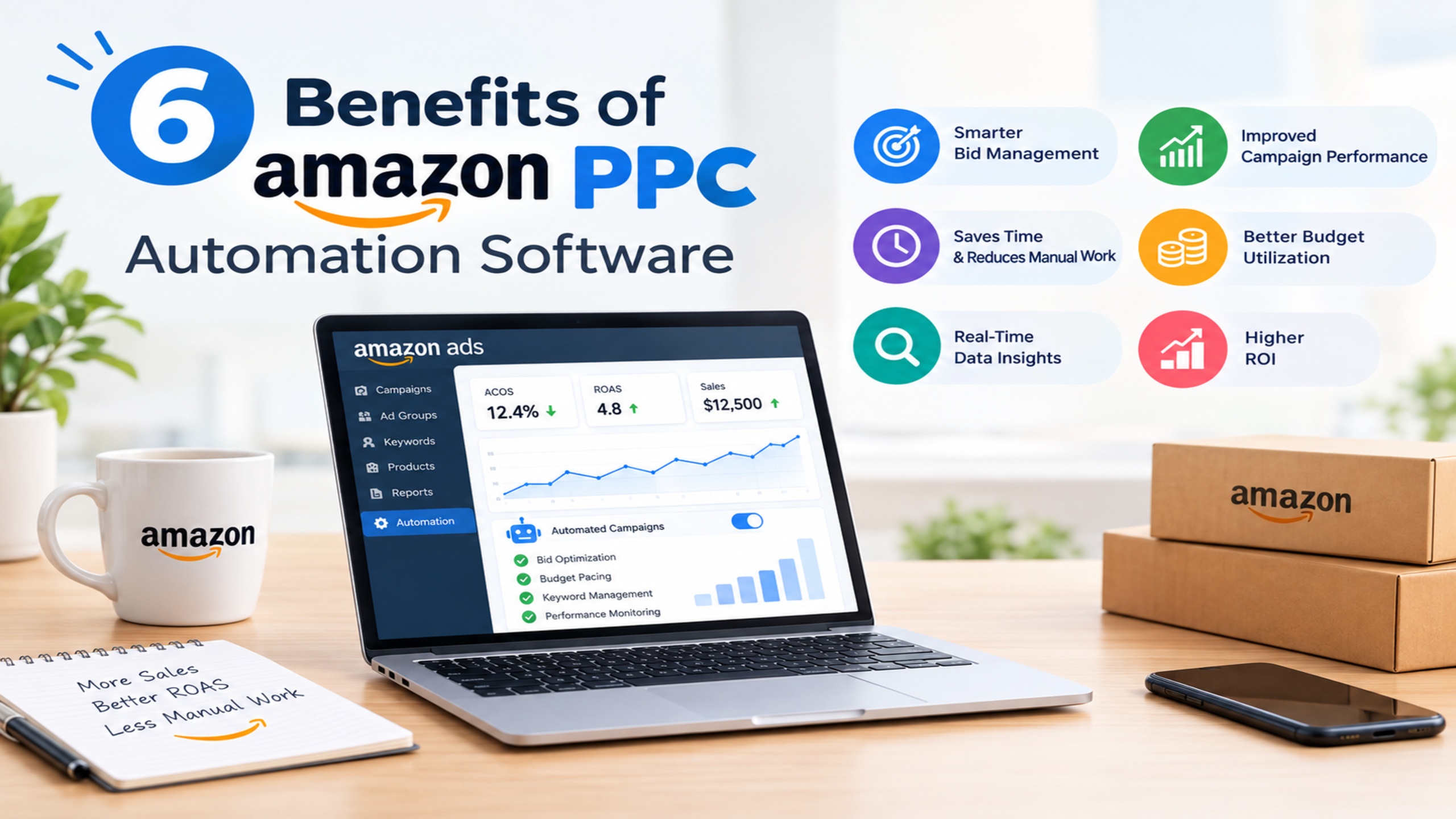

Amazon advertising helps sellers and e-commerce businesses reach potential customers, increase product visibility, and generate sales. However, managing multiple pay-per-click (PPC) campaigns manually can become time-consuming as product catalogs grow and advertising budgets increase. Sellers must monitor keyword performance, adjust bids, review search terms, manage budgets, and identify opportunities to improve campaign results.
Without an organized approach, businesses may spend too much on underperforming keywords, miss valuable search opportunities, or struggle to maintain consistent campaign performance. This is where Amazon PPC Automation Software can help. It simplifies repetitive advertising tasks, supports data-driven decisions, and allows sellers to manage campaigns more efficiently.
By using Amazon Ads Automation, businesses can streamline bidding, budget management, keyword optimization, and performance monitoring. Let’s explore six important benefits of automating Amazon PPC campaign management and how the right Amazon ads software can support long-term advertising growth.
What Is Amazon PPC Automation Software?
Amazon PPC Automation Software is a technology solution that helps sellers and advertisers automate repetitive tasks involved in managing Amazon pay-per-click campaigns. Depending on its features and integrations, the software can support automated bidding, keyword management, budget adjustments, campaign monitoring, and performance reporting.
Instead of making every change manually, advertisers can configure rules, performance thresholds, and optimization strategies to guide campaign management. Some solutions also use machine learning or predictive analytics to identify patterns and recommend adjustments.
For example, an advertiser can create a rule to reduce bids on keywords that consistently generate spending without conversions. Another rule might increase bids for profitable keywords within an approved budget.
Automation does not eliminate the need for advertising expertise. Rather, it gives teams better tools to manage campaigns, evaluate results, and make informed decisions.
1. Saves Time by Automating Repetitive Tasks
Managing Amazon PPC campaigns involves many recurring activities. Advertisers frequently check campaign dashboards, review keyword reports, update bids, adjust budgets, and evaluate search terms. When businesses manage dozens or hundreds of campaigns, these tasks can consume significant time.
Amazon PPC Automation Software reduces this workload by handling predefined tasks automatically. Advertisers can establish rules for bid adjustments, budget allocation, and keyword management instead of reviewing every campaign manually.
How Automation Improves Daily Campaign Management
- Automated bid adjustments: Apply predefined bidding rules based on clicks, conversions, spending, or profitability.
- Scheduled campaign monitoring: Track campaign performance at regular intervals and identify changes that require attention.
- Keyword management: Help identify search terms that deserve additional investment or keywords that may need to be paused.
- Automated reporting: Organize advertising metrics into reports that are easier to review and share.
For example, an e-commerce business selling hundreds of products may struggle to monitor every campaign throughout the day. With Amazon Ads Automation, the team can automate routine adjustments and focus more attention on campaign strategy, product selection, and market research.
2. Improves Bidding Accuracy and Budget Control
Bidding plays an important role in Amazon PPC performance. Bids that are too high can increase advertising costs, while bids that are too low may limit visibility for valuable search terms. Finding the right balance requires regular monitoring and adjustments.
Amazon PPC Automation Software helps advertisers apply consistent bidding strategies using campaign performance data and predefined business objectives.
For instance, businesses can configure rules to reduce bids when spending exceeds an acceptable threshold without generating sales. They can also increase bids for keywords that meet specific conversion or profitability targets, subject to budget limits and campaign settings.
Maintain Better Control Over Advertising Spend
Automated bidding rules can help businesses:
- Set maximum and minimum bid limits.
- Adjust bids according to conversion performance.
- Reduce unnecessary spending on underperforming targets.
- Prioritize campaigns that meet profitability requirements.
- Monitor budget usage against planned advertising expenditure.
Consider a seller whose product campaign receives many clicks but produces few orders. Instead of waiting for a manual review, the configured software may flag the problem or adjust bids according to established rules.
3. Helps Identify Profitable Keywords and Search Terms
Keyword selection directly influences which shoppers see sponsored product advertisements. Relevant keywords can connect products with customers who are actively searching for similar items. However, identifying valuable search terms across multiple campaigns can be challenging.
Amazon PPC Automation Software can simplify keyword analysis by organizing search term data, tracking performance, and applying rules to identify potential opportunities.
For example, a search term that consistently generates orders at an acceptable advertising cost may be suitable for further investment. Meanwhile, an irrelevant search term that consumes budget without producing meaningful results may need to be excluded through negative keyword targeting.
Turn Advertising Data Into Actionable Insights
Amazon Ads Automation can support keyword management by helping advertisers:
- Identify search terms that generate conversions.
- Detect keywords with high spending and limited sales.
- Find potential negative keywords.
- Monitor keyword performance over time.
- Discover opportunities to expand successful campaigns.
These capabilities can reduce the manual effort involved in reviewing search term reports and identifying patterns.
However, automation should not automatically classify every keyword without considering context. Some keywords may have longer purchase cycles, seasonal demand, or limited conversion data. Human review remains important when evaluating search intent, product relevance, and campaign objectives.
By combining automated analysis with informed keyword decisions, businesses can build more relevant campaigns and use their advertising budgets more strategically.
4. Supports Better Campaign Performance Monitoring
Amazon advertising performance can change because of competition, product availability, pricing, seasonal demand, and shopper behavior. A campaign that performs well today may become less efficient tomorrow.
Manually checking every campaign can make it difficult to identify changes quickly, particularly when a business manages several product categories.
Amazon PPC Automation Software can monitor important performance indicators and notify advertisers when predefined conditions are met. Depending on the platform, it may also trigger automated actions to address specific issues.
5. Makes It Easier to Scale Advertising Campaigns
As e-commerce businesses expand, they may add new products, enter new marketplaces, launch seasonal campaigns, or target additional customer segments. Each expansion increases the complexity of advertising management.
Manual processes that work for a small product catalog may become difficult to maintain at a larger scale.
Amazon PPC Automation Software helps businesses manage growing campaign portfolios by applying consistent rules across multiple campaigns. Depending on the solution, advertisers may be able to create reusable workflows, group campaigns by product category, and apply optimization rules to selected advertising targets.
Scale Campaign Operations More Efficiently
Automation can support growth by helping teams:
- Manage multiple campaigns through centralized dashboards.
- Apply consistent optimization rules across product groups.
- Monitor spending across different campaigns.
- Standardize reporting and performance reviews.
- Support the launch and ongoing management of new campaigns.
For example, a retailer selling products across home, kitchen, and personal care categories can organize campaigns into separate groups. Each group can use different bidding limits and performance targets based on product margins and business priorities.
6. Provides Data-Driven Insights for Smarter Decisions
Successful Amazon advertising requires more than changing bids or pausing keywords. Businesses must understand which products perform well, where advertising costs are increasing, and which campaigns contribute to their commercial objectives.
Amazon PPC Automation Software can bring campaign data together, track performance trends, and generate reports that help advertisers evaluate their strategies.
Depending on its capabilities, the software may compare historical results, identify changes in advertising efficiency, and highlight campaigns that require further investigation.
Make Campaign Optimization More Strategic
Data-driven automation can help advertisers:
- Compare performance across products and campaigns.
- Identify recurring patterns in advertising costs.
- Evaluate keyword and targeting effectiveness.
- Track results against campaign objectives.
- Generate reports for internal teams and stakeholders.
For example, a business may discover that one product category generates stronger returns during specific periods, while another requires tighter bid controls. These insights can help the team plan budgets and adjust campaign priorities.
How to Choose the Right Amazon PPC Automation Software
Choosing the right solution depends on advertising goals, campaign complexity, budget, and existing business systems. Before selecting Amazon PPC Automation Software, businesses should evaluate the features they actually need.
Consider these factors:
- Automation features: Check whether the platform supports bidding rules, keyword management, budget controls, alerts, and reporting.
- Data accuracy: Review how frequently campaign data is updated and whether the reporting meets your requirements.
- Customization: Ensure that rules can be configured around product margins, campaign objectives, and acceptable spending limits.
- Integration capabilities: Verify compatibility with the relevant Amazon advertising accounts, APIs, and internal reporting systems.
- Scalability: Choose a solution that can support additional campaigns and products as the business grows.
- Monitoring and safeguards: Look for change logs, approval options, spending limits, and clear visibility into automated actions.
Businesses with specialized workflows may also consider custom Amazon ads software that connects advertising data with internal dashboards, inventory systems, or business intelligence tools.
Conclusion
Automating Amazon PPC campaign management can help e-commerce businesses reduce repetitive work, improve bidding consistency, identify keyword opportunities, monitor campaign performance, scale advertising operations, and make more informed decisions.
With the right Amazon PPC Automation Software, advertisers can create structured workflows that support better budget control and more efficient campaign management. However, automation is most effective when combined with clear objectives, reliable data, and regular human oversight.
Vision Infotech helps businesses explore software development, API integration, and automation solutions tailored to their operational needs. If your advertising workflows require more than standard tools can provide, a customized approach may help connect campaign data, reporting processes, and internal systems.



