Physical Address
304 North Cardinal St.
Dorchester Center, MA 02124
Physical Address
304 North Cardinal St.
Dorchester Center, MA 02124

Artificial intelligence is no longer limited to experimental projects or internal automation. Businesses are using AI to create customer-facing products, improve existing platforms, personalize digital experiences, and build entirely new services around changing user expectations.
The challenge is not simply deciding to build an AI product. Businesses also need to identify the right use case, understand what users actually need, choose suitable AI models, plan the product architecture, and make sure the final solution can scale beyond an initial prototype.
That is where choosing the right development partner becomes important. A strong partner can help transform an early concept into a usable product while handling areas such as AI model integration, application development, APIs, data processing, security, testing, and deployment.
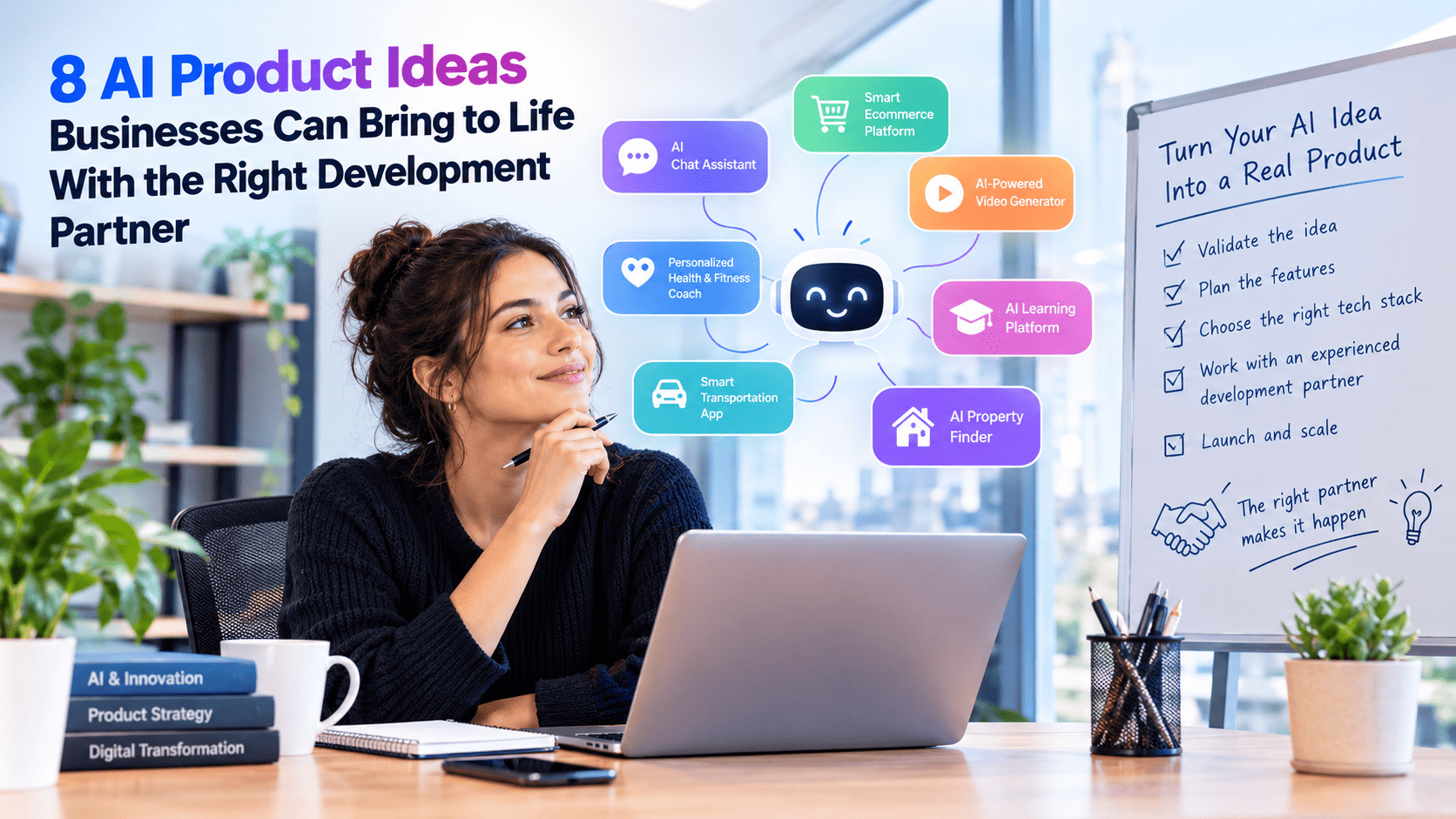
For businesses exploring these opportunities, here are eight AI product ideas that can move beyond the concept stage and become practical digital products.
Before looking at individual ideas, it helps to understand what separates a useful AI product from an AI feature added simply because the technology is popular.
A commercially viable AI product should solve a recognizable problem. Users should understand why they need it, what it helps them accomplish, and why an AI-powered approach provides an advantage over traditional software.
A good starting point is to evaluate an idea around four questions:
Businesses should also consider data availability, development costs, privacy requirements, model accuracy, response speed, and long-term maintenance before committing to a product roadmap.
AI assistants have moved well beyond simple chatbots. Businesses can build specialized assistants designed around particular industries, workflows, or customer needs.
For example, an assistant for a real estate platform could help users find properties, compare listings, summarize property information, and answer questions about specific locations. A business-focused assistant could organize documents, generate summaries, prepare reports, or help employees retrieve information.
The important opportunity is specialization.
Instead of creating another general-purpose chatbot, businesses can develop an assistant around a specific audience and workflow. This can make the product more useful and easier to position in a competitive market.
Potential capabilities include:
Content production is another area where businesses can develop dedicated AI products.
Rather than offering only text generation, a platform can combine multiple AI capabilities into one workflow. Users might generate an article, create social media variations, produce product descriptions, summarize research, or adapt existing content for different audiences.
A specialized content platform could also include brand guidelines, approval workflows, content calendars, templates, analytics, and collaboration features.
This makes the product more than an AI writing tool. It becomes a complete content workflow.
Businesses entering this market should focus on a particular customer segment instead of trying to serve everyone. For example, a product designed specifically for ecommerce teams could generate product descriptions and advertising copy based on catalog information.
AI companion applications demonstrate how conversational AI can become the central experience of an entire product.
A platform inspired by the broader Candy AI clone concept, for example, could combine conversational interaction with personalization, character-based experiences, voice features, memory, and multimedia capabilities.
However, simply reproducing another AI companion application is unlikely to create long-term differentiation.
Businesses can instead focus on a particular audience or experience, such as:
The product experience should be designed around responsible data handling, user privacy, moderation, consent, and transparent AI behavior from the beginning.
Recommendation technology can become a valuable product when businesses have enough behavioral or contextual data to personalize experiences.
Traditional recommendation systems often depend heavily on predefined rules. AI can make recommendations more dynamic by considering user behavior, preferences, purchase history, content interactions, and contextual signals.
Businesses can build recommendation products for:
For example, an AI-powered learning platform could recommend courses based not only on what a student has viewed but also on their progress, interests, skill gaps, and learning behavior.
The strongest products make recommendations explainable and useful rather than simply presenting users with more content.
Customer support is another area where AI can provide immediate practical value.
Businesses can build AI support products that understand customer questions, retrieve information from company knowledge bases, classify requests, and assist human support teams.
A mature AI support platform might combine:
The goal should not necessarily be to eliminate human support.
In many cases, the better product strategy is to let AI handle repetitive questions while transferring complex or sensitive cases to human representatives.
This creates a more realistic balance between automation and human expertise.
Businesses generate enormous amounts of data but often struggle to turn that information into actionable insights.
An AI analytics product can simplify this process by allowing users to interact with business data through natural language.
Instead of manually navigating multiple dashboards, a user could ask:
“Which products experienced the largest decline in sales this quarter?”
The system could analyze the relevant information and return an explanation, visualization, or follow-up insight.
Possible features include:
For this type of product, accuracy and data security are particularly important. Businesses should ensure that AI-generated insights can be traced back to reliable data sources.
Education provides another opportunity for AI products because students often have different learning speeds, knowledge gaps, and preferences.
An AI learning platform can personalize the experience by adapting lessons, generating practice questions, explaining difficult concepts, and providing feedback.
For example, a learning application could evaluate a student’s previous answers and create a personalized learning path instead of giving every student the same sequence of lessons.
Potential features include:
The most valuable products should support learning rather than encourage students to simply outsource their thinking to AI.
One of the biggest opportunities for AI lies in connecting intelligent decision-making with existing business workflows.
A company could develop a platform that receives information from different systems, interprets it using AI, and then triggers appropriate actions.
For example:
Customer inquiry → AI classification → Information retrieval → Response generation → CRM update → Human escalation if required
Similar workflows could be created for sales, marketing, HR, finance, customer service, and operations.
This type of product can provide significant value because businesses are often not looking for another standalone AI tool. They want AI to work with the software they already use.
Having an interesting AI concept does not necessarily mean it is worth building.
Businesses should evaluate an idea from both a technical and commercial perspective.
Avoid starting with the question, “What can we build with AI?”
Instead ask:
“What problem are users already struggling to solve?”
AI should support the solution rather than become the reason for creating the product.
Different products require different approaches.
Depending on the use case, businesses might need:
Choosing the technology after understanding the product requirement can prevent unnecessary complexity.
Many AI products depend on data.
Before development begins, businesses should determine:
Data planning should be part of product development rather than an afterthought.
A prototype that works for 100 users may not work efficiently for 100,000 users.
Businesses should consider infrastructure, API costs, model usage, response times, storage, security, and monitoring before scaling the product.
A good architecture should allow the product to evolve as demand increases.
Choosing a development partner can significantly influence the outcome of an AI product.
An experienced AI development company should be able to discuss more than AI models. The team should understand product development, user experience, backend architecture, integrations, security, deployment, and ongoing optimization.
Look for a partner that can demonstrate experience with:
It is also worth asking how the team approaches AI accuracy, hallucinations, data privacy, model selection, scalability, and cost optimization.
A development partner should be willing to explain these areas clearly instead of simply promising that AI can solve everything.
There is no universal price for an AI application.
The development cost can vary considerably depending on the product’s complexity and requirements.
Major cost factors include:
A basic AI-enabled application may require considerably less investment than a platform involving custom models, real-time interactions, complex data processing, and multiple integrations.
Businesses should therefore define an MVP before estimating the full product cost.
One common mistake is attempting to launch every planned feature at once.
A better approach is to identify the smallest version of the product that can validate the core idea.
For example, an AI customer-support product might initially include:
Advanced automation, voice interaction, predictive analytics, and additional integrations can be introduced later.
This approach allows businesses to test demand before making a larger investment.
Businesses that want to turn an AI concept into a working application can work with an experienced development partner such as Triple Minds.
The development process can cover different stages of an AI product, from validating the concept and defining the MVP to designing the application, integrating AI capabilities, testing the product, and preparing it for deployment.
For businesses exploring conversational products, automation platforms, recommendation systems, or specialized AI applications, the important consideration is not simply whether the technology can be implemented. The product should be designed around a clear business objective and a useful customer experience.
That is especially important for products inspired by existing concepts such as a Candy AI clone. The goal should be to identify the underlying user demand and develop a differentiated product rather than simply reproducing an existing application.
Even promising AI products can struggle if the development strategy is poorly planned.
Adding AI to an application does not automatically make the product valuable.
Start with a genuine customer problem.
Too many features can increase development costs and make the product difficult to test.
Start with an MVP and expand based on user feedback.
AI-generated information can sometimes be incorrect or misleading.
Products should include appropriate validation, monitoring, human review, or retrieval mechanisms where accuracy matters.
AI applications may process personal, business, or confidential information.
Security, access control, encryption, privacy, and data governance should be considered during architecture and development.
AI products may have ongoing costs associated with model usage, APIs, cloud infrastructure, storage, and monitoring.
Businesses should estimate these costs before launch.
The next wave of AI products is likely to move beyond simple chat interfaces.
Businesses are increasingly exploring products that can understand context, interact with multiple systems, perform tasks, personalize experiences, and support users throughout complete workflows.
This creates opportunities across industries ranging from ecommerce and education to entertainment, healthcare, finance, marketing, and enterprise software.
The businesses most likely to benefit will not necessarily be those using the most advanced AI technology. They will be the ones that identify meaningful problems and apply AI where it creates measurable value.
AI creates a wide range of opportunities for businesses that are willing to move beyond experimentation and build products around genuine customer needs.
From intelligent assistants and recommendation engines to AI companions, analytics platforms, education tools, and workflow automation, the possibilities are broad. But technology alone is not enough.
A successful AI product needs a clear audience, a practical use case, reliable data, an appropriate technical architecture, strong user experience, and a development strategy that can evolve after launch.
The right AI development company can help businesses bring these pieces together and turn an early concept into a product that is practical, scalable, and ready for real users.
The most important question, therefore, is not simply “What AI product can we build?”
It is “What valuable problem can we solve better with AI?”
That question is where a strong AI product usually begins.