
How to Get Durable And Stain-Free Tiles With Epoxy Grout?
Tiles make a bathroom, kitchen or balcony look finished, but within a few months the joints can look discolored, there can be dark patches of mold, oil stains and even spill stains that refuse to come out.
Water, soap, oil, food and other stains can get trapped in the narrow joints between tiles and can be very difficult to remove. This causes the grout to stain, weaken and even allow moisture to penetrate behind the tiles, damaging the adhesive.
So, how do you get durable, stain-free tiles?
Clean the joints, select the right epoxy grout for tiles and exposure, mix it correctly, apply it in small sections, remove excess grout on time, and allow it to cure properly.
Why Do Grout Lines Become the Weak Point?
Tiles handle foot traffic, water and regular cleaning. These areas can collect dirt, moisture and other stains much faster than the rest of the tile surface as they are thinner and more exposed to water and other cleaning agents.
Soap, oil, food spills, cleaning chemicals, all of these can collect in the narrow joints between tiles. Over time, cement-based grout absorbs water and causes the grout to stain, weaken and even allow moisture to penetrate behind the tiles to affect the adhesive layer.
Epoxy grout is a much better option to use for grouting in areas that are constantly wet or where there is a lot of staining. Astral Trubuild treats grouting as an essential part of the tiling system, since a properly filled joint supports the tiled surface.
What Is Epoxy Grout Made Of?
Epoxy grout is a resin-based joint filler which consists of three components: resin, hardener and filler powder. When the components are mixed correctly, they react to form a hard, dense joint.
Unlike cement based grout, which sets with water, this grout does not set with water. Instead it forms a non-porous surface which is highly resistant to stains and is easily cleaned.
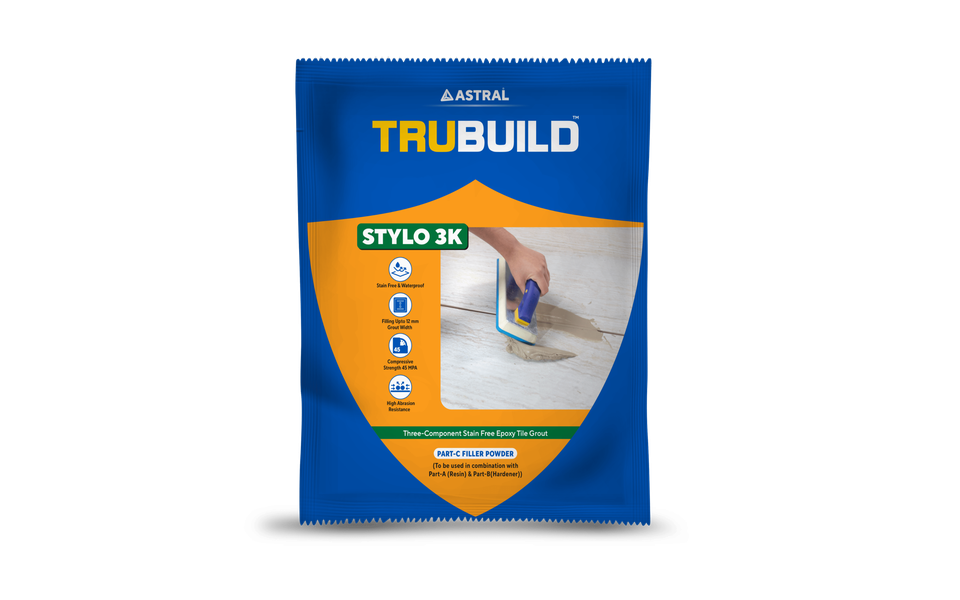
Astral Trubuild’s Stylo 3K is a three-component epoxy tile grout suitable for use in joints of 2mm to 12mm wide. It can be used on both walls and floors and gives a stain-free smooth finish in demanding environments.
Where Can Epoxy Grout Make a Difference?
Epoxy grout is most valuable where tiles face water, spills, cleaning agents and constant use, and ordinary joints are likelier to stain, weaken or let moisture through.
In a Bathroom, Water Does Not Stay in One Place
Water can remain on surfaces in the bathroom for long periods of time. This includes the shower, wash basin, toilet base and floor drains. Soap can also reside in the joints between tiles.
Because of the non-porous surface of the cured grout, it does not absorb moisture or stains like normal cement grout, so joints in areas that are constantly wet stay clean.
In a Kitchen, Spills Are Part of Daily Life
In areas where there are high chances of spillages of oils, turmeric, coffee and sauces, porous grout is highly unsuitable. Epoxy grout for tiles forms a very dense joint which is highly resistant to absorption. Thus, any such stains on the kitchen floor, backsplashes, etc. can be easily wiped away.
On a Balcony, Weather Tests the Joints
The tile surface of a balcony is exposed to rain, dust, sun and can undergo repeated wet and dry cycles. If the joints are not protected with a suitable grout, water can penetrate through the joints and cause damage to the surface below the tiles.
Astral Trubuild recommends you to check the tile type, the drainage system and exposure conditions of the tiles.
In Wash Areas, Cleaning Is Frequent
Utility rooms, laundry areas, and outdoor wash areas are areas which are constantly being washed down with detergent, water and dirt. The hard surface of the epoxy grout means that it will not stain easily and will retain its color even after frequent washing.
Around Pools, Moisture Is Constant
Pool decks, changing rooms and wet corridors are exposed to constant moisture as well as cleaning chemicals.
Epoxy grout for tiles cures into a tough, non-porous joint and will resist any stains from the chemicals. Always check that the chosen grout is suitable for permanent water exposure as well as any other chemicals used in the pool area.
How Should You Select an Epoxy Grout?
Choosing the correct epoxy grout for your application is more than selecting a color. You must also consider the tile surface, joint width, exposure and the manufacturer’s instructions for use.
Start With the Tile Surface
Ceramic, vitrified and porcelain tiles are commonly suitable for this grout. Natural stones, however, can be affected by the epoxy and some polished or even porous stones can be adversely affected by the residue of the epoxy as it is applied.
Apply a small amount in an unnoticed area first to check that the grout removes cleanly and suits the tile finish.
Measure the Joint Width
A grout meant for narrow joints may not fill wider gaps properly, while one meant for wider joints can be hard to control in thin lines.
Think About Daily Exposure
For example, a bedroom floor needs to be protected from completely different types of exposure than a shower wall. Generally, for wet, stain-prone and high-traffic areas, use of epoxy grout is advisable. Cement-based grout can be used for dry, low-exposure areas, such as walls in interior rooms.
Choose a Colour That Suits Maintenance
Light colors make a room look spacious but get dirty very quickly in high traffic areas. Dark colors hide dirt well but make a room look smaller.
Select a color of grout which complements the tiles and suits the maintenance of the area.
Follow the Product Data Sheet
Every grout has its own mixing ratio, range of suitable joint widths, curing time and recommended applications.
It is therefore very important to read the technical data sheet of the grout to be purchased before use and to follow the instructions for application given in the data sheet. Astral Trubuild provides product-specific guidance.
What Is the Right Application Process?
Epoxy grout for tiles works best when the joints are clean, the ratio of the components is mixed correctly and the excess is removed on time. Work in small sections, as the working time of the mixture is limited.
Clean the Joints First
The joints must be clean and free of dust, oil, debris, loose adhesive and any sealers. Remove any spacers and allow the adhesive to fully cure before starting the grout application.
Mix the Components Correctly
Thoroughly mix Part A and Part B together in a container of suitable size until a uniform color is achieved. Slowly add Part C powder to the mixed grout and continue to mix until a stiff, even paste is achieved.
It is important to mix the correct ratio of components and to not add any water unless the manufacturer specifies so. If the mixing is not correct, the grout will not cure properly, will not be as strong as possible and will not look as good as it could.
Fill Joints in Small Sections
Press the grout firmly into the joints with a hard rubber grout float held at an angle, moving diagonally across the tiles. This will ensure that all of the joints are completely filled with grout and that any excess grout can be removed before it sets.
Remove Excess Grout on Time
The excess grout must be removed from the tile surface before it sets. This is best done within 30 minutes of application. For the Astral Trubuild Stylo 3K this can be done by using an emulsifying pad and gripper and cleaning the surface with water using a circular motion with the pad flat against the surface.
Allow the Grout to Cure
Do not expose freshly grouted tiles to water or heavy use before curing. Astral Trubuild Stylo 3K reaches initial cure in 24 hours at 30°C and maximum strength and chemical resistance after 7 days.
Light foot traffic may be possible after 24 hours, but avoid aggressive cleaning, standing water and heavy loads until fully cured.
Conclusion
Epoxy grout is a suitable grout for durable and stain-free tiles in areas with high moisture and high use. It fills the joints between the tiles densely and helps to prevent water from entering the joints.
In order to get the desired result, the grout has to be prepared correctly and applied in the right way. That means that the joints have to be clean, the right grout has to be chosen, has to be mixed correctly, and needs to be applied in small sections. The excess grout has to be removed in time.
FAQs
Q1. Can epoxy grout be used in bathrooms?
Yes. It can be used in bathrooms as it is resistant to water and stains caused by soap, shampoo and cleaning products. The joints must be cleaned thoroughly before the grout is applied in small sections and allowed to cure fully before the area is used.
Q2. Is epoxy grout better than cement grout?
Epoxy grout is generally better than cement grout for wet areas, areas that are likely to stain and for high traffic areas as it forms a dense, non-porous joint. Cement grout is still suitable for dry, low exposure areas.
Q3. How long does epoxy grout take to cure?
Curing time depends on the product and temperature. Trubuild Stylo 3K achieves initial cure in 24 hours at 30°C, while full strength and chemical resistance develop after 7 days. Always follow the instructions given on the product pack.
Q4. Can epoxy grout for tiles be used for wide tile joints?
Yes, but the width of the joint must fall within the maximum recommended joint width for the product. Trubuild Stylo 3K is suitable for joints between 2mm and 12mm wide. For wider joints, use a product rated for wideness.
Q5. How do I clean epoxy grout haze from tiles?
To remove any excess grout haze from the tiles, clean within 30 minutes of application (for Trubuild Stylo 3K) with an emulsifying pad and gripper and clean water, using a circular motion and keeping the pad flat against the surface of the tile.