
Artificial intelligence is changing how businesses operate, make decisions, serve customers, and manage everyday tasks. From automating repetitive processes to analyzing large amounts of data, AI offers opportunities to improve productivity and create better customer experiences.
However, adopting AI is not simply about purchasing a tool or introducing a chatbot. Businesses need a clear strategy to identify suitable opportunities, prepare their teams, manage data, and measure results. Without proper planning, AI projects can become expensive experiments that fail to deliver meaningful value.
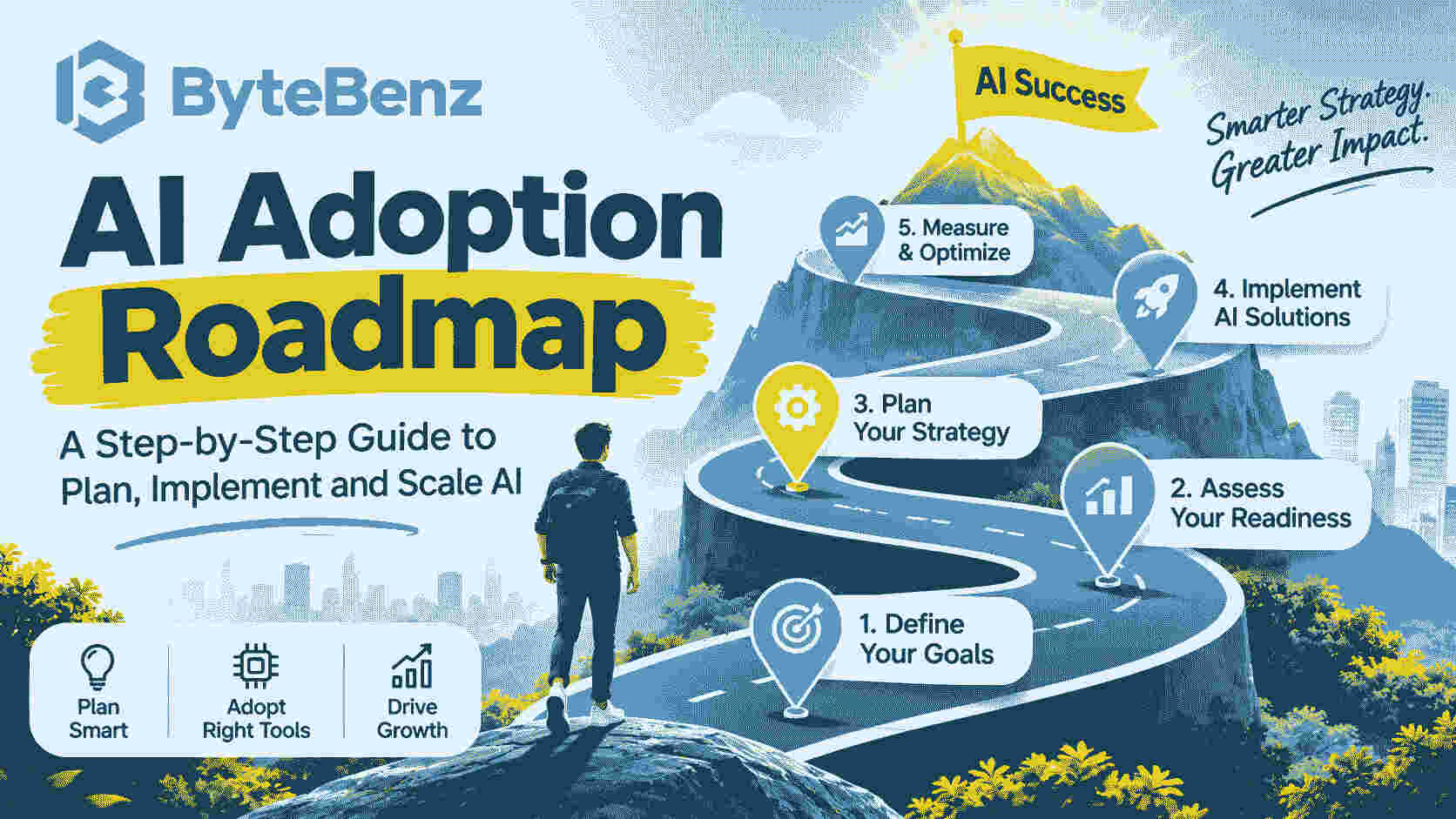
An effective AI Adoption Roadmap helps organizations move from initial research to practical implementation. It provides a structured approach to understanding business needs, selecting the right technologies, testing solutions, and expanding successful projects.
Whether you run a small business, manage a growing company, or lead digital transformation in a large organization, this guide explains how to develop an AI adoption strategy that supports long-term business goals.
What Is an AI Adoption Roadmap?
An AI Adoption Roadmap is a strategic plan that explains how an organization will introduce, implement, and expand artificial intelligence across its operations.
It identifies business challenges that AI can solve, the resources required for implementation, the technologies that may be suitable, and the performance indicators used to evaluate success.
Rather than implementing AI everywhere at once, a roadmap helps businesses prioritize projects based on their potential value, complexity, cost, and risk.
A typical roadmap covers:
- Business objectives and AI opportunities
- Data availability and infrastructure readiness
- AI technology selection
- Employee training and change management
- Pilot projects and testing
- Security, privacy, and governance
- Performance measurement and continuous improvement
The main objective is to make AI adoption practical, responsible, and aligned with measurable business outcomes.
Why Do Businesses Need an AI Adoption Strategy?
AI tools are becoming easier to access, but successful implementation still requires planning. Organizations that adopt technology without understanding their requirements may face integration problems, unexpected expenses, inaccurate outputs, and employee resistance.
A well-defined strategy helps businesses approach these challenges systematically.
1. Better Business Efficiency
AI can automate repetitive activities such as document processing, customer inquiries, data entry, and basic reporting. Employees can spend more time on tasks that require creativity, judgment, and problem-solving.
2. Improved Decision-Making
AI-powered analytics can help organizations identify patterns, understand customer behavior, and evaluate business performance. These insights can support better-informed decisions.
3. Enhanced Customer Experience
Businesses can use AI chatbots, recommendation systems, and automated support tools to provide faster responses and more personalized interactions.
4. Reduced Operational Costs
Automation may reduce the time and resources required for selected business processes. However, organizations should evaluate implementation, maintenance, and integration costs before expecting savings.
5. Stronger Business Competitiveness
Companies that identify useful AI applications can improve their workflows, respond to changing customer expectations, and explore new opportunities.
Step-by-Step AI Adoption Roadmap
A successful AI implementation should follow a clear process. The following steps provide a practical starting point for organizations at different stages of digital transformation.
Step 1: Define Your Business Goals
Before selecting an AI platform, identify the business problem you want to solve.
Start by reviewing existing operations and asking questions such as:
- Which activities consume too much employee time?
- Where do customers experience delays?
- Which processes involve repetitive manual work?
- Are important business decisions limited by insufficient data?
- Which departments could benefit from automation?
For example, an e-commerce company may want to improve customer support response times, while a manufacturing business may focus on equipment maintenance and production planning.
Clear objectives prevent organizations from adopting AI simply because it is popular.
Step 2: Identify Suitable AI Use Cases
Once business goals are defined, identify processes where AI could provide measurable value.
Common applications include:
Customer Service: AI chatbots can answer common questions, direct customers to relevant information, and support service teams.
Marketing: AI can assist with content research, audience analysis, campaign optimization, and customer segmentation.
Human Resources: AI tools can help organize recruitment workflows, analyze job applications, and support employee training.
Finance: AI-powered systems can assist with invoice processing, transaction analysis, forecasting, and identifying unusual activity.
Operations: AI can support inventory forecasting, workflow automation, quality monitoring, and predictive maintenance.
Prioritize use cases that solve real problems and can be tested without creating unnecessary operational risks.
Step 3: Evaluate Your AI Readiness
Before implementation, understand whether your organization has the necessary resources and infrastructure.
AI readiness involves more than having access to modern software. Businesses should evaluate their data, technology, employees, processes, and governance practices.
Important areas to review include:
- Data readiness: Is business data accurate, organized, relevant, and accessible?
- Technical readiness: Can existing systems integrate with the proposed AI solution?
- Employee readiness: Do employees understand how AI may affect their responsibilities?
- Financial readiness: Is there a realistic budget for implementation and maintenance?
- Security readiness: Are appropriate privacy and cybersecurity controls available?
A readiness assessment helps identify gaps before they become expensive implementation problems.
Step 4: Prepare and Organize Your Data
Data is one of the most important foundations of successful AI adoption.
AI systems depend on data to identify patterns, generate predictions, and produce useful outputs. Poor-quality, outdated, or incomplete information can reduce the reliability of results.
Businesses should focus on:
- Collecting relevant information from approved sources.
- Removing duplicate and unnecessary records.
- Correcting inaccurate or inconsistent data.
- Organizing information into suitable formats.
- Managing access permissions.
- Protecting confidential and personal information.
Organizations should also establish clear rules about which data employees can share with external AI platforms.
Strong data management improves the quality and reliability of AI-powered workflows.
Step 5: Select the Right AI Tools and Technologies
The best AI solution depends on the problem, available resources, technical requirements, and expected outcomes.
Businesses should compare tools based on their actual capabilities rather than choosing a platform simply because it is popular.
Consider these factors:
- Features and business requirements
- Ease of use
- Integration with existing software
- Data privacy and security
- Pricing and licensing
- Scalability
- Technical support
- Customization options
For example, a small company may begin with an existing AI-powered productivity platform, while a larger organization may require customized models or enterprise-level AI infrastructure.
Before making a long-term commitment, test shortlisted solutions against real business requirements.
Step 6: Start With a Small Pilot Project
Implementing AI across an entire organization at once can introduce unnecessary complexity.
A better approach is to begin with a limited pilot project.
Choose one department or workflow where the expected benefits are clear and the risks can be managed.
For example, a business could test an AI assistant for handling frequently asked customer questions. During the pilot, employees can review the answers, identify mistakes, and provide feedback.
A pilot project helps organizations understand:
- Whether the solution performs as expected
- How employees interact with the technology
- Whether existing systems integrate properly
- What problems need to be corrected
- Whether the expected business value is achievable
Use the findings to improve the solution before expanding implementation.
Step 7: Train Employees and Manage Change
AI adoption is not only a technology project. It also involves people, responsibilities, and workplace processes.
Employees may feel uncertain about new tools or worry that automation will replace their roles. Clear communication and practical training can help address these concerns.
Businesses should explain why AI is being introduced, which tasks it will support, and where human judgment remains essential.
Training should cover:
- Basic AI concepts and limitations
- Responsible use of AI tools
- Prompt-writing and task instructions
- Data privacy and security practices
- Output verification and fact-checking
- Department-specific AI workflows
Employees should understand that AI can support their work, but important decisions still require appropriate human oversight.
Step 8: Establish AI Governance and Security
AI systems can create risks involving data privacy, inaccurate information, intellectual property, bias, and unauthorized access.
Organizations should establish clear governance policies before expanding AI usage.
An effective governance framework should define:
- Approved AI tools and platforms
- Data-sharing restrictions
- User permissions and access controls
- Human review requirements
- Output verification procedures
- Security monitoring and incident reporting
- Accountability for AI-supported decisions
Businesses should also assess applicable legal and regulatory requirements.
Responsible AI adoption requires ongoing oversight rather than a one-time policy document.
Step 9: Measure AI Performance
After implementing a pilot or full solution, evaluate whether it delivers the expected business value.
Performance measurement should connect AI usage with specific business objectives.
Useful key performance indicators (KPIs) may include:
|
Business Objective |
Example KPI |
|
Improve productivity |
Time saved per task |
|
Reduce operating costs |
Cost per completed process |
|
Improve customer support |
Average response time |
|
Increase customer satisfaction |
Customer satisfaction score |
|
Improve accuracy |
Error or correction rate |
|
Increase efficiency |
Tasks completed per employee |
Compare performance before and after implementation wherever reliable baseline data is available.
Avoid measuring success only through the number of AI tools purchased or the number of employees using them. The real question is whether AI improves business outcomes.
Step 10: Scale Successful AI Projects
Once a pilot demonstrates consistent value, consider expanding the solution to additional teams or workflows.
Scaling should happen gradually and with appropriate controls.
Before expansion, confirm that:
- The solution performs reliably.
- Employees have received sufficient training.
- Data protection requirements are satisfied.
- Integration systems can support additional usage.
- Costs remain within the approved budget.
- Performance can be monitored continuously.
Successful AI adoption is an ongoing process. Organizations should regularly review their systems and update their approach as business needs and technology change.
Common Challenges in AI Adoption
Even well-planned AI projects can face difficulties. Understanding common challenges helps businesses prepare realistic solutions.
Poor Data Quality
AI systems may produce unreliable results when the information they receive is incomplete or inaccurate.
Solution: Establish data-cleaning processes, access controls, and regular quality checks.
Lack of Employee Skills
Employees may struggle to use AI tools effectively without suitable training.
Solution: Provide practical workshops, clear usage guidelines, and ongoing support.
High Implementation Costs
AI adoption can involve software subscriptions, infrastructure, integration, training, and maintenance expenses.
Solution: Start with high-value pilot projects and evaluate total costs before scaling.
Security and Privacy Risks
Sharing confidential information with unsuitable AI platforms can expose businesses to unnecessary risks.
Solution: Use approved platforms, apply data protection policies, and restrict access to sensitive information.
Unrealistic Expectations
AI cannot solve every business problem or guarantee accurate results in every situation.
Solution: Set measurable objectives, test performance, and maintain human oversight.
AI Adoption Roadmap for Small and Large Businesses
The adoption process may differ depending on an organization’s size, budget, technical capabilities, and operational complexity.
AI Adoption for Small Businesses
Small businesses can begin with accessible AI tools that improve existing workflows.
Potential starting points include:
- Customer support automation
- Marketing research and content assistance
- Meeting summaries and document organization
- Basic sales and customer data analysis
- Repetitive administrative tasks
The focus should be on affordability, simplicity, and measurable time savings.
AI Adoption for Medium-Sized Businesses
Medium-sized organizations may benefit from integrating AI across multiple departments.
Possible priorities include:
- CRM automation
- Advanced customer analytics
- Automated reporting
- Inventory forecasting
- Employee productivity systems
- AI-assisted business intelligence
These organizations should pay particular attention to system integration, employee training, and data governance.
AI Adoption for Large Enterprises
Large enterprises often need a more comprehensive strategy because they manage complex systems, multiple departments, and large volumes of sensitive information.
Their priorities may include:
- Enterprise AI infrastructure
- Custom AI applications
- Advanced data platforms
- AI governance frameworks
- Model monitoring and evaluation
- Organization-wide training programs
- Integration with existing enterprise systems
Large-scale AI adoption should involve collaboration between business leaders, IT teams, security specialists, legal professionals, and operational departments.
Best Practices for Successful AI Implementation
A structured approach can improve the chances of achieving long-term value from AI investments.
Follow these practical recommendations:
- Start with business problems: Select AI applications based on actual organizational needs.
- Set realistic expectations: Understand that AI systems have limitations and require monitoring.
- Prioritize data quality: Use reliable, relevant, and properly managed information.
- Involve employees early: Encourage teams to participate in planning and testing.
- Maintain human oversight: Review important AI-generated outputs and decisions.
- Protect sensitive information: Apply appropriate cybersecurity and privacy measures.
- Measure business impact: Track performance using meaningful KPIs.
- Improve continuously: Review results and update systems as requirements change.
These practices help organizations build an AI strategy that is practical, responsible, and sustainable.
What Is the Future of AI Adoption?
AI adoption is likely to become a more integrated part of business operations as tools become more accessible and organizations gain experience using them.
Businesses are exploring technologies such as generative AI, AI agents, predictive analytics, intelligent automation, and industry-specific AI applications.
However, future success will not depend only on adopting the newest technology. Organizations will also need reliable data, skilled employees, secure infrastructure, and clear governance.
Companies that combine technological innovation with responsible implementation will be better positioned to identify useful opportunities and adapt to changing business requirements.
Final Thoughts
AI adoption requires more than selecting software and introducing it into daily operations. Businesses need a clear understanding of their objectives, data readiness, technology requirements, employee capabilities, and security responsibilities.
A practical AI Adoption Roadmap provides a structured path from identifying business opportunities to testing solutions, measuring performance, and scaling successful projects.
Start with one meaningful business challenge, evaluate the results, and expand gradually. By combining careful planning, employee involvement, reliable data, and responsible governance, organizations can make AI a valuable part of their long-term business strategy.
Frequently Asked Questions (FAQs)
1. What is an AI Adoption Roadmap?
An AI Adoption Roadmap is a structured plan that explains how a business can identify, implement, manage, and scale artificial intelligence solutions to achieve its objectives.
2. Why is an AI adoption strategy important?
It helps businesses select suitable AI applications, manage implementation costs, prepare employees, reduce risks, and measure the actual value of AI projects.
3. How should a business start adopting AI?
A business should begin by identifying a specific operational challenge, evaluating available data and resources, selecting an appropriate tool, and testing it through a small pilot project.
4. Is AI adoption suitable for small businesses?
Yes. Small businesses can use accessible AI tools for customer support, marketing assistance, administrative tasks, and workflow automation without building complex AI systems.
5. What are the biggest challenges in AI adoption?
Common challenges include poor data quality, limited employee skills, implementation costs, integration difficulties, security risks, and unrealistic expectations.