Physical Address
304 North Cardinal St.
Dorchester Center, MA 02124
Physical Address
304 North Cardinal St.
Dorchester Center, MA 02124

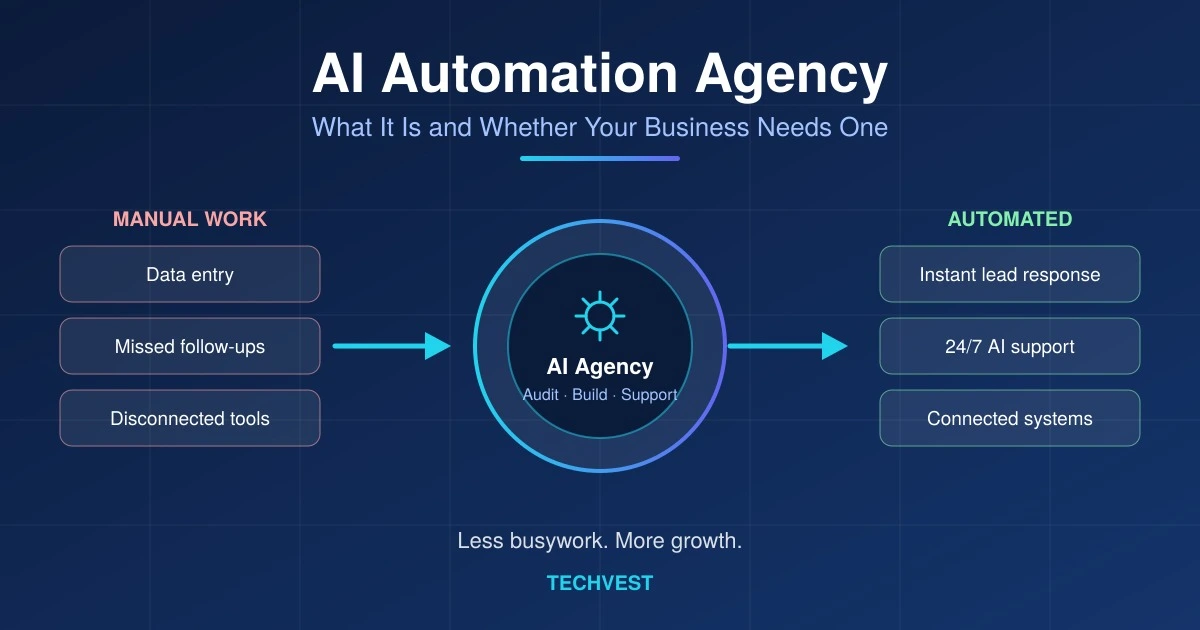
Most business owners know the feeling. The team is busy all day, yet leads still slip through, invoices go out late, and the same questions land in the inbox again and again. The work is real, but a lot of it is repetitive, and repetitive work is exactly what modern AI automation is built to handle.
That is where the AI automation agency comes in. This guide explains what one is, what it does, what it costs you in time and money, and how to decide whether your business needs one.
An AI automation agency is a specialist firm that designs, builds, and maintains automated systems powered by artificial intelligence. Instead of selling you software and leaving you to figure it out, an AI agency studies how your business runs, finds the tasks that drain time, and replaces them with workflows that run on their own.
Think of it as an outsourced automation department. You get strategists, engineers, and integration specialists without hiring each one full time.
It helps to separate three ideas that often get mixed up:
A good agency does not just switch on features. It decides which processes deserve automation, builds them properly, tests them, and keeps them running after launch.
The exact services vary, but most AI agencies work across a handful of areas.
Lead capture and follow-up. Inquiries from your website, ads, or social channels are captured, scored, and routed automatically. Follow-up messages go out within minutes instead of days.
Customer support. AI assistants answer common questions around the clock, collect details, and hand complex cases to a human with the full context attached.
CRM and sales workflows. Contact records update themselves, deals move through the pipeline based on real activity, and reminders appear when a prospect goes quiet.
Back-office operations. Invoicing, onboarding, scheduling, document handling, and reporting happen without someone copying data between systems.
System integration. Your CRM, accounting software, email platform, and project tools are connected so data flows between them without manual entry.
Strategy and roadmapping. Before building anything, a quality agency audits your workflows and ranks automation opportunities by impact and effort.
At Techvest, for example, the starting point is a workflow audit. The goal is to understand where your team loses hours each week, then build automation around those bottlenecks rather than around whatever tool happens to be popular.
You save time on work that does not need a human
The most obvious gain is hours back. When data entry, scheduling, reminders, and routine replies run automatically, your team can focus on conversations, decisions, and creative work that actually grow the business.
Customers and prospects notice speed. Automation can acknowledge an inquiry immediately, even at night or on weekends. Faster response often means more conversions and happier clients.
People make small mistakes when they copy information between systems or repeat the same task fifty times a day. Well-built automation does the same step the same way every time.
If growth means hiring a new person for every extra batch of customers, margins shrink. Automation lets you handle more volume with the team you already have.
AI tools change quickly. An agency works with them daily, so you benefit from tested approaches rather than paying for your own trial and error.
Not every company needs outside help right away. These signs suggest it is time to consider it.
Your team spends hours on repetitive tasks. If people regularly copy data, send the same emails, or chase status updates, that is a strong automation candidate.
Leads or requests fall through the cracks. Missed follow-ups usually mean a process problem, not a people problem.
Your tools do not talk to each other. When information lives in five systems and someone has to bridge them by hand, integration will pay off.
You tried DIY automation and it stalled. Many businesses start with no-code tools, build a few zaps, and then watch them break or become impossible to manage. An agency can stabilize and expand what you started.
You are growing and processes are straining. What worked at ten customers often fails at a hundred.
You do not have technical staff. If nobody on your team can design or maintain automated systems, outside help is usually faster than hiring.
Honesty matters here. An AI agency may be premature if:
A trustworthy agency will tell you when something should not be automated. If every idea sounds like a perfect fit, be cautious.
Choosing between these three routes comes down to speed, cost, and control.
Agency. Fastest to results, access to a broad skill set, flexible spending, and ongoing support. You depend on an outside partner, so choosing a good one matters.
In-house team. Maximum control and deep company knowledge, but hiring is slow and expensive, and you carry the burden of keeping skills current.
DIY tools. Cheap to start and fine for simple tasks. The tradeoff is time, a learning curve, and systems that can become fragile as complexity grows.
Many businesses combine approaches. An agency builds the foundation and trains the team, who then manage day-to-day adjustments. This keeps knowledge inside the company while avoiding a slow start.
Knowing the typical process helps you judge whether a partner is credible.
Starting small is usually smartest. Pick one high-impact workflow, such as lead follow-up or support triage, prove the result, and expand from there.
The label “AI agency” is used loosely, so evaluate carefully.
Look for a process-first approach. The best agencies begin with your goals and workflows, not with a list of tools.
Ask for evidence. Case studies and specific outcomes, such as hours saved or response times cut, show real experience.
Check integration skills. Your automation must work with the software you already use. Be wary of any agency that wants you to replace everything.
Demand clear scope and pricing. You should know what is included, what is not, and what happens if the project grows.
Confirm ongoing support. Automations need maintenance. Ask who monitors them after launch and how problems are handled.
Ask about data security. Your agency will handle customer and business data, so understand how it is stored, accessed, and protected.
Watch for honesty. A partner who points out limitations is more valuable than one who promises everything.
Questions worth asking before you sign:
Starting with the tool instead of the problem. Choose the outcome first, then the technology.
Automating too much at once. Big-bang projects are hard to test and harder to fix. Phase the work.
Ignoring your team. People adopt automation more easily when they understand how it helps them, not replaces them.
Skipping measurement. Decide in advance what success looks like, whether that is hours saved, faster replies, or fewer errors.
Treating automation as set-and-forget. Software updates and business changes mean workflows need regular review.
Ask yourself these four questions:
If you have plenty of repetitive work, limited technical capacity, and a need for speed, an AI automation agency is likely a strong fit. If your processes are still undefined or your volume is small, begin by documenting your workflows and revisit the question as you grow.
AI automation is no longer reserved for large corporations with technical departments. Small and mid-sized businesses can now automate lead handling, support, reporting, and operations in ways that were out of reach a few years ago. The challenge is not whether the technology works. It is knowing what to automate, building it well, and keeping it running.
That is the value an AI agency offers. It turns a vague idea about using AI into a working system tied to real business results. Whether your business needs one depends on how much repetitive work you carry, how fast you want to move, and how much technical capacity you have in-house.
If you are exploring this path, start with an honest audit of where your time goes. Partners like Techvest can help you map those opportunities and turn them into a practical automation roadmap, so you spend less time on busywork and more time on growth.




