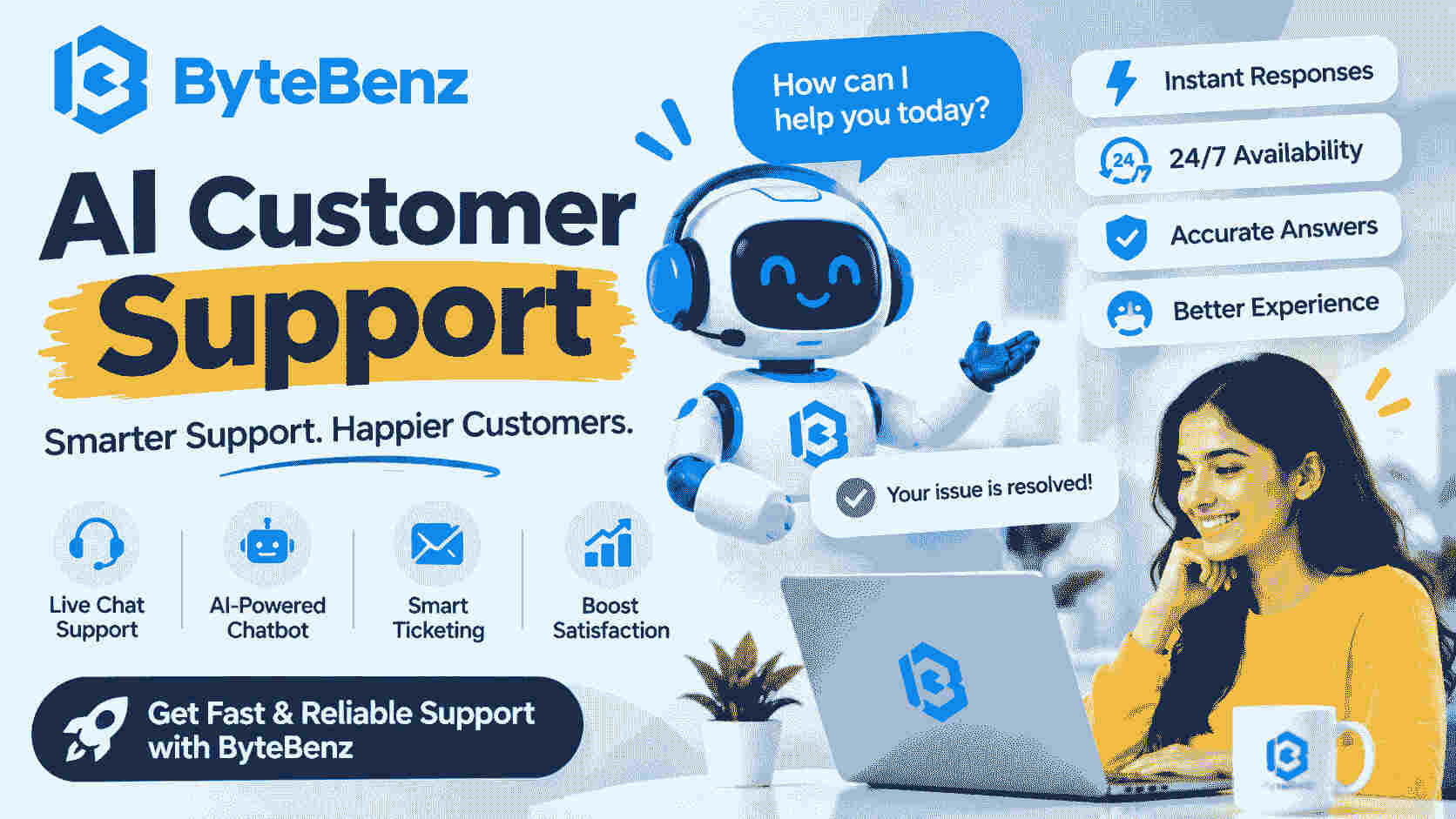

Customer expectations are changing rapidly. People want quick answers, personalized assistance, and support whenever they need it. Traditional customer service teams often struggle to meet these expectations, especially when businesses receive a high volume of customer inquiries. This is where AI Customer Support is becoming an important part of modern business operations.
Artificial intelligence helps companies automate repetitive support tasks, respond to common questions, understand customer needs, and improve service efficiency. Instead of replacing human agents completely, AI can work alongside support teams to make customer interactions faster and more convenient.
In this guide, we will explore how AI-powered customer service works, its major benefits, practical applications, challenges, and ways businesses can implement it successfully.
What Is AI Customer Support?
AI Customer Support refers to the use of artificial intelligence technologies to assist customers, answer questions, and manage service-related tasks. It uses technologies such as machine learning, natural language processing (NLP), chatbots, and generative AI to understand customer requests and provide relevant responses.
For example, when a customer visits an online store and asks about an order, an AI-powered chatbot can retrieve order information and provide an update without requiring a human agent.
AI-powered systems can also:
- Answer frequently asked questions.
- Provide product and service information.
- Help customers troubleshoot common problems.
- Route complex inquiries to the right department.
- Summarize customer conversations for support agents.
- Analyze customer feedback and interaction patterns.
These capabilities help businesses manage support operations while maintaining a consistent customer experience.
How Does AI-Powered Customer Support Work?
AI-powered support systems combine different technologies to understand customer messages and determine the most appropriate response.
1. Natural Language Processing
Natural Language Processing allows AI systems to understand human language. Customers can communicate using everyday words instead of following fixed commands.
For example, a customer might ask, “Where is my order?” The system identifies the intent and retrieves the relevant order information if it has access to the required data.
2. Machine Learning
Machine learning helps AI systems identify patterns in customer interactions. As models are improved using appropriate data and feedback, they can become better at recognizing common questions and predicting customer needs.
3. AI Chatbots and Virtual Assistants
Chatbots can handle routine conversations, guide customers through simple processes, and provide support outside regular business hours. More advanced virtual assistants can manage multi-step requests when connected to approved business systems.
4. Generative AI
Generative AI can create natural-language responses based on customer questions and available information. Businesses can use it to draft replies, summarize conversations, and help agents find relevant information.
However, responses should be grounded in reliable company information and checked carefully when accuracy is important.
Key Benefits of AI Customer Support for Businesses
Implementing AI Customer Support can improve service operations when businesses select suitable use cases and monitor performance.
1. Faster Response Times
Customers do not always want to wait in a queue for simple answers. AI chatbots can respond immediately to common questions, such as delivery updates, account instructions, business hours, and return policies.
This reduces unnecessary waiting and allows customers to find basic information more easily.
2. 24/7 Customer Assistance
Traditional support teams usually work within scheduled hours. AI-powered tools can provide automated assistance at any time, including weekends and holidays.
This is especially useful for online businesses that serve customers across different time zones.
3. Reduced Workload for Support Teams
Support agents often spend significant time answering repetitive questions. AI can handle suitable routine inquiries and help organize incoming requests.
As a result, human agents can focus on complicated problems that require judgment, empathy, or individual attention.
4. More Consistent Customer Experiences
AI systems can use approved knowledge bases and standardized response guidelines to provide consistent information across customer conversations.
Businesses should regularly review their knowledge sources to prevent outdated or inaccurate answers.
5. Better Customer Insights
AI tools can analyze conversation trends, identify frequently reported problems, and highlight common customer concerns.
These insights can help companies improve products, update help documentation, and identify areas where their service processes need attention.
6. Improved Operational Efficiency
Automating repetitive tasks can reduce manual effort and help businesses manage increasing support volumes without immediately expanding their teams.
The actual savings depend on implementation costs, integration requirements, support volume, and the complexity of customer requests.
Common Applications of AI in Customer Service
Businesses across different industries can use AI in several areas of customer service.
E-commerce and Online Shopping
Online stores can use AI to answer questions about product availability, delivery status, order tracking, returns, and refund policies.
For example, an AI assistant connected to an order management system can help customers check the status of their purchases.
Banking and Financial Services
Financial institutions may use AI assistants to answer general questions about account services, explain basic processes, and guide customers to relevant support resources.
Sensitive transactions and account-related decisions should follow appropriate identity verification and security procedures.
Healthcare Services
Healthcare organizations can use AI to help patients find appointment information, understand administrative procedures, and access general service details.
AI should not replace qualified medical professionals or independently make clinical decisions.
Telecommunications
Telecom companies can use automated assistants to answer billing questions, explain service plans, guide customers through basic troubleshooting, and direct technical issues to support specialists.
Travel and Hospitality
Hotels, airlines, and travel companies can use AI to answer booking questions, share travel information, explain cancellation policies, and assist with common reservation requests.
AI Chatbots vs. Human Customer Support Agents
AI and human agents offer different strengths. A successful service strategy uses each where it is most effective.
|
Area |
AI Support |
Human Support |
|
Availability |
Can provide automated assistance around the clock |
Usually follows scheduled shifts |
|
Response speed |
Fast for supported routine questions |
Depends on workload and complexity |
|
Repetitive tasks |
Suitable for automation |
Can become time-consuming |
|
Empathy |
Limited ability to understand emotional context |
Better suited to sensitive conversations |
|
Complex problems |
Depends on system capabilities and integrations |
Can apply judgment and experience |
|
Personalization |
Uses available customer data and context |
Can adapt through direct interaction |
The best approach is not necessarily to choose one over the other. AI can manage routine requests, while human agents handle sensitive, unusual, and complex situations.
Challenges of Implementing AI in Customer Support
Although AI offers several advantages, businesses should understand its limitations before adopting it.
1. Inaccurate or Misleading Responses
AI systems may generate incorrect information or misunderstand a customer’s request. This can damage customer trust.
Solution: Connect AI tools to reliable business information, establish response boundaries, and provide a clear option to contact a human agent.
2. Data Privacy and Security
Customer support conversations may contain personal or confidential information. Poor data handling can create privacy and security risks.
Solution: Use appropriate access controls, data protection practices, encryption, and vendor security reviews. Collect only the information needed for the intended task.
3. Integration Difficulties
AI tools may need to connect with CRM platforms, order management systems, help desks, and internal databases.
Solution: Review existing systems and integration requirements before selecting a solution. Start with a limited use case before expanding.
4. Lack of Human Interaction
Some customers prefer speaking with a real person, particularly when dealing with complaints or sensitive matters.
Solution: Make human escalation easy to find. AI should support customer service teams rather than create barriers to reaching them.
5. Implementation and Maintenance Costs
AI software may involve subscription fees, integration expenses, training, monitoring, and ongoing maintenance.
Solution: Begin with a practical business case and compare the expected benefits with the total cost of ownership.
How to Implement AI Customer Support Successfully
A structured implementation process helps businesses avoid unnecessary complexity and focus on measurable outcomes.
Step 1: Identify Repetitive Support Tasks
Review customer inquiries and identify questions that appear frequently. Order tracking, business hours, product information, and basic troubleshooting may be suitable starting points.
Step 2: Select the Right AI Tools
Compare tools based on features, integration capabilities, security, pricing, scalability, and ease of use. Choose technology that addresses actual customer service problems.
Step 3: Build a Reliable Knowledge Base
Prepare accurate FAQs, product documentation, policies, troubleshooting guides, and other approved information. Keep these resources updated so the AI system can provide relevant answers.
Step 4: Start With a Small Pilot
Introduce AI for a limited category of customer inquiries. Monitor how accurately it responds and whether customers can complete their tasks successfully.
Step 5: Train Employees
Support agents should understand how the AI system works, how to review its responses, and when to take over a conversation.
Step 6: Monitor and Improve Performance
Track response accuracy, resolution rates, customer satisfaction, escalation rates, and other relevant indicators. Use the findings to improve workflows and update the knowledge base.
Important Metrics to Measure AI Support Performance
Businesses should measure more than the number of conversations handled by AI. Useful performance indicators include:
- First Response Time: How quickly customers receive an initial response.
- First Contact Resolution: The percentage of inquiries resolved during the first interaction.
- Customer Satisfaction Score (CSAT): How satisfied customers are with the support experience.
- Average Resolution Time: How long it takes to resolve a customer issue.
- Escalation Rate: The percentage of conversations transferred to human agents.
- AI Response Accuracy: How often AI provides correct and relevant information.
- Cost per Resolution: The average cost of resolving a customer inquiry.
Comparing these metrics before and after implementation can help businesses understand whether their AI investment is delivering meaningful improvements.
The Future of AI in Customer Support
AI-powered customer service is moving beyond basic question-and-answer chatbots. Businesses are exploring more advanced systems that can understand context, assist employees, and coordinate tasks across connected applications.
Some emerging developments include:
More Personalized Conversations
AI systems may use relevant customer history and preferences to provide more contextual assistance, subject to appropriate data permissions and privacy safeguards.
Voice-Based AI Assistants
Voice technology is making it possible for customers to interact with automated assistants through spoken conversations. These systems may help manage routine requests and direct complex issues to human agents.
AI-Assisted Human Agents
AI can help support employees by summarizing conversations, suggesting responses, retrieving knowledge-base articles, and organizing customer information.
AI Agents and Workflow Automation
AI agents are being developed to perform multi-step tasks through connected business systems. For example, an appropriately configured agent might collect information, check an order, and initiate an approved service workflow.
Businesses should introduce such capabilities gradually, with clear permissions, monitoring, and human oversight.
Conclusion
Artificial intelligence is changing how businesses manage customer interactions. From answering common questions to supporting human agents and analyzing customer feedback, AI offers practical ways to improve service efficiency and accessibility.
However, successful implementation requires more than selecting a chatbot. Businesses need reliable information, secure integrations, employee training, clear escalation processes, and regular performance reviews.
When implemented thoughtfully, AI Customer Support can help organizations deliver faster assistance while allowing human employees to focus on conversations that require personal attention and judgment. The goal should be a balanced customer service experience where technology and people work together.
Frequently Asked Questions (FAQs)
1. What is AI Customer Support?
AI Customer Support uses artificial intelligence technologies such as chatbots, machine learning, and natural language processing to answer customer questions and assist with service-related tasks.
2. How does AI improve customer service?
AI can provide faster responses to common inquiries, automate repetitive tasks, offer assistance outside business hours, and help support agents access relevant information.
3. Can AI completely replace human customer service agents?
No. AI can manage suitable routine tasks, but human agents remain important for complex problems, emotional situations, exceptions, and decisions that require judgment.
4. Are AI chatbots available 24/7?
Many AI chatbots can provide automated assistance around the clock, provided the service and its supporting systems are available.
5. Is AI customer service suitable for small businesses?
Yes. Small businesses can begin with affordable chatbot solutions for FAQs, appointment information, order updates, and other repetitive inquiries.