
Introduction
Starting a career after graduation can be challenging when you have limited practical experience or are unsure which technical skills employers expect. Job-oriented IT training can help freshers connect theoretical knowledge with practical tasks, develop confidence, and prepare for entry-level opportunities.
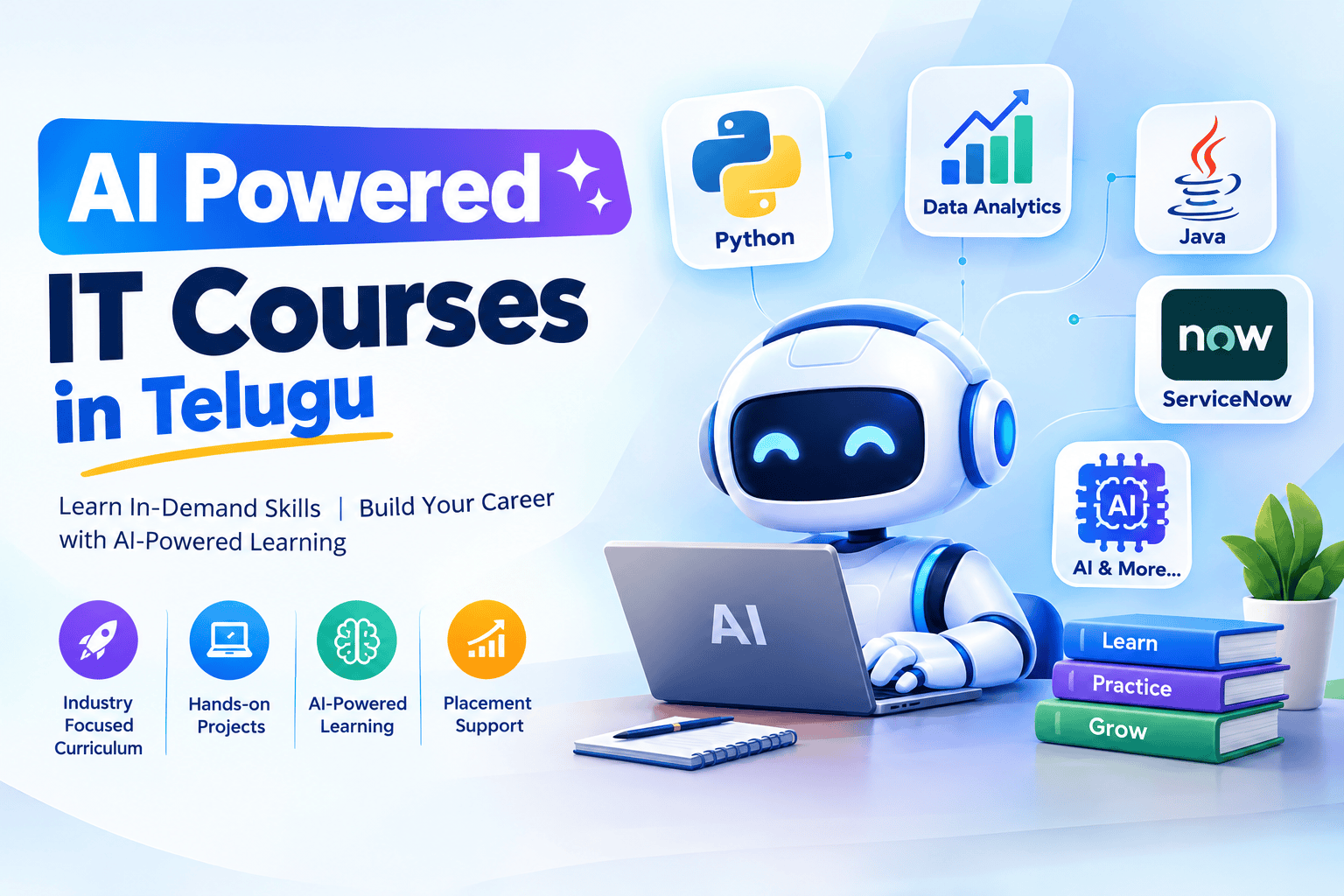
AI Powered IT Courses in Telugu can support this process by explaining technical concepts in an accessible way and introducing learners to practical tools. However, choosing a course should involve more than checking its title or advertised placement claims. The syllabus, project work, learning support, and relevance to target roles all matter.
What Is Job-Oriented IT Training?
Job-oriented training focuses on developing skills related to specific job responsibilities. Rather than concentrating only on theory, it combines technical lessons with assignments, projects, and problem-solving activities.
For example, a software development course may include programming exercises and application building. A data analytics course may focus on SQL, data cleaning, and dashboard creation. Cybersecurity training may introduce networking, security monitoring, and incident analysis.
The goal is to help learners understand how their knowledge can be applied to practical workplace tasks.
Popular IT Courses for Freshers
1. Java Full Stack Development
Java Full Stack Development is suitable for learners interested in creating web applications. Training may cover Java, object-oriented programming, databases, front-end development, APIs, and application testing.
A practical project could involve building a basic registration system connected to a database. This helps learners understand how different application components work together.
2. Python Programming and AI
Python programming introduces coding fundamentals and can lead toward automation, analytics, and AI applications. Freshers should begin with basic syntax, functions, data structures, and file handling before exploring specialized libraries.
AI tools can assist with practice exercises and explanations, but learners must understand and test their code independently.
3. Data Analytics
Data Analytics is an option for learners interested in working with business information. Courses may cover spreadsheets, SQL, data visualization, statistics, and tools such as Power BI.
Projects involving sales reports or customer datasets can help learners practice cleaning data, identifying patterns, and presenting findings.
4. Cybersecurity and SOC Analyst Training
Cybersecurity training introduces networking fundamentals, operating systems, security principles, log analysis, and threat monitoring. Learners can practice identifying suspicious activity using sample logs in an authorized lab environment.
This path requires attention to detail, analytical thinking, and a strong understanding of security fundamentals.
5. Cloud Computing and DevOps
Cloud computing and DevOps training may cover Linux, networking, cloud infrastructure, version control, automation, and software deployment. Freshers should build foundational knowledge before moving to complex cloud architectures or production environments.
What Should a Good IT Training Course Include?
Before enrolling, evaluate the course against your career objectives. A suitable program should provide:
- A structured syllabus that progresses from fundamentals to advanced topics.
- Hands-on exercises that reinforce important concepts.
- Practical projects relevant to the target role.
- Trainer or mentor support for clarifying doubts.
- Interview preparation involving technical questions and project discussions.
- Learning resources that allow revision and independent practice.
Telugu explanations can make difficult concepts easier to understand, while exposure to English technical terminology helps learners prepare for documentation and workplace communication.
How AI Tools Can Help Freshers Prepare
AI tools can generate mock interview questions, explain unfamiliar technical terms, suggest coding exercises, and help organize study plans. Freshers can also use them to practice describing projects or revising key concepts.
Nevertheless, AI-generated information should be checked for accuracy. Do not submit work you cannot explain, and avoid sharing confidential information. Employers may evaluate your actual understanding through practical tests and technical interviews.
Build a Resume and Prepare for Interviews
After completing foundational training, create a resume that highlights relevant skills, academic projects, personal projects, and certifications. Include specific details about what you built and the tools you used.
Practice explaining the purpose of each project, the challenges you faced, and how you resolved them. Review basic technical questions and apply for internships, trainee positions, or entry-level roles that match your abilities.
Course completion does not guarantee a job. Employment outcomes depend on practical competence, communication, interview performance, employer requirements, and market conditions.
Quick Answers
- What is job-oriented IT training? It combines technical learning with practical exercises and job-related preparation.
- Which course is best for freshers? Consider Java Full Stack, Python, Data Analytics, Cybersecurity, or Cloud Computing based on your interests.
- Are Telugu IT courses helpful for beginners? They can make concepts easier to understand when combined with practical work.
- Can a course guarantee placement? No. Review course support carefully and develop demonstrable skills.
Frequently Asked Questions (FAQs)
1. Can freshers join IT training without experience?
Yes. Many introductory courses are designed for beginners, although some specialized programs require prior knowledge.
2. How many projects should I include on my resume?
Focus on a few relevant projects that you can explain clearly. Quality, practical relevance, and your understanding matter more than the number alone.
3. Is certification enough to get an IT job?
Certification may support your profile, but employers may also evaluate practical skills, projects, and problem-solving ability.
4. How can I prepare for technical interviews?
Revise fundamentals, practice role-specific questions, review your projects, and explain your solutions in a clear, structured way.
Conclusion
Job-oriented training can help freshers move from academic knowledge toward practical IT skills. AI Powered IT Courses in Telugu can provide an accessible learning path across software development, analytics, cybersecurity, cloud computing, and AI. Choose a course aligned with your goals, complete relevant projects, and prepare consistently to improve your readiness for entry-level opportunities.